







New improvements make the Camino more inclusive than ever
The Camino de Santiago continues to evolve in 2026, with new efforts focused on improving accessibility for people with disabilities and reduced mobility. While there is no single official announcement of fully new large-scale “accessible routes” opened this year, ongoing projects across Spain are gradually making different stretches of the Camino easier to navigate for a wider range of pilgrims.
These improvements reflect a broader trend: the Camino is becoming more inclusive, not through one major change, but through continuous upgrades in infrastructure, services, and awareness.
Accessibility: a growing priority on the Camino
In recent years, accessibility has become a key issue in the development of the Camino de Santiago. Public institutions, local governments, and organizations have been working to adapt sections of the route so that more people can experience it.
This includes:
- Improved path surfaces in certain stretches
- Better signage and clearer markings
- Adapted accommodation options
- Information resources for pilgrims with disabilities
These changes are not uniform across all routes, but they are increasingly visible, especially on the most popular paths.
Which Camino routes are more accessible today
Some sections of the Camino are more suitable than others for people with reduced mobility.
The most accessible stretches are typically found on:
- The Camino Francés (especially the last 100 km from Sarria)
- The Camino Portugués (from Tui or Porto)
- The Camino Inglés (shorter and more manageable)
These routes tend to have better infrastructure, more services, and easier terrain compared to longer or more remote paths like the Vía de la Plata or the Camino Primitivo.
The role of organizations and associations
Accessibility improvements on the Camino are often driven by organizations rather than a single central authority.
Groups such as disability associations, local Camino societies, and tourism boards have played a key role in:
- Mapping accessible stretches
- Promoting inclusive pilgrimages
- Providing adapted travel guides
- Supporting group initiatives
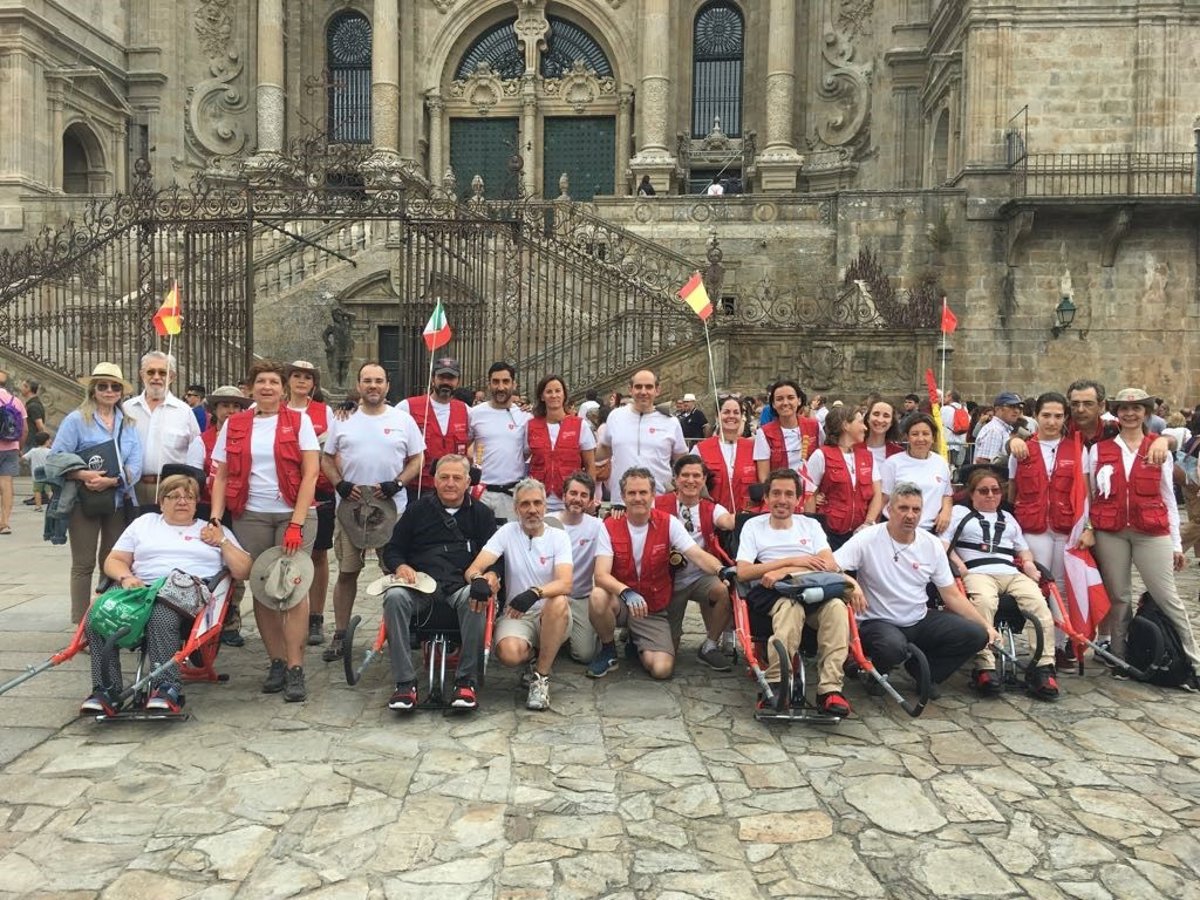
In some cases, guided pilgrimages for visually impaired or mobility-restricted pilgrims have been organized, demonstrating that the Camino can be experienced in different ways.
Technology and information: key tools for inclusion
One of the biggest changes in recent years is the availability of information.
Pilgrims with disabilities now have access to:
- Detailed route descriptions
- Accessibility reports for accommodation
- GPS-based navigation tools
- Mobile apps adapted for different needs
This allows better planning and reduces uncertainty, which is essential for many travelers.
Rather than relying only on physical infrastructure, accessibility today also depends on access to reliable information.
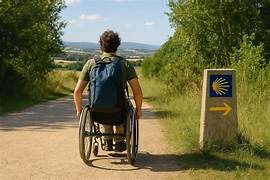
A different way of experiencing the Camino
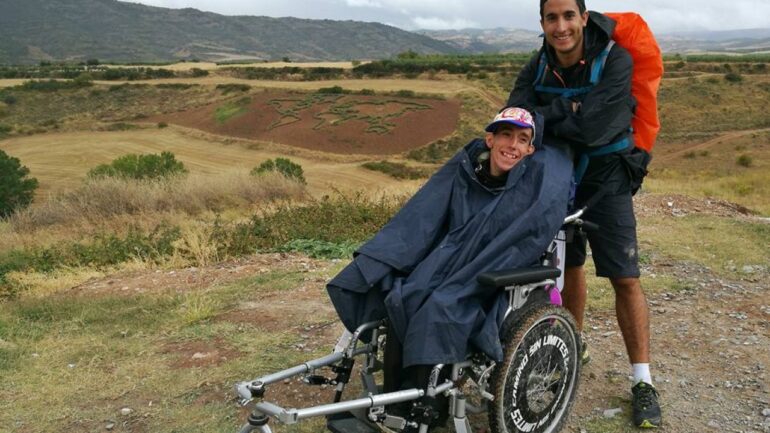
Walking the Camino with a disability often requires a different approach. Some pilgrims walk shorter stages, others use adapted bicycles or travel with assistance.
But the essence of the Camino remains the same.
Many pilgrims report that accessibility challenges do not diminish the experience—in some cases, they even deepen it. The focus shifts toward connection, resilience, and shared moments.
The Camino becomes less about distance and more about the journey itself.
Challenges that still exist
Despite progress, accessibility on the Camino is still uneven.
Some of the main challenges include:
- Irregular terrain in rural areas
- Limited adapted accommodation in certain stages
- Lack of consistent standards across regions
- Occasional gaps in information
This means that planning remains essential, especially for those with specific mobility needs.
The Camino is improving, but it is not yet fully accessible in all sections.
The importance of gradual progress
One of the key aspects of accessibility on the Camino is that change happens gradually.
Instead of large-scale transformations, improvements are often small but meaningful:
- A better-marked path
- A newly adapted hostel
- A more accessible town entrance
Over time, these changes add up and make a real difference.
An inclusive vision of the Camino
The idea that the Camino belongs to everyone is not new, but it is becoming more visible.
The growing number of pilgrims with different abilities highlights an important shift: the Camino is not limited to one type of traveler.
People of different ages, backgrounds, and physical conditions are finding ways to experience it.
This diversity is becoming part of the Camino’s identity.
Conclusion: a Camino that opens step by step
In 2026, the Camino de Santiago is not fully accessible—but it is clearly moving in that direction.
Through gradual improvements, better information, and growing awareness, more people than ever can take part in the experience.
The Camino continues to adapt without losing its essence.
And perhaps that is what defines it best: a path that evolves, step by step, while remaining open to everyone willing to walk it—whatever their pace or ability.