











For centuries, pilgrims have walked to Santiago de Compostela seeking faith, forgiveness, reflection, adventure or simply a few days away from ordinary life.
But in 2026, some residents of Santiago are asking a rather different question:
When did the end of the Camino become a party zone?
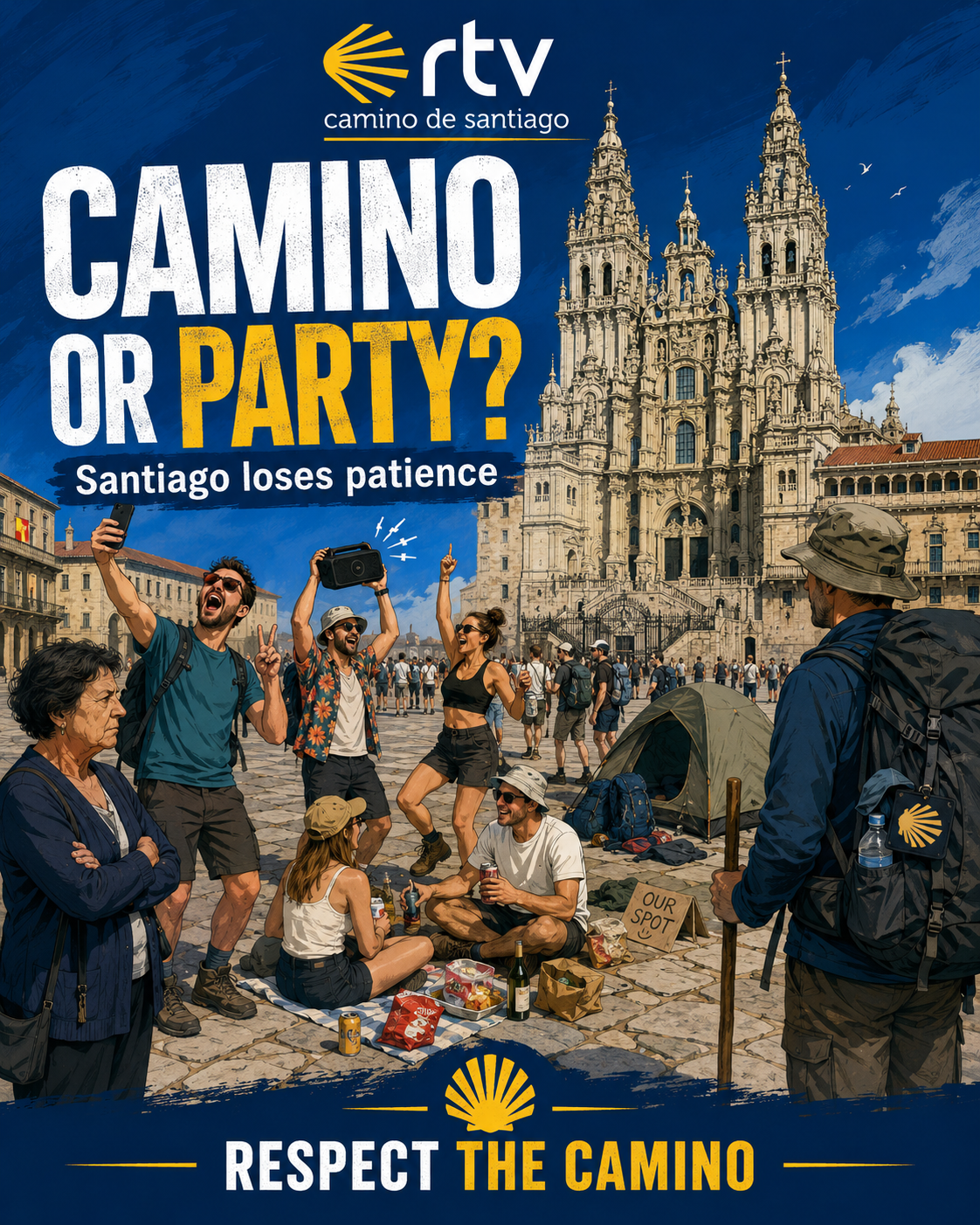
Reports published this summer describe pilgrims arriving in the historic centre shouting, singing, dancing, playing loud music, holding picnics and drinking in public spaces. There have also been complaints about people bathing naked in fountains, pitching tents and even using camping stoves around the Praza do Obradoiro.
Yes. A camping stove.
In front of one of the most important pilgrimage destinations in Europe.
At some point, someone apparently looked at the magnificent façade of Santiago Cathedral and thought:
“Lovely. Perfect place to cook dinner.”
From spiritual arrival to viral celebration
Most pilgrims still arrive in Santiago exactly as you would expect.
Tired.
Emotional.
Some cry.
Some hug strangers they met hundreds of kilometres earlier.
Some simply sit quietly in the square and stare at the Cathedral.
But the sheer number of arrivals has changed the atmosphere, particularly during the busiest summer weeks.
More than 376,000 pilgrims had already reached Santiago this year when The Times reported on the growing tensions, while earlier this month Europa Press described thousands of walkers filling the Obradoiro and long queues forming to enter the Cathedral.
More pilgrims are good news for hotels, restaurants, shops and thousands of businesses along the routes.
But success has consequences.
And Santiago is beginning to feel them.
“The Obradoiro has become a campsite”
Residents interviewed by Spanish media have complained that the main square and the streets of the historic centre are increasingly being treated as entertainment spaces rather than a living neighbourhood.
One July report described complaints about people having picnics, drinking alcohol and bathing naked in public fountains, with residents saying the Obradoiro was becoming a kind of camping area.
Other locals have spoken publicly about pilgrims stripping off in the square and disturbing residents with noise.
Nobody is suggesting that pilgrims should reach Santiago in complete silence, walking in single file while Gregorian chants play in the background.
Finishing the Camino deserves celebration.
After 100, 300, 800 or even 1,000 kilometres, hugging your companions, laughing, taking photographs or opening a bottle to celebrate is hardly a crime.
But there is a difference between celebrating an arrival and behaving as though the historic centre of Santiago were a festival campsite.
The Camino has changed
The Camino de Santiago is experiencing extraordinary popularity.
That success has made the routes more international, more accessible and economically important to hundreds of towns.
It has also produced something increasingly visible:
the Camino as entertainment.
The Camino as challenge.
The Camino as social-media content.
The Camino as bachelor-party atmosphere.
And sometimes the Camino as a stage where the objective seems less about reaching Santiago and more about attracting attention while doing it.
None of this means that there was some mythical golden age when every pilgrim was a medieval monk walking barefoot in absolute silence.
Pilgrims have always eaten, drunk, laughed and celebrated.
But the scale is different now.
And scale changes everything.
You do not need to be religious to respect Santiago
This is perhaps the most important point.
The Camino is not reserved for Catholics.
You do not have to believe in Saint James.
You do not need to attend Mass.
You do not even need to describe yourself as a pilgrim.
Millions walk because they love nature, history, culture, friendship or simply the challenge.
But none of that makes the meaning of the destination irrelevant.
The Camino ends at Santiago because this city grew for centuries around the tradition of the Apostle’s tomb.
That history is what created the pilgrimage.
Without it, there would be no yellow arrows, no pilgrim credentials, no Compostela and probably no global Camino phenomenon as we know it today.
Respecting that does not require faith.
It requires only a little common sense.
Santiago is not Disneyland
This may be the uncomfortable conversation the Camino now needs.
The huge popularity of the routes is worth celebrating.
But popularity should not mean that every place along the Camino becomes merely a backdrop for our photographs, videos and celebrations.
People actually live in Santiago.
They sleep there.
They work there.
They raise families there.
And the monumental centre is not a theme park built exclusively for the person arriving with a backpack.
The Camino belongs to pilgrims.
But Santiago also belongs to Santiago.
Perhaps the simplest rule is also the oldest one on the entire route:
walk through someone else’s home as you would want them to walk through yours.
Celebrate when you reach the Obradoiro.
Cry.
Laugh.
Take the photograph you have been imagining for 500 kilometres.
Hug everyone.
You have earned it.
But maybe leave the tent, the loudspeaker and the camping stove for somewhere else.
Buen Camino. And good manners.