







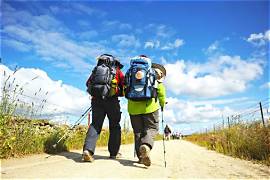
Americans, French, South Koreans and Italians are transforming one of the great starting points of the Camino de Santiago — and another surprising figure challenges the idea that the route belongs mainly to young backpackers
Walk into the pilgrim hostel at Roncesvalles and you could be forgiven for wondering whether you are still in Spain.
English, French, Korean, Italian and countless other languages mix around dinner tables and backpacks. Pilgrims who were complete strangers a few hours earlier compare blisters, discuss tomorrow’s weather and ask the most universal question on the Camino: Where are you from?
New figures reveal just how international this legendary gateway to the Camino de Santiago has become.
During the first six months of 2026, 85.5% of pilgrims registered at the Roncesvalles hostel came from outside Spain. Of 19,319 pilgrims recorded between January and June, 16,515 were international visitors, while 2,804 were Spanish.
The figures offer a fascinating snapshot of what the Camino has become: one of the world’s great international journeys.
And some of the countries appearing near the top may surprise you.
Americans are now one of the biggest groups
Spain remains the largest individual nationality, with 2,804 pilgrims, representing 14.5% of registrations.
But only just.
France contributed 2,593 pilgrims, or 13.5%, while the United States was close behind with 2,327 walkers — 12.1% of everyone registered.
That American presence is particularly significant.
For many US travellers, walking the Camino means crossing the Atlantic before taking the first step. It requires considerably more planning, travel and expense than it does for most European pilgrims.
Yet thousands are choosing to do exactly that.
The Camino is no longer simply a Spanish or European phenomenon.
It has become a genuinely global destination.
South Korea’s extraordinary love affair with the Camino
Perhaps the most remarkable figure comes from South Korea.
A total of 2,047 South Korean pilgrims were registered at Roncesvalles during the first half of the year, representing 10.6% of the total.
That puts South Korea only 757 pilgrims behind Spain itself at this particular point on the Camino.
For a country thousands of miles from northern Spain, it is an extraordinary presence.
South Korea’s fascination with the Camino has developed over many years, helped by books, television programmes, personal accounts and a growing culture around long-distance walking and personal reflection.
Today, hearing Korean spoken in an albergue on the Camino Francés is no longer unusual.
It is part of the Camino.
Italy completes a remarkably international picture
Italian pilgrims also have a strong presence.
Between January and June, 1,542 Italians were recorded at Roncesvalles, accounting for 8% of the total.
Put these figures together and something becomes clear.
A pilgrim beginning the long journey from the Pyrenees is not simply walking across Spain.
They are joining a temporary international community.
At breakfast, your table companion might be French.
By lunchtime, you could be walking with an American.
That evening, you may share dinner with Koreans and Italians.
And tomorrow you may all walk together without speaking the same language particularly well.
That is one of the Camino’s most extraordinary qualities.
Why Roncesvalles tells a different story
There is an important detail behind these statistics.
Roncesvalles is still approximately 750 kilometres from Santiago de Compostela and is one of the classic gateways to the Camino Francés.
That means its figures cannot simply be compared with statistics from Santiago.
Many people arriving in Compostela begin much closer to the destination, particularly on the hugely popular final sections of the Camino.
Roncesvalles captures a different kind of pilgrim: someone standing near the beginning of a very long journey across northern Spain.
That may partly explain the exceptionally international profile.
For overseas visitors travelling to Europe specifically to walk the Camino, completing a long section — or even the entire Camino Francés — remains a powerful ambition.
The biggest surprise isn’t nationality. It’s age.
There is another statistic that challenges one of the stereotypes surrounding the Camino.
Forget the idea that the route is dominated by twenty-something backpackers.
The largest age group recorded at Roncesvalles was actually 61 to 70 years old, with 5,150 pilgrims.
The second largest was 51 to 60, with another 4,350.
Together, those two groups accounted for 9,500 people — almost half of all pilgrims recorded during the six-month period.
The 21-to-30 group, by comparison, recorded 3,194 pilgrims.
For tourism businesses and destinations along the Camino, this is an important detail. A huge proportion of long-distance pilgrims are mature travellers with very different requirements, budgets and travel habits from the stereotypical young backpacker.
Why are they walking?
The answer is equally interesting.
The largest share of respondents, 39.5%, identified spirituality as their motivation for undertaking the journey. Another 18.2% specifically cited religious reasons.
Only 9.1% identified the physical challenge as their main motivation.
People may discover the Camino through Instagram, YouTube, a film or a friend’s recommendation.
But once they decide to walk hundreds of kilometres, many are searching for something deeper than a holiday.
Some want silence.
Others need time to think.
Some are recovering from difficult periods in their lives.
Others simply want to disconnect from a world that rarely stops moving.
The reasons are intensely personal.
Yet they all end up following the same yellow arrows.
One figure sounds a note of caution
Not every statistic points upwards.
Roncesvalles registered 19,319 pilgrims during the first six months of 2026, compared with 21,185 during the equivalent period of 2025.
That represents a decline of 8.81%.
Annual figures also show that numbers at Roncesvalles peaked recently at 49,503 in 2023 before falling to 47,064 in 2024 and 42,215 in 2025.
It will therefore be important to watch whether the decline continues or whether the remainder of 2026 changes the picture.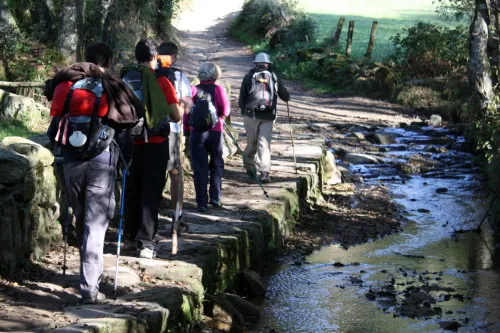
More than 90% still arrive on foot
Despite the enormous transformation of the Camino — luggage transfers, booking apps, private accommodation and increasingly sophisticated services — one tradition remains overwhelmingly dominant.
Walking.
More than 90% of pilgrims registered at Roncesvalles in 2026 arrived on foot, while bicycles represented a much smaller share.
The technology around the pilgrimage may have changed.
The fundamental act has not.
Put one foot in front of the other.
Repeat.
And keep going towards Santiago.
The world’s meeting place on two feet
Perhaps that is the real story behind the 85.5%.
The Camino de Santiago belongs to Spain geographically and is inseparable from Spanish and European history.
But culturally, something remarkable has happened.
The world has adopted it.
Americans cross the Atlantic to walk it. South Koreans travel halfway around the planet. French, Italians and dozens of other nationalities converge on the same paths.
They arrive with different passports, languages, religions and reasons for walking.
Then the Camino performs its oldest trick.
After a few days, those differences seem much less important.
Everyone is tired.
Everyone gets wet when it rains.
Everyone celebrates finding an open café.
And almost everyone understands two words:
Buen Camino.