







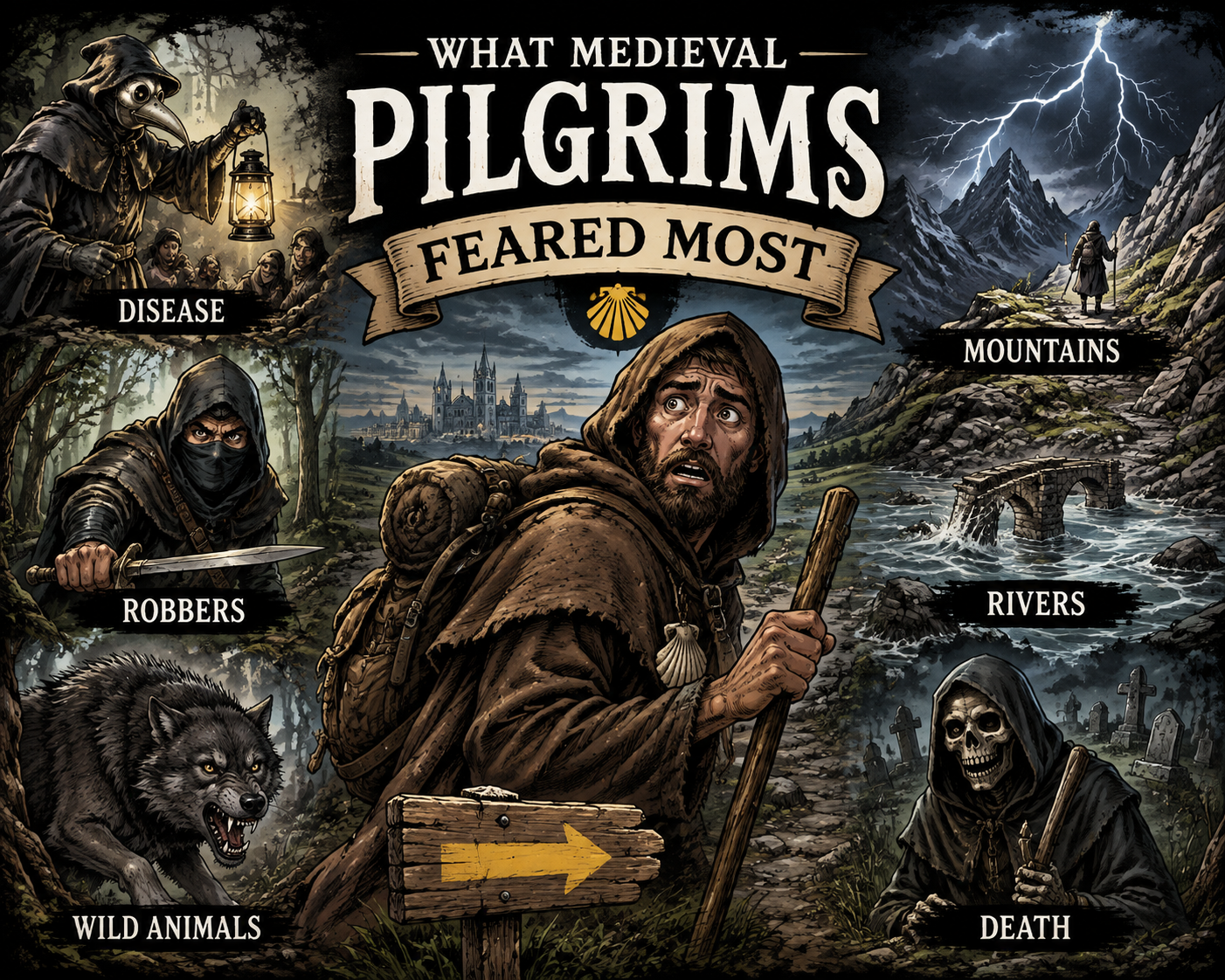
oday, walking the Camino de Santiago can mean worrying about blisters, finding a bed or whether rain will ruin the next stage. For a medieval pilgrim, the same journey could mean something very different: robbery, disease, dangerous rivers, brutal mountain crossings — and the very real possibility of never returning home.
Imagine leaving your house to walk to Santiago de Compostela eight hundred years ago.
No mobile phone.
No GPS.
No weather forecast.
No emergency number.
No modern hospitals.
And, perhaps most importantly, no certainty that you would ever see your family again.
The Camino was already one of medieval Europe’s great pilgrimage routes, bringing travellers towards Santiago from across the continent. But undertaking such a journey meant accepting risks that are difficult for a modern pilgrim to imagine.
So real were those dangers that historical research into medieval pilgrimage records travellers making wills before setting out for Santiago, aware that disease, accidents or other disasters might prevent them from returning home.
1. Disease: the invisible enemy
Perhaps the greatest danger did not carry a sword.
It could begin with contaminated water, spoiled food, an infected wound or an illness contracted while sleeping among other travellers.
There were no antibiotics and medical knowledge was extremely limited by modern standards. Something that today might require a visit to a pharmacy could become a serious problem after days of walking.
Medieval institutions understood that vulnerability.
Hospitals and hospices appeared along the pilgrimage routes to provide pilgrims with food, shelter and both physical and spiritual assistance. The Crown, the Church, religious communities and local populations all participated in developing this network of hospitality.
Some of those places would eventually become inseparable from the history of the Camino.
2. Robbers knew exactly where pilgrims were going
A pilgrim travelling hundreds or thousands of kilometres was an obvious target.
He or she might be carrying money, clothing and belongings needed for a very long journey — while travelling through unfamiliar territory.
And criminals knew it.
Historical studies of pilgrimage describe assaults by bandits on travellers, particularly around difficult passages and isolated areas.
The danger was significant enough that the medieval guide contained in the Codex Calixtinus warned pilgrims about places, people and hazards they could encounter on their journey.
The yellow arrow had not yet been invented.
But the medieval Camino already needed a travel guide.
3. Mountains were genuinely frightening
Today, crossing the Pyrenees or climbing towards O Cebreiro can be one of the great experiences of the Camino.
For a medieval traveller, mountains could be terrifying.
Weather could change rapidly. Snow could hide paths. Fog could destroy visibility. There were difficult crossings and few possibilities of obtaining rapid assistance when something went wrong.
Medieval accounts even associated mountains with fear of the unknown and, sometimes, supernatural or diabolical forces. Religious orders established shelters and hospices in strategic mountain areas partly to protect and assist travellers.
A beautiful mountain photograph for Instagram?
Not exactly.
For them, reaching the other side could be an achievement in itself.
4. Rivers could stop a pilgrimage
Bridges are so familiar on today’s Camino that we often forget what they represented.
A substantial bridge could mean survival.
Rivers without safe crossings presented a serious obstacle, especially after heavy rain. A pilgrim might depend upon ferries, primitive crossings or simply wait until conditions improved.
That helps explain why bridges, roads and hospitals became such important elements in the development of the medieval pilgrimage infrastructure.
The Camino was not merely a line drawn across a map.
It required an entire network capable of keeping people moving.
5. Hunger, exhaustion and bad weather
Modern pilgrims can normally check where the next café or supermarket is located.
A medieval traveller could not.
Food availability varied enormously. Bad harvests and periods of famine affected Europe repeatedly, and pilgrims were especially vulnerable because they were far from their own communities and resources.
The Camino itself survived extraordinarily difficult periods, including the Black Death of the 14th century, wars, hunger and economic crises.
Add cold, rain, heat, exhaustion and inadequate clothing and a long pilgrimage became a genuine test of survival.
6. Animals — but perhaps not the ones we imagine
The medieval landscape was far less controlled than today’s.
Pilgrims crossed forests, mountains and rural territories where encounters with animals were possible.
But the greater everyday danger may often have come from something less dramatic than a cinematic attack by wolves: horses, livestock, dogs, insects and animals encountered around roads, farms and settlements.
And when an injury occurred, the absence of modern medical treatment made even an apparently minor accident potentially serious.
7. Getting lost
There were no yellow arrows painted every few hundred metres.
No Camino app.
No Google Maps.
Medieval pilgrims depended on roads, landmarks, local knowledge, other travellers and information passed between communities.
That is one reason why Book V of the Codex Calixtinus is so extraordinary.
Written in the 12th century, it described routes through France and Spain and provided practical information about towns, sanctuaries, food, water, local customs and dangers encountered by pilgrims.
In other words, almost nine centuries before we started downloading Camino apps…
pilgrims already wanted a Camino guide.
And above everything else: death
This was the fear behind all the others.
Not every pilgrim reached Santiago.
And not everyone who reached Santiago returned home.
Illness, accidents and natural disasters were recognised hazards of pilgrimage, and death was sufficiently present in the minds of travellers that some prepared their affairs before departure.
Santiago itself once had a large cemetery for pilgrims close to the Cathedral, while hospitals provided care to those arriving sick or exhausted.
That changes the meaning of the medieval pilgrimage.
Reaching the tomb of the Apostle was not simply completing an itinerary.
For some, it meant surviving it.
The Camino was dangerous — yet they kept coming
And perhaps this is the most remarkable part of the story.
They knew the risks.
Yet pilgrims continued to leave their homes and walk towards Santiago.
Kings and peasants.
Clergy and merchants.
Men and women.
People from different parts of medieval Europe joined a network of routes that helped turn Santiago into one of Christianity’s great pilgrimage destinations alongside Rome and Jerusalem.
Today’s Camino is incomparably safer.
We have GPS, weather forecasts, pharmacies, hospitals, emergency services, marked trails and accommodation reservations sitting inside a phone.
But when you cross an ancient bridge, enter a medieval hospital or climb a mountain pass, it is worth remembering the people who walked there centuries before us.
They carried no smartphone.
Sometimes they didn’t even know where they would sleep that night.
They simply kept walking west.
And hoped Santiago was waiting at the end.