







More young people turn to the Camino de Santiago for meaning
The Camino de Santiago is experiencing a notable shift in 2026, with a growing number of young pilgrims seeking more than just travel or adventure. Recent data suggests that nearly half of younger pilgrims are motivated by a desire for spiritual connection during their journey.
This trend reflects a deeper transformation in the profile of those walking the Camino. While the route has always combined cultural, physical, and religious motivations, younger generations are increasingly drawn by the need to disconnect from modern life and reconnect with something more meaningful.
A generation searching for purpose
The rise in youth participation is not just about numbers. It signals a change in mindset.
In recent years, the Camino has seen record-breaking figures, with over 530,000 pilgrims reaching Santiago in 2025, marking a significant increase compared to pre-pandemic levels.
Within this growth, young pilgrims stand out. Many are not necessarily religious in a traditional sense, but they are searching for:
- Personal meaning
- Inner peace
- Time away from digital life
- Human connection
This aligns with broader studies that describe pilgrimage as a form of “spiritual experience” beyond formal religion.
Beyond religion: spirituality as experience
The Camino de Santiago has always had religious roots, but its appeal has evolved.
Today, many young pilgrims describe their journey not as a strictly religious act, but as a personal and emotional experience. Walking for days, facing physical effort, and sharing moments with strangers creates a space for reflection.
The slow rhythm of the Camino allows something that modern life rarely offers: time.
Time to think.
Time to disconnect.
Time to reset.
Why the Camino attracts young people now
Several factors explain why the Camino is gaining popularity among younger generations:
- Digital fatigue and the need to disconnect
- Rising stress and mental health awareness
- Interest in meaningful travel experiences
- Lower cost compared to traditional tourism
In a world dominated by speed and constant connectivity, the idea of walking hundreds of kilometers without distractions has a powerful appeal.
Community and shared experience
Another key factor is the sense of community.
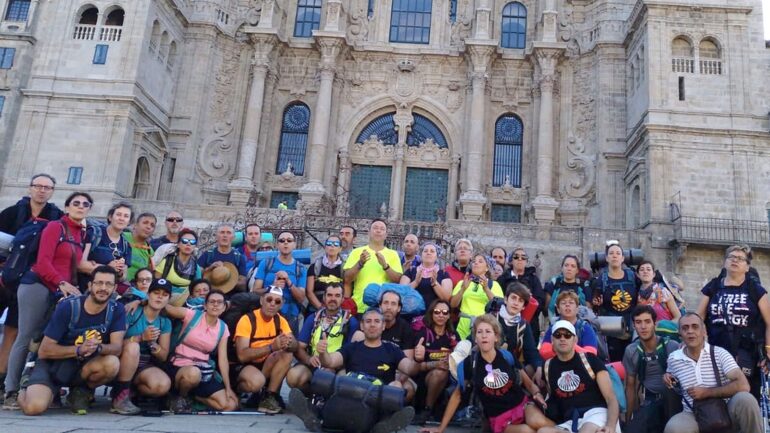
Unlike traditional travel, the Camino creates a shared experience among strangers. Conversations start naturally, often without planning, and connections form quickly.
For many young people, this sense of belonging is one of the most valuable aspects of the journey.
It is not uncommon for pilgrims to describe the Camino as a place where “everyone is open” and where relationships feel more authentic.
The role of faith remains present
Although motivations have diversified, faith still plays a role.
Some young pilgrims approach the Camino with clear religious intentions, while others rediscover spirituality along the way.
Events such as youth pilgrimages and church-led initiatives continue to attract participants, reinforcing the connection between the Camino and its Christian origins.
At the same time, the Camino remains open to all, regardless of belief.
A trend likely to continue
Experts suggest that this trend will continue in the coming years.
As younger generations seek alternatives to traditional tourism, experiences that combine physical challenge, emotional depth, and cultural value are likely to grow.
The Camino de Santiago fits perfectly into this shift.
A journey that adapts to each generation
The strength of the Camino lies in its ability to adapt.
For centuries, it has welcomed pilgrims with different motivations—religious, cultural, or personal.
In 2026, it continues to do so, offering something that many young people are actively searching for: a pause from the world, and a path toward something deeper.