














Santiago de Compostela is preparing for a major boost in international connectivity ahead of Xacobeo 2027, with eight new air routes linking Galicia with destinations in Spain and across Europe.
The countdown to Xacobeo 2027 is already changing the travel map around Santiago de Compostela. With another Holy Year approaching, the Galician capital is strengthening its air connections at a crucial moment for tourism and for the thousands of international pilgrims who travel to Spain every year to walk the Camino de Santiago.
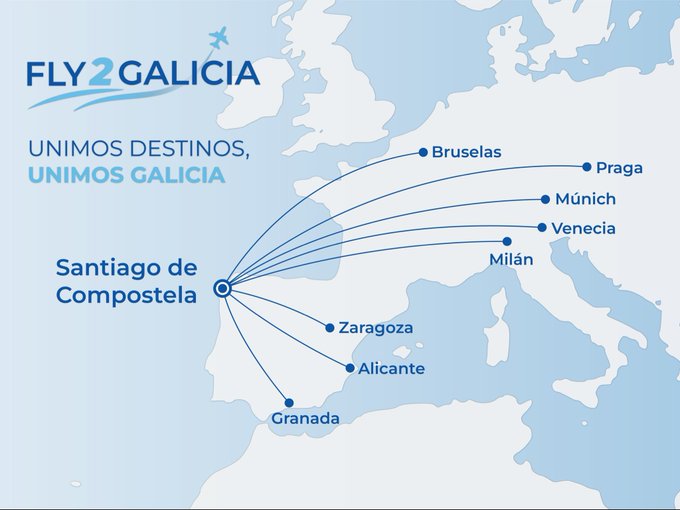
A new airline, Fly2Galicia, plans to begin operations from Santiago–Rosalía de Castro Airport on 1 December 2026, initially offering eight routes: Granada, Alicante, Zaragoza, Milan, Venice, Munich, Prague and Brussels.
The company also plans to put tickets on sale from 18 August, according to information published this week.
Eight destinations that bring Santiago closer to Europe
The planned network is particularly interesting for the Camino because five of the destinations are major European cities: Milan, Venice, Munich, Prague and Brussels.
Better direct access to Galicia could make it easier for travellers from several European markets to reach Santiago, either to begin a journey in Galicia or to return home after completing their pilgrimage.
For Camino travellers, flight connectivity is an important part of planning. Santiago is not simply the destination at the end of the pilgrimage: it is also the main departure point for thousands of international pilgrims returning home.
Santiago prepares for Xacobeo 2027
The new routes arrive as airlines are increasingly looking towards Santiago ahead of the next Holy Year.
Wizz Air has also announced a new base at Santiago with additional connections, including Rome and Warsaw, while Vueling plans to reinforce its presence at the airport for the summer 2027 season.
This does not mean that every new route has been created specifically for Xacobeo 2027. But the expansion comes at an especially significant time, as Galicia prepares for a year expected to attract enormous international attention.
Good news for international pilgrims
For the Camino de Santiago, connectivity matters.
Every new direct connection potentially reduces the number of transfers needed by pilgrims travelling from abroad and makes Santiago easier to reach from major European markets.
And with Italy, Germany, Belgium and Central Europe gaining new connections, the impact could extend well beyond conventional tourism.
The Camino is becoming increasingly international — and now Santiago’s airport is preparing for that international audience too.
Xacobeo 2027 is still months away, but Santiago is already taking off.