




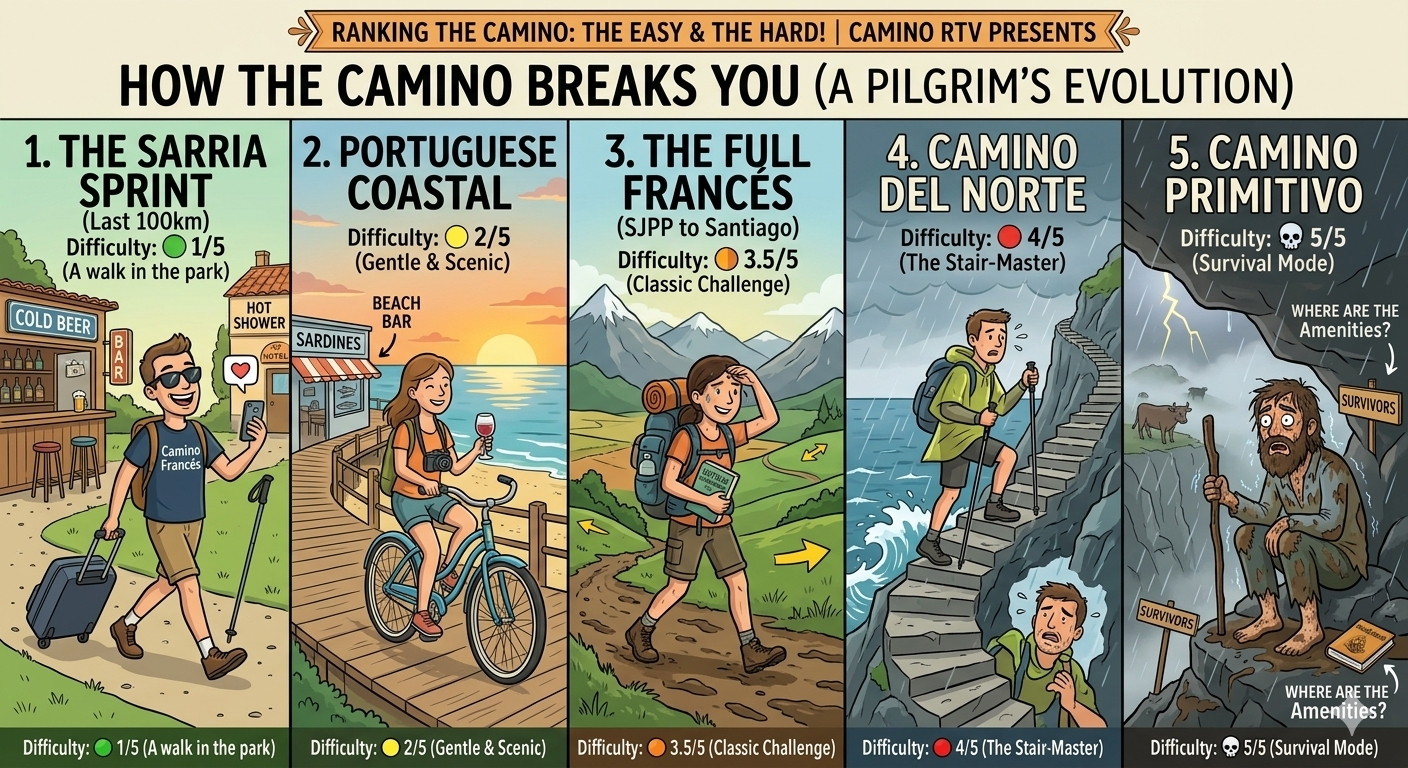
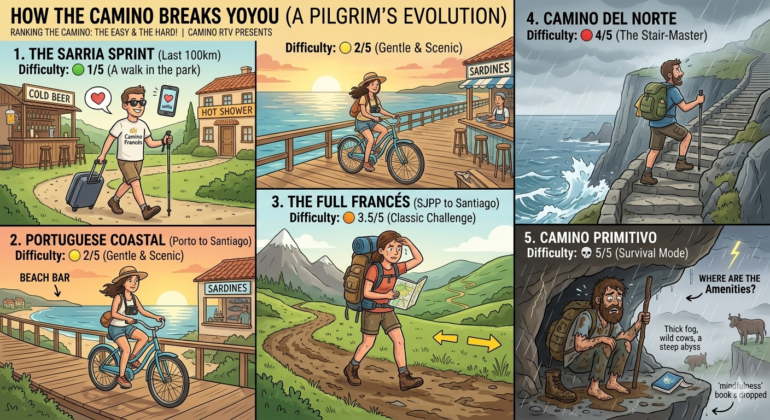
From relaxed coastal walks to mountain survival mode, here’s how the main Camino routes compare in 2026
Every year, thousands of travelers arrive in Spain dreaming of walking the Camino de Santiago. But once they start researching, many discover a surprising problem: there isn’t just one Camino.
There are several major routes, each offering a completely different experience. Some are ideal for beginners looking for a comfortable hiking holiday with good hotels, local restaurants and plenty of fellow pilgrims. Others push walkers through remote mountains where rain, mud and steep climbs become part of daily life.
Choosing the right route can be the difference between an unforgettable travel experience and questioning every life decision halfway up a mountain in Asturias.
For first-time pilgrims planning a hiking holiday, cultural trip or wellness travel experience in 2026, understanding the difficulty of each route is essential.
1. Camino Francés from Sarria
Difficulty: 1/5
The final 100 kilometers from Sarria to Santiago remain the most popular Camino option in Spain.
This route is often called the “starter Camino” because it offers relatively gentle terrain, frequent accommodation, countless cafés and a constant flow of pilgrims. Walking here feels almost effortless compared to other routes.
For many travelers, it combines cultural tourism, local gastronomy, comfortable hotels and the opportunity to earn the Compostela certificate without tackling the more demanding sections of the Camino.
It is perfect for families, beginner hikers and travelers looking for an active holiday without extreme physical challenges.
2. Portuguese Coastal Camino
Difficulty: 2/5
Starting in Porto and following the Atlantic coastline, this route has become one of the fastest-growing pilgrimage experiences in Europe.
The scenery is spectacular. Ocean views, seafood restaurants, charming fishing villages and long wooden boardwalks create an experience that feels more like a coastal travel adventure than a traditional pilgrimage.
The terrain is generally kind to the knees, making it a favorite among international travelers interested in wellness tourism, slow travel and cultural experiences.
Its biggest challenge may be resisting the temptation to stop at every seaside terrace for lunch.
3. Full Camino Francés
Difficulty: 3.5/5
This is the classic Camino that most people imagine.
Beginning in Saint-Jean-Pied-de-Port in France, it crosses the Pyrenees, traverses the vast Meseta and eventually reaches Santiago after nearly 800 kilometers.
It offers everything:
historic villages,
rural tourism,
traditional gastronomy,
spiritual experiences,
boutique hotels,
hostels
and breathtaking landscapes.
Many pilgrims describe it as a life-changing journey that combines physical challenge with emotional growth.
It is demanding but achievable for most people who prepare properly.
4. Camino del Norte
Difficulty: 4/5
The northern route is one of the most beautiful walks in Europe.
It follows Spain’s Atlantic coast through the Basque Country, Cantabria, Asturias and Galicia.
The views are spectacular, but so is the effort required.
Pilgrims constantly climb from sea level to hilltops before descending again. The route feels like a never-ending staircase surrounded by beaches, cliffs and green landscapes.
Weather can change quickly and accommodation is often less concentrated than on the Camino Francés.
For experienced hikers, however, it offers some of the best scenery found anywhere on the Camino de Santiago.
5. Camino Primitivo
Difficulty: 5/5
Welcome to survival mode.
The Camino Primitivo, beginning in Oviedo, is the oldest Camino route and many consider it the toughest.
The route cuts directly through the Asturian mountains, where steep climbs, muddy trails, fog and isolation become part of the adventure.
There are stages where walkers spend hours surrounded only by cows, forests and silence.
The reward is extraordinary.
Many experienced pilgrims consider the Primitivo the most authentic and emotionally powerful Camino experience available today.
But it demands preparation, fitness and determination.
Which Camino should you choose?
There is no perfect Camino.
Some travelers dream of luxury walking holidays, boutique accommodation and coastal sunsets. Others seek personal transformation, mountain challenges and a true test of endurance.
What matters is choosing the route that matches your expectations, fitness level and travel style.
Because whether you walk for spirituality, adventure, health, culture, gastronomy or personal growth, every Camino eventually teaches the same lesson:
the journey matters far more than the destination.