









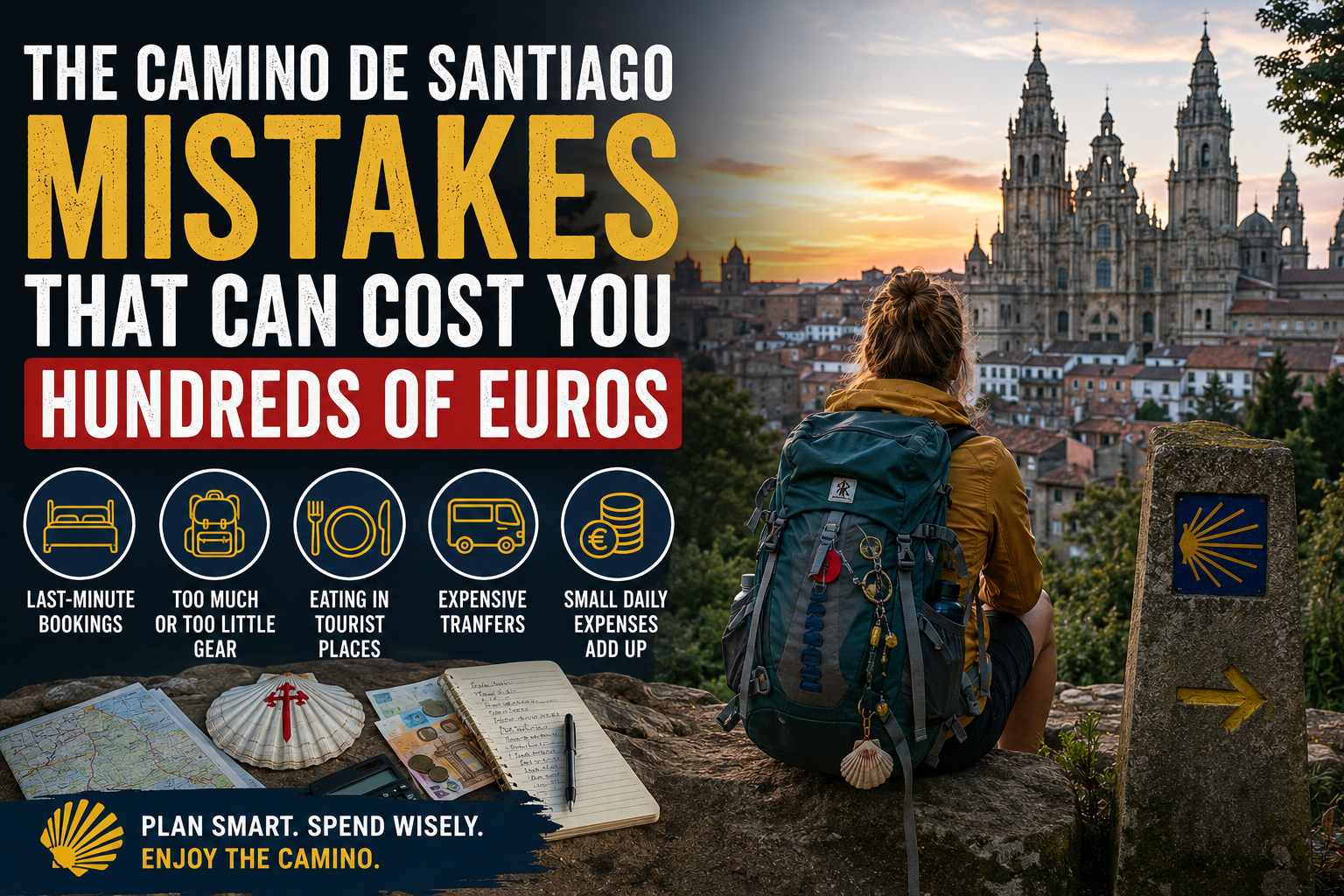
Walking to Santiago can still be an affordable adventure, but poor planning, last-minute bookings and a few seemingly harmless decisions can turn a budget pilgrimage into a surprisingly expensive trip
The Camino de Santiago has a reputation for being one of Europe’s most affordable great adventures. You do not need a luxury hotel, a rental car or an expensive tour package. In theory, all you need is a backpack, a pair of good shoes and enough money for somewhere to sleep and something to eat.
But the Camino of 2026 is not quite that simple.
As the pilgrimage attracts hundreds of thousands of walkers from Spain and around the world, accommodation, luggage transfers, restaurants, transport and travel services have become an increasingly important part of planning a Camino. And this creates a curious situation: two pilgrims can walk exactly the same route and finish in Santiago having spent dramatically different amounts of money.
The difference is often not luxury. It is planning.
For international pilgrims in particular, a handful of mistakes can quietly add hundreds of euros to the final cost of a Camino.
Booking everything at the last minute can become expensive
There is something wonderfully romantic about waking up without knowing where you will sleep that night. For generations, that uncertainty was simply part of pilgrimage.
In peak season, however, spontaneity can have a price.
Popular Camino towns have a limited number of beds, particularly during busy periods. If the cheaper accommodation has already filled up when you arrive, the remaining options may be private rooms, hotels or properties outside the town.
That does not mean every pilgrim should reserve every night months ahead. Doing so can remove some of the freedom that makes the Camino special.
A more sensible approach is to understand where the pressure points are likely to be and make strategic reservations when necessary.
The cheapest bed is not really cheap if it forces you to take a taxi 15 kilometres away because everything else is full.
Starting with the wrong equipment is one of the most expensive mistakes
The backpack is another classic example.
Before travelling to Spain, first-time pilgrims frequently buy equipment as though they were preparing for an expedition across Antarctica. Extra clothes, enormous toiletries, multiple pairs of shoes, gadgets, cameras and “just in case” items disappear into the backpack.
Then comes the first serious climb.
Suddenly, every unnecessary object develops its own gravitational field.
Within several days, some pilgrims begin mailing belongings home, abandoning inexpensive equipment or paying for luggage transportation between stages.
The lesson is simple: buying more gear does not necessarily make the Camino easier.
Good footwear, an appropriate backpack, lightweight clothing and essential rain protection matter far more than owning dozens of specialised accessories.
A lighter backpack can save money as well as knees.
Cheap shoes can become extremely expensive
There is one area where saving money before departure can backfire badly: footwear.
Nobody needs the most expensive hiking shoes in the shop simply because they are walking the Camino. But using unsuitable, badly fitted or completely new footwear can transform an otherwise wonderful journey into a painful succession of blisters.
The financial consequences are easy to overlook.
Pharmacy visits, new socks, replacement shoes, taxis, additional accommodation and even unexpected rest days can all add to the cost.
The best Camino shoe is not necessarily the most expensive one.
It is the one you already know you can comfortably walk long distances in.
Breaking in footwear before arriving in Spain remains one of the cheapest forms of travel insurance a pilgrim can give their feet.
Eating cheaply does not always mean eating badly
Food is another area where costs accumulate almost invisibly.
A coffee here. A beer there. Breakfast. Lunch. Dinner. Another coffee because there are still eight kilometres remaining. A celebratory bottle of wine because somebody in the albergue has reached their 500th kilometre.
None of these purchases feels particularly significant.
Multiply them by four or five weeks and the picture changes.
Fortunately, the Camino crosses some of the great food regions of Spain. Local bakeries, supermarkets, markets and traditional restaurants can make eating well surprisingly affordable if pilgrims move beyond the most obvious tourist options.
Navarra, La Rioja, Castilla y León and Galicia each offer their own regional food culture. Experiencing it is part of the journey.
The mistake is not spending money on food.
The mistake is paying tourist prices for forgettable food when something genuinely local may be two streets away.
The final 100 kilometres require a different strategy
For many international visitors, “the Camino” means the section from Sarria to Santiago de Compostela.
There is nothing wrong with that. Walking the required distance and meeting the applicable conditions can qualify a pilgrim for the Compostela, and those final stages provide a genuine Camino experience.
But their popularity changes the economics.
More walkers mean greater competition for accommodation and services, especially during popular travel periods. Someone who has spent weeks improvising successfully on quieter sections of the route may discover that the same strategy becomes more difficult approaching Santiago.
This is where flexibility becomes valuable.
Leaving earlier, considering nearby villages rather than only the traditional stage endings and avoiding an obsession with following exactly the same itinerary as everybody else can make the journey both cheaper and more enjoyable.
The Camino is a route.
It is not a compulsory sequence of hotel reservations.
Luggage transfers are convenient — but calculate the total
Transporting a backpack from one accommodation to the next can be extremely useful, particularly for pilgrims with physical limitations or anyone who simply prefers walking with a small daypack.
The mistake is not using the service.
The mistake is looking only at the daily price.
A small daily expense multiplied by twenty, thirty or forty stages becomes a meaningful part of the travel budget. International pilgrims planning a long Camino should therefore calculate the entire cost before departure rather than treating each transfer as an isolated purchase.
The same applies to taxis, laundry, drinks, snacks and other seemingly minor daily expenses.
The Camino rarely destroys a budget with one enormous purchase. It does it €5, €10 and €15 at a time.
Getting to the starting point can cost more than expected
One of the most overlooked expenses happens before the first yellow arrow even appears.
Reaching popular starting points such as Saint-Jean-Pied-de-Port can require several connections depending on where a pilgrim arrives in Europe. Flights, trains, buses and occasionally taxis can quickly become a significant part of the total budget.
The return journey matters too.
A pilgrim who books an inflexible flight home immediately after their expected arrival in Santiago is making an assumption that the Camino will respect their spreadsheet.
Sometimes it does not.
Bad weather happens. Feet hurt. People take rest days. And sometimes pilgrims simply discover a town they love and decide to stay.
Building a little flexibility into the schedule can prevent an expensive last-minute change.
Travel insurance is boring until you need it
Nobody dreams about walking the Camino because they are excited about comparing insurance policies.
But international travellers should think carefully about medical and travel coverage before leaving home.
A Camino involves repeated long-distance walking, unfamiliar terrain and weeks away from normal routines. Flight disruption, lost luggage, illness or an injury can turn a relatively inexpensive journey into a substantial financial problem.
The important point is not simply to buy any policy. Travellers should understand what their coverage actually includes, particularly regarding medical treatment, hiking activities, cancellations and existing health conditions.
Ten minutes spent reading the details before travelling can be considerably more useful than discovering an exclusion from a hospital waiting room.
Santiago itself can become the final budget trap
Then comes the moment everybody has imagined.
The towers appear.
The pilgrim enters Santiago.
Someone cries.
Someone hugs a complete stranger.
Someone immediately orders several beers.
After weeks of sleeping in pilgrim accommodation, it is extremely tempting to celebrate with a comfortable hotel, a large dinner and an additional couple of nights in the city.
And perhaps you should.
Reaching Santiago deserves celebrating.
But include that celebration in the original budget.
The strange thing about Camino spending is that pilgrims often plan meticulously for the walking and almost completely forget about what happens after they stop walking.
Santiago is not merely the finish line. For many travellers it becomes another destination, with restaurants, museums, shopping, accommodation and onward transport.
The cheapest Camino is not necessarily the best Camino
There is a danger in turning pilgrimage into a competition to see who can survive on the smallest number of euros.
That misses the point.
If you can afford a private room after a brutal stage and desperately need sleep, take it. If an unforgettable meal with new Camino friends costs more than your normal dinner budget, enjoy it. If sending your backpack ahead means you can continue walking without pain, that money may be very well spent.
A good Camino budget is not about spending as little as possible.
It is about spending money on the things that genuinely improve the journey and avoiding unnecessary expenses caused by poor planning.
That distinction can save hundreds of euros.
And there is one final irony.
Many pilgrims arrive in Spain worried about how much the Camino will cost them. Weeks later, they reach Santiago and realise that the most valuable parts of the journey were free.
Walking through a Galician forest early in the morning costs nothing.
Watching the sun rise over Castilla costs nothing.
Sharing a conversation with a stranger from the other side of the world costs nothing.
And neither does the moment when the Cathedral of Santiago finally appears in front of you.
Perhaps that is why, despite everything, the Camino de Santiago remains one of Europe’s greatest travel experiences.
You can spend a fortune on it.
But you really do not have to.