









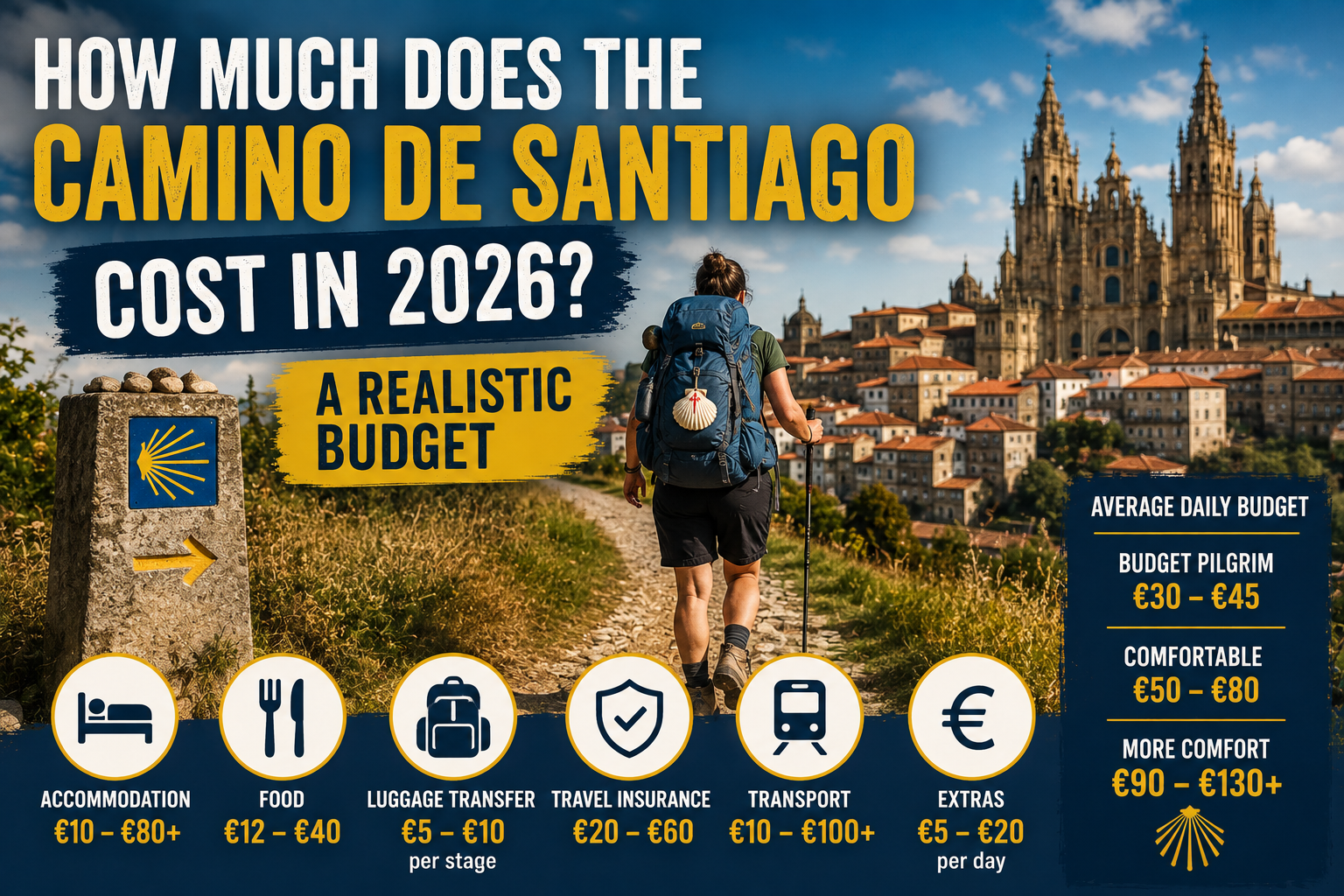
Walking the Camino de Santiago does not have to be expensive, but the idea that you can cross northern Spain for almost nothing is becoming increasingly unrealistic. Accommodation, food, transport, luggage transfers and the way you travel can turn the same Camino into a €35-a-day adventure or a journey costing well over €100 per day. So, how much money should a pilgrim really budget for the Camino de Santiago in 2026?
For many international pilgrims, calculating the cost of the Camino begins long before the first yellow arrow.
Flights to Spain or France, trains to the starting point, accommodation, travel insurance and equipment can represent a significant part of the total expenditure. Once on the Camino, however, life becomes surprisingly simple.
You need somewhere to sleep.
You need to eat.
And the following morning, you walk again.
The problem is that there is no single answer to the question “How much does the Camino de Santiago cost?” because two pilgrims walking exactly the same route can spend completely different amounts.
Here is a realistic way to plan your 2026 Camino budget.
How much does the Camino cost per day in 2026?
For planning purposes, we would divide Camino budgets into three broad categories.
| Type of pilgrim | Approximate daily budget |
|---|---|
| Budget pilgrim | €30–45 |
| Comfortable pilgrim | €50–80 |
| Private rooms / greater comfort | €90–130+ |
These figures should be treated as planning ranges rather than fixed prices. Costs vary enormously according to the route, season, town, type of accommodation and how far in advance you book.
A pilgrim sleeping mainly in inexpensive albergues, buying some food from supermarkets and carrying their own backpack can keep expenditure relatively low.
Someone choosing private rooms, restaurants, luggage transfers and additional services will spend considerably more.
And there is nothing wrong with either Camino.
The important thing is knowing what kind of experience you want before calculating the budget.
Accommodation: usually your biggest daily expense
Accommodation is one of the first areas where Camino budgets begin to diverge.
Traditional pilgrim albergues remain one of the defining experiences of the Camino. They provide basic accommodation, usually in shared dormitories, and are an excellent place to meet other walkers.
Municipal, parochial and private albergues have different prices and conditions.
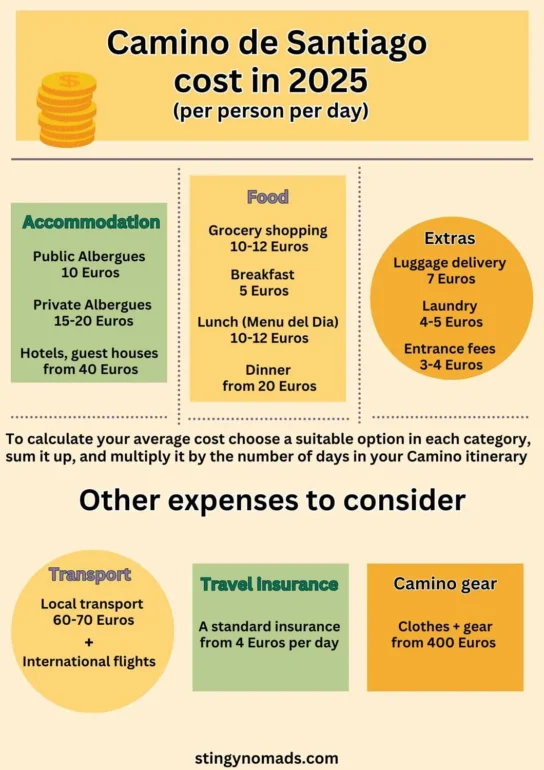
For a rough 2026 budget, allow approximately €10–20 for inexpensive pilgrim accommodation, although private albergues and better-equipped establishments can cost more.
Private rooms change the calculation significantly.
A room in a pension, hostel, rural house or hotel might cost approximately €40–80 or considerably more, particularly in popular destinations, during holidays or at times of exceptionally high demand.
Santiago de Compostela deserves special attention.
Waiting until you arrive in Santiago to find accommodation can be an expensive decision during busy periods.
Food: the expense pilgrims often underestimate
Walking 20 or 25 kilometres every day makes people hungry.
Very hungry.
A typical Camino day might include breakfast before leaving, coffee during the morning, lunch, drinks during the afternoon and dinner after reaching the destination.
Small purchases quickly accumulate.
A pilgrim using supermarkets and preparing food where facilities permit might spend around €12–20 a day on food.
Eating regularly in cafés and restaurants can push the daily food budget towards €25–40 or more.
Many towns along the principal Camino routes offer menus aimed at pilgrims, but prices and availability vary considerably.
And then there is one expenditure that rarely appears in spreadsheets:
The second coffee.
After walking uphill for two hours, financial discipline sometimes disappears remarkably quickly.
What does a week on the Camino cost?
Many international pilgrims do not have five weeks available.
Instead, they walk the final section from Sarria, Tui, Ferrol or another starting point that allows them to experience the Camino during a shorter holiday.
For seven days on the Camino, excluding international flights, a reasonable planning estimate would be:
Budget: approximately €250–350
Mid-range: approximately €400–600
Greater comfort: approximately €700–1,000+
This can include accommodation, food and ordinary daily expenses, but additional transport, luggage services and activities can increase the final figure.
A couple choosing private rooms can sometimes reduce the per-person accommodation cost compared with a solo traveller paying for a private room alone.
How much does the full Camino Francés cost?
The Camino Francés from Saint-Jean-Pied-de-Port to Santiago is roughly 780–800 kilometres, depending on variations and the exact route followed.
Most pilgrims need approximately 30–35 days.
That means the total on-the-ground budget can look very different depending on travelling style.
A very careful pilgrim might aim for around €1,100–1,500.
A more comfortable budget could be approximately €1,700–2,700.
Regular private accommodation, restaurants and additional services could take the cost to €3,000–4,500 or more.
International flights and major pre-Camino equipment purchases would be additional.
The crucial lesson is simple:
A €10 difference in daily spending becomes €350 over a 35-day Camino.
Small decisions matter on a long pilgrimage.
Luggage transfer: paying to walk without the weight
One of the biggest changes in the modern Camino has been the growth of luggage-transfer services.
Instead of carrying everything, pilgrims can arrange for their backpack or suitcase to be transported to the next accommodation.
The service is especially popular among older walkers, organised groups and people with physical limitations, but increasingly it is simply another way of doing the Camino.
Prices depend on the company, route, distance and whether individual stages or packages are booked.
As a planning figure, allowing roughly €5–10 per bag per stage is sensible, while checking the actual current price with the operator before travelling.
Over five stages, that is a relatively small addition.
Over 30 stages, it becomes a meaningful part of the holiday budget.
Do you need travel insurance for the Camino?
For international pilgrims, this is one expense worth considering before trying to save a few euros.
The Camino is generally safe, but it is still a long-distance walking journey.
Falls happen.
Ankles get injured.
People become ill.
Flights are cancelled.
Luggage disappears.
And occasionally a pilgrim has to abandon the Camino unexpectedly.
Travel insurance can include medical assistance, emergency transport, cancellation or interruption protection and baggage cover, depending on the policy.
The key is not simply buying the cheapest policy.
Check whether long-distance hiking and the conditions of your particular Camino are actually covered.
European travellers should also understand the difference between healthcare rights available through the European Health Insurance Card and broader travel-insurance protection. The European Commission states that the EHIC covers necessary state-provided healthcare during temporary stays under the applicable conditions, but it is not an alternative to travel insurance and does not cover matters such as private healthcare or repatriation.
For pilgrims arriving from the United States, Canada, Australia and other non-EU countries, understanding medical coverage before departure is even more important.
Getting to the starting point
This is one of the costs people often forget when they calculate their Camino.
Reaching Santiago is one thing.
Reaching Saint-Jean-Pied-de-Port, Sarria, Tui, Porto, Oviedo or Ferrol before you have walked a single kilometre is another.
You may need a combination of:
- Flight
- Train
- Bus
- Taxi or transfer
- One night’s accommodation before starting
For international pilgrims, transportation to and from the Camino can easily add several hundred euros to the trip.
Book early when possible, but leave enough flexibility to deal with flight delays.
Starting the Camino exhausted because an itinerary saved €30 is rarely a great investment.
Equipment: you probably need less than you think
The Camino has an extraordinary ability to expose unnecessary purchases.
A pilgrim can spend hundreds of euros on technical equipment and still discover after three days that the favourite item in the backpack is a €2 pair of clothes pegs.
The major expenses are normally footwear, backpack, waterproof clothing and suitable walking clothes.
If you already hike regularly, you may own most of what you need.
If you are starting from zero, €200–500 is a reasonable broad equipment-planning range, although premium equipment can push the figure much higher.
The most expensive boot is not automatically the best Camino boot.
The best footwear is the one that fits you properly and that you have tested before departure.
Never make the first day of the Camino the first day you wear your walking shoes.
The hidden costs of the Camino
A realistic budget should contain an emergency margin.
Laundry costs money.
Pharmacies cost money.
A taxi after an injury costs money.
An unexpected hotel because every albergue is full costs money.
A rest day costs money.
And Santiago itself has a strange ability to make pilgrims suddenly decide they deserve a good dinner after spending a month carefully watching every euro.
Set aside at least 10–15% of your total budget for unexpected expenses.
If you never need it, excellent.
If something goes wrong, it can transform a stressful problem into a manageable inconvenience.
Is the Camino cheaper in Spain or Portugal?
It depends far more on the precise route and accommodation choices than simply on the country.
The Camino Francés has an enormous accommodation infrastructure, which creates plenty of choice but also significant demand.
The Camino Portugués has become increasingly popular and offers everything from traditional pilgrim accommodation to high-end hotels.
The Camino del Norte and Camino Primitivo can sometimes require more careful accommodation planning because certain stages have fewer options.
Price should therefore not be the only factor when choosing a route.
A route with cheaper individual accommodation but fewer available beds can become expensive if you repeatedly have to use private rooms.
When you walk matters
July and August are not the only months to walk the Camino.
Spring and autumn can provide excellent conditions, although weather becomes less predictable and some seasonal services may be closed.
Holy Week, major festivals and particularly busy periods can increase accommodation pressure in certain places.
The final 100 kilometres of popular routes also behave differently from quieter sections.
A pilgrim walking from Sarria in August and another crossing Castilla y León in October may have completely different experiences — financially as well as socially.
Can you still walk the Camino cheaply?
Absolutely.
One of the beautiful things about the Camino is that it remains accessible to people travelling with very different budgets.
You do not need luxury hotels.
You do not need expensive restaurants.
You do not need a new outfit for every day.
And you certainly do not need every piece of equipment recommended by somebody on the internet.
But travelling cheaply requires planning.
Use pilgrim accommodation.
Carry your backpack if you are physically able.
Buy food locally.
Travel outside the most pressured periods when possible.
Reserve an emergency fund.
And spend money on the things that genuinely matter to you.
So, how much should you save for the Camino in 2026?
For a one-week Camino, having around €400–600 available on the ground gives many pilgrims a sensible degree of flexibility.
For the full Camino Francés, approximately €1,700–2,700 provides a more comfortable planning range for many walkers, before international flights and major equipment purchases.
It is possible to spend less.
It is extremely easy to spend more.
But there is one final piece of Camino budgeting advice worth remembering.
Do not calculate your budget so tightly that every coffee, unexpected taxi or night in a private room becomes a crisis.
The Camino is supposed to be walked.
Not survived financially.
Build a little flexibility into the budget, put on your backpack and start following the yellow arrows.
Buen Camino.