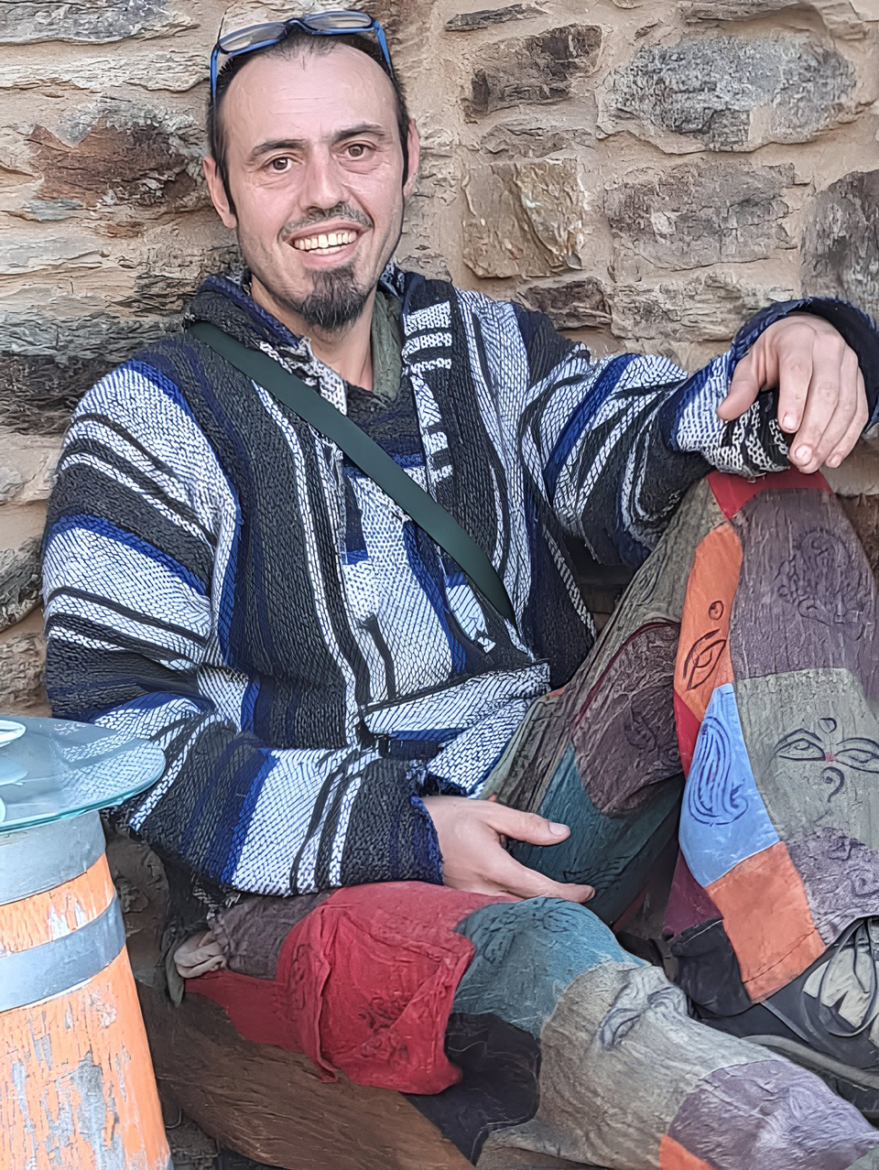











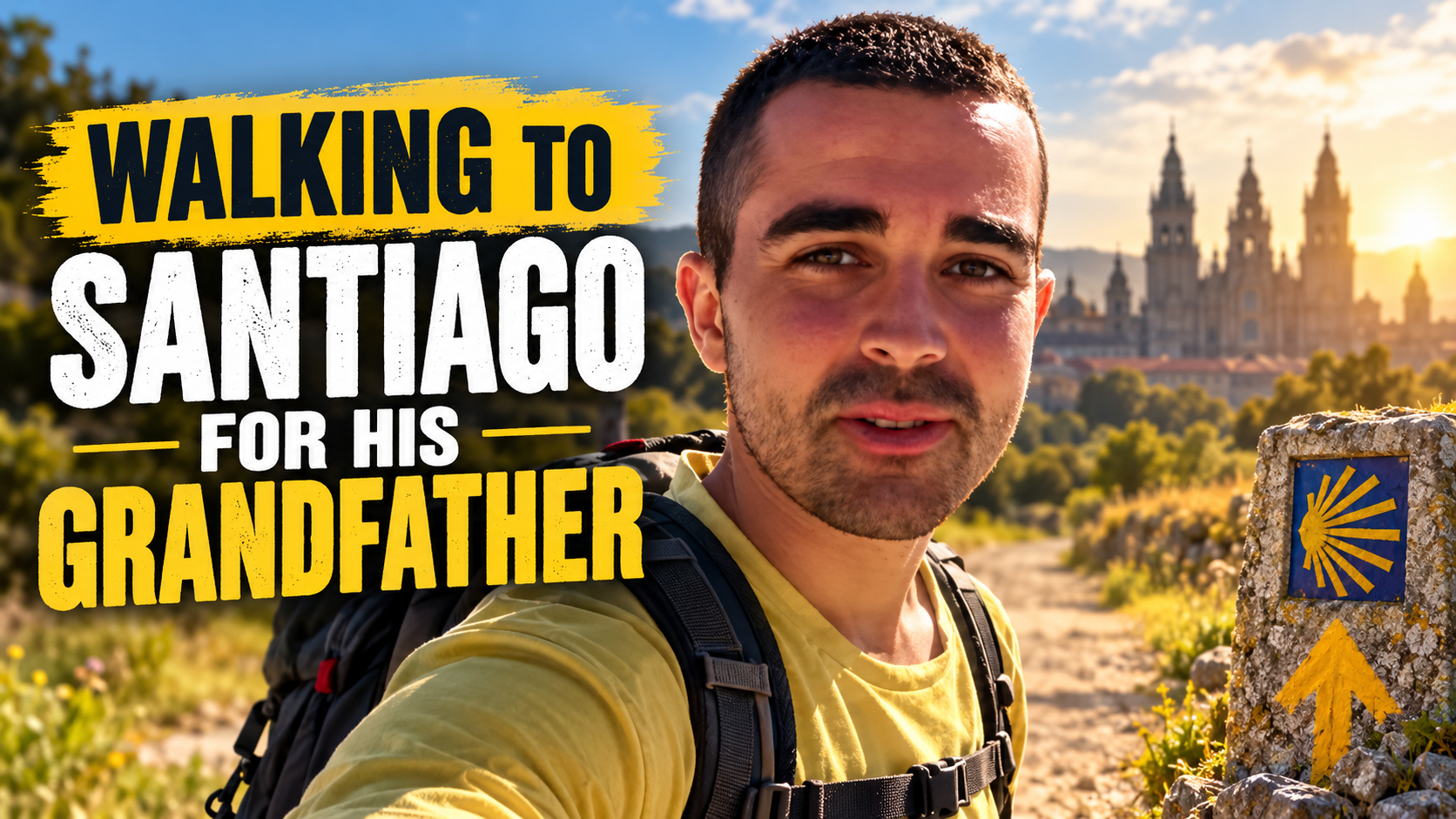
Spanish content creator Alejandro Berenguer is walking from his hometown of Agost, in Alicante, all the way to Santiago de Compostela in memory of his grandfather, who died only two months ago. His journey follows the little-known Camino del Sureste, a long and solitary route through inland Spain.
Some Caminos begin with a map.
Others begin with a promise.
For Alejandro Berenguer, the decision to walk to Santiago de Compostela came shortly after the death of his grandfather.
Rather than starting in one of the best-known Camino towns, Alejandro chose to leave from the door of his own home in Agost, Alicante, and head north-west on foot.
His route follows the Camino del Sureste, one of the lesser-known pilgrimage routes in Spain, crossing long stretches of countryside, small towns and wide open landscapes before eventually joining the wider network of paths leading to Santiago.
A Camino in memory of his grandfather
Alejandro’s grandfather died around two months before the start of the journey.
Soon afterwards, Alejandro decided to make the pilgrimage in his memory and to fulfil a dream connected with reaching Santiago.
That decision transformed the walk into something much more personal than a physical challenge.
Every stage now carries an emotional weight.
Every village, sunrise and difficult kilometre becomes part of a journey linked to remembrance.
From Agost through Albacete
The Camino del Sureste has taken Alejandro through a long list of towns and rural landscapes.
During his passage through the province of Albacete, he walked through places such as Caudete, Montealegre del Castillo, Pétrola, Chinchilla de Monte-Aragón, Albacete, La Gineta, La Roda and Minaya.
From there, the route continues towards El Provencio and Cuenca.
It is a Camino very different from the crowded final stages of the Camino Francés.
Long, flat sections.
Open horizons.
Small towns.
And sometimes very few pilgrims.
That solitude is part of what gives the route its character.
Almost 30,000 people are following his journey
Although Alejandro often walks alone physically, he is not completely alone.
He has been sharing the journey through social media, where nearly 30,000 followers are keeping up with his progress.
That has created an unusual contrast.
On the trail, he may spend hours without meeting another pilgrim.
But on his phone, messages of support continue to arrive.
People comment on his progress, encourage him during difficult stages and follow the emotional story behind the walk.
In a way, his Camino is both deeply solitary and highly shared.
A night in a bullring
One of the most unusual moments of the journey happened in La Roda, in the province of Albacete.
Alejandro spent the night in a place few pilgrims could ever imagine using as accommodation:
the infirmary of the local bullring.
It became one of those unexpected Camino stories that are impossible to plan in advance.
For a route with fewer dedicated pilgrim services than the major Caminos, improvisation can become part of the experience.
And sometimes those improvised nights become the ones a pilgrim remembers most.
The Camino del Sureste is still a quiet route
The Camino del Sureste remains far less travelled than the Camino Francés, Portugués or Norte.
That means some stages can feel extremely isolated.
For experienced pilgrims, that can be part of the attraction.
There are fewer crowds.
Less pressure.
More silence.
But it also means the walker must be more independent and prepared.
Accommodation, food and services can be more spread out, and long stages require careful planning.
Alejandro’s journey is also introducing this little-known route to thousands of people who may never have heard of it before.
Landscapes that force you to slow down
The route through inland Spain is defined by wide landscapes and long distances.
The terrain around Albacete brings endless horizons, rural roads, agricultural land and dramatic sunrises.
It is a very different image of the Camino de Santiago from the green landscapes many international pilgrims associate with Galicia.
And that difference is important.
The Camino is not one single landscape.
It is a network of routes crossing very different parts of Spain.
The Camino del Sureste is one of the clearest examples.
A journey through grief
Long-distance walking often creates space for thoughts that daily life pushes aside.
Hours of silence can bring memories back.
Sometimes gently.
Sometimes painfully.
Alejandro’s pilgrimage has become a way of carrying the memory of his grandfather forward, step by step.
The journey cannot change what happened.
But it can transform grief into movement.
And movement into meaning.
The Camino often begins before the first yellow arrow
One of the most powerful details of Alejandro’s story is where he started.
Not at a famous pilgrimage gateway.
Not at Sarria.
Not at Saint-Jean-Pied-de-Port.
At home.
That changes the meaning of the journey.
The Camino does not suddenly begin when a pilgrim reaches a famous route.
It begins the moment someone decides to walk towards Santiago.
For Alejandro, that first step happened in Agost.
Everything after that has been part of the same promise.
A grandfather travelling in every step
There are thousands of reasons to walk the Camino de Santiago.
Faith.
Adventure.
Sport.
Curiosity.
A life change.
A promise.
Or the memory of someone who is no longer here.
Alejandro’s Camino belongs to that last category.
He walks alone on many stages, but every kilometre carries a relationship that continues beyond absence.
And perhaps that is why stories like this resonate so strongly.
Because the Camino is not always about reaching a place.
Sometimes it is about carrying someone with you all the way there.
Alejandro is walking to Santiago for his grandfather. And with every step, that dream becomes a little more real.