



Symbols of the Camino de Santiago: signs that guide the steps… and also the soul
In it Camino de Santiago, nothing is left to chance. Each symbol that appears on the edge of the trail, on a backpack or on the door of a church has a story behind it and a meaning that goes beyond orientation. Are exterior signs that, as the days go by, also begin to point out something internal.
The most recognizable symbol is the scallop. Many carry it hanging without really knowing why, until the Camino explains it to them on foot. The scallop is an arrival, a goal, but it is also an origin. All its lines converge at a point, like the roads and like the people. Each pilgrim comes from a different place, with a different story, but they all advance towards the same horizon. And, without realizing it, also inward.
The yellow arrow It is another of the great symbols of the Camino. Simple, direct, humble. It does not adorn, it does not convince, it does not explain. Just point. It appears when you hesitate, when you stop too much, when the intersection is confusing. And it's almost always there at the right time. For many pilgrims, the arrow becomes a clear metaphor: you don't always know where you are going, but someone—or something—has already marked the next step.
The stone cairns, with the remaining kilometers to Santiago, fulfill a practical function, but also a spiritual one. They not only indicate distance, they remind us of constancy. Each milestone is a silent confirmation that you are still moving forward, even if you don't notice it. Even if the day is long. Although the body weighs. The number goes down, but the inner path grows.
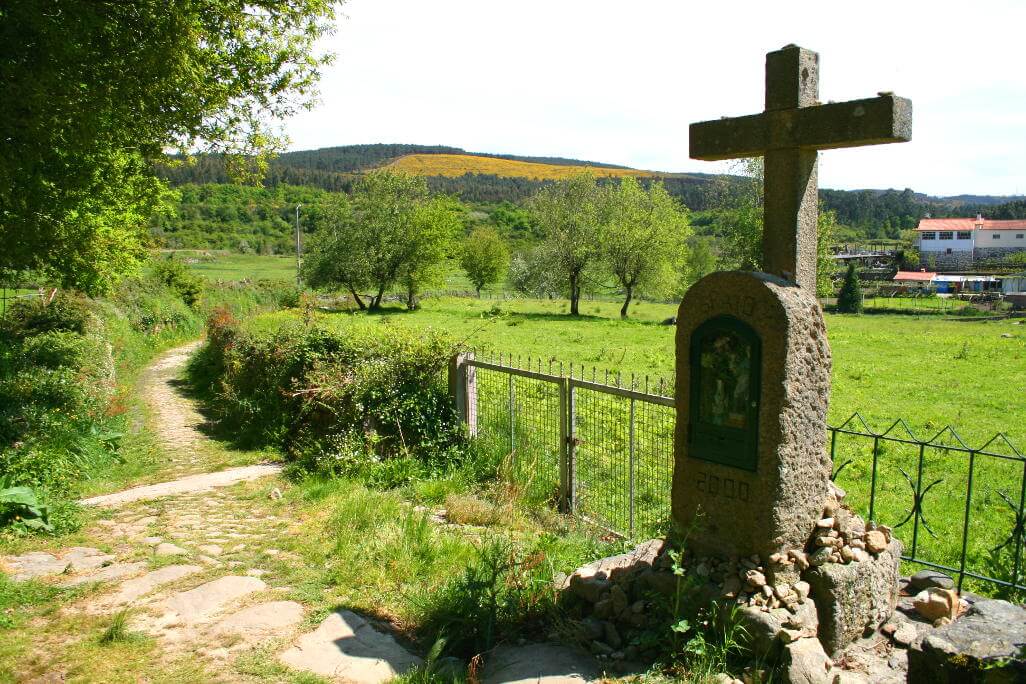
The crosses and calvaries At the edge of the Camino they speak of faith, but also of memory. They remember those who walked before, those who did not arrive, those who left something behind. They are places where many pilgrims stop without knowing why. Sometimes to pray, sometimes to think, sometimes just to be silent for a moment.
He staff, the pilgrim's staff, also has its symbolic meaning. Support, sustain, balance. You don't walk alone, but you don't walk without help either. The staff reminds us that moving forward is not just a matter of strength, but of knowing how to support yourself when necessary.
These symbols do not require faith. They do not force you to believe. They accompany. Each pilgrim interprets them in their own way, according to their moment, their history and their search. But they all fulfill the same function: remember that the Camino is not just a physical journey, but a silent language full of signs for those who walk attentively.
And when the Camino ends, many of these symbols continue to accompany the pilgrim. On a shelf, in a stored backpack, in a memory. Because even though you no longer point the way with yellow arrows, something inside has learned to recognize them.

















