











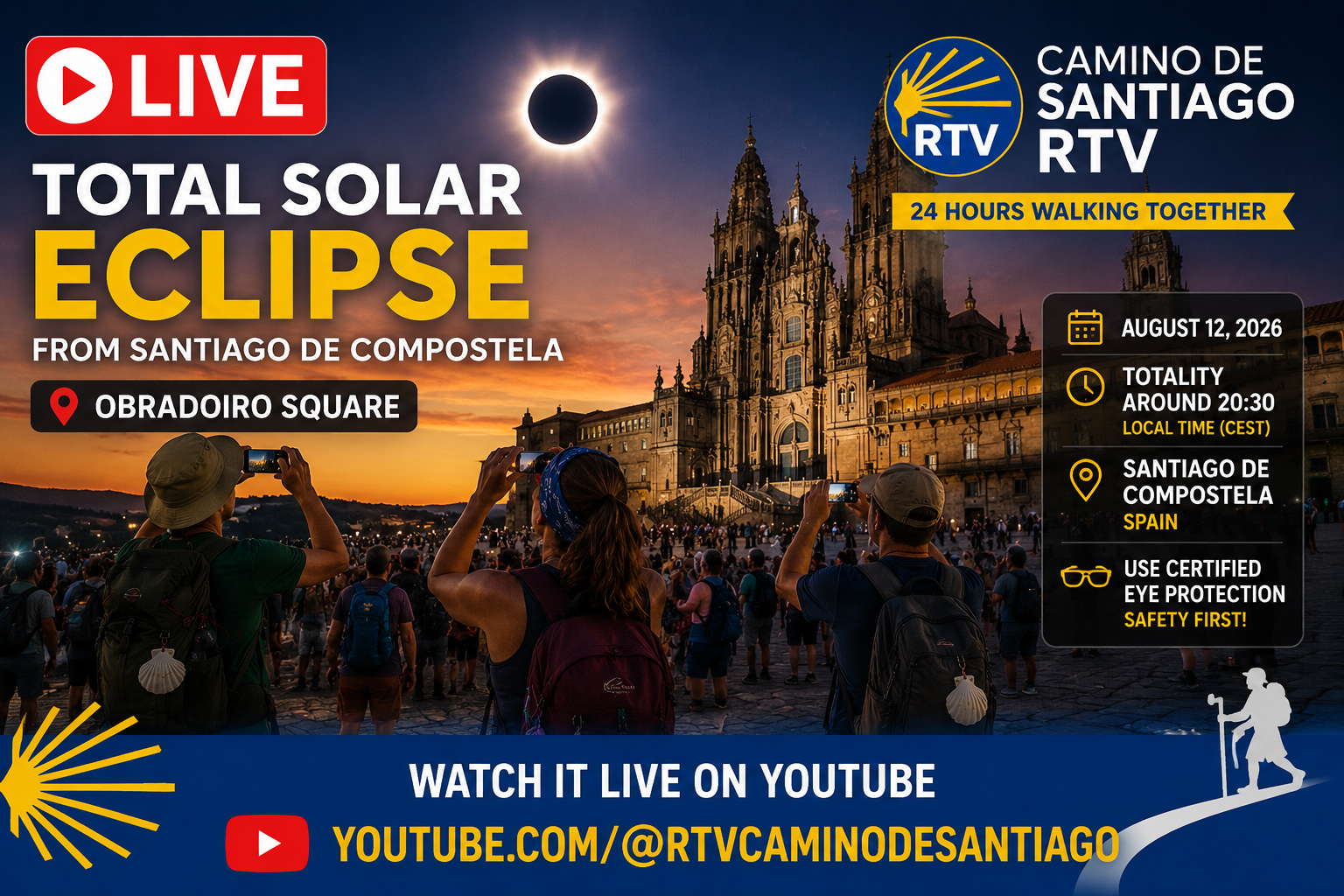
Thousands of pilgrims walking the Camino de Santiago are about to experience something that may never happen again in their lifetime. This evening, August 12, a total solar eclipse will sweep across northern Spain, plunging large sections of the Camino into an extraordinary twilight just before sunset.
For those currently walking the Camino Francés, Camino del Norte or Camino Primitivo, this will not be an ordinary stage. Pilgrims who began their day following yellow arrows through northern Spain will end it watching the Moon move in front of the Sun as one of the most spectacular astronomical events visible from Europe in decades unfolds directly above the pilgrimage routes.
The eclipse is already attracting enormous international attention. Millions of people are expected to watch across Spain, while authorities have deployed exceptional security and emergency measures to cope with huge concentrations of visitors. Spain is one of the world’s privileged locations for today’s phenomenon, with the path of totality crossing the country from west to east.
The Camino lies directly beneath the eclipse
What makes today’s event particularly extraordinary for pilgrims is geography.
The path of totality crosses much of northern Spain, precisely the territory through which several of the most famous Camino de Santiago routes run.
According to Spain’s National Geographic Institute (IGN), the total eclipse crosses the Iberian Peninsula from west to east, passing through or close to provincial capitals including A Coruña, Lugo, Oviedo, León, Burgos, Santander, Bilbao, Vitoria-Gasteiz and Logroño.
Look at a map of the Camino and the significance immediately becomes clear.
The Camino Francés passes through some of the areas experiencing totality, including major pilgrim destinations such as Logroño, Burgos and León. The Camino Primitivo crosses Asturias and Lugo, while the Camino del Norte follows much of Spain’s northern coast.
For thousands of pilgrims, therefore, the eclipse is not something they have travelled separately to see.
It has come directly to the Camino.
From yellow arrows to a darkening sky
There is something almost symbolic about the coincidence.
Every day, pilgrims wake before sunrise, shoulder their backpacks and follow a succession of yellow arrows towards Santiago de Compostela.
Today, many will finish their stage looking in the opposite direction.
Instead of following the arrows towards Santiago, they will be searching for a clear western horizon.
Spain is located near the end of the eclipse’s path, meaning totality occurs when the Sun is already very low in the evening sky. The IGN stresses that observers need an unobstructed view towards the west.
In A Coruña, for example, the eclipse begins at approximately 19:31, reaches maximum at around 20:28 and continues until shortly before sunset. In Burgos, one of the great cities of the Camino Francés, it begins at around 19:33, with maximum eclipse at approximately 20:29. Totality there lasts about 104 seconds.
A minute and a half may sound short.
For somebody standing after weeks of walking towards Santiago, it could become one of the most unforgettable minutes of the entire journey.
Pilgrims have paid a price for the spectacle
The eclipse has also created a much less romantic reality along parts of the Camino.
Accommodation has been under exceptional pressure.
Pilgrims have been warning for months that beds around August 12 could become difficult to find because eclipse visitors and organised groups were booking accommodation throughout northern Spain.
That prediction has now become reality in some places.
One pilgrim currently walking the Camino del Norte recently described contacting seven different albergues without finding a bed for tonight. The same pilgrim reported hotel prices averaging around €500 for the night, forcing them to consider changing their route altogether. This is an individual account rather than evidence that €500 prices are widespread across the Camino, but it illustrates the extraordinary pressure in some locations.
For pilgrims accustomed to inexpensive albergues, the sudden arrival of thousands of eclipse tourists has therefore created an unexpected challenge.
Some people planned their Camino specifically to coincide with the eclipse.
Others simply discovered that one of the biggest astronomical events of the century happened to fall directly across their pilgrimage.
Spain prepares for an extraordinary evening
Today’s eclipse is far bigger than a Camino story.
Millions of people across Spain are preparing to watch it, while visitors have travelled from around the world specifically for the event. Authorities have introduced exceptional safety measures because the eclipse coincides with summer heat, wildfire risk and potentially huge movements of people towards viewing locations.
In Cantabria alone, traffic restrictions have been introduced at several popular viewing areas, including Cabo Mayor in Santander and Peña Cabarga, as authorities prepare for large crowds.
The scale of the preparations shows just how unusual this evening will be.
But the experience of the pilgrim will be very different from that of somebody who has driven hundreds of kilometres specifically to find the perfect viewing point.
A pilgrim may simply stop walking.
Take off the backpack.
Find an open field or hill with a clear western horizon.
And wait.
A Camino stage that will never be repeated
Every pilgrim eventually collects stories.
The unexpected storm. The stranger who became a friend. The impossible climb. The albergue nobody planned to stay in. The sunrise that made getting up at 5 a.m. worthwhile.
Tonight, another story will be added to the Camino.
For a brief period, daylight will fade across northern Spain as the Moon passes directly between Earth and the Sun.
Temperatures may fall. The landscape will change colour. Shadows will become strange. And along ancient pilgrimage paths travelled for more than a thousand years, thousands of people will stop and look towards the same point in the sky.
Tomorrow the yellow arrows will still be there.
The pilgrims will put their backpacks on again and continue towards Santiago.
But the Camino they walk tonight will never look quite like this again.