












The shocking theft of the Codex Calixtinus that stunned Santiago de Compostela and the world
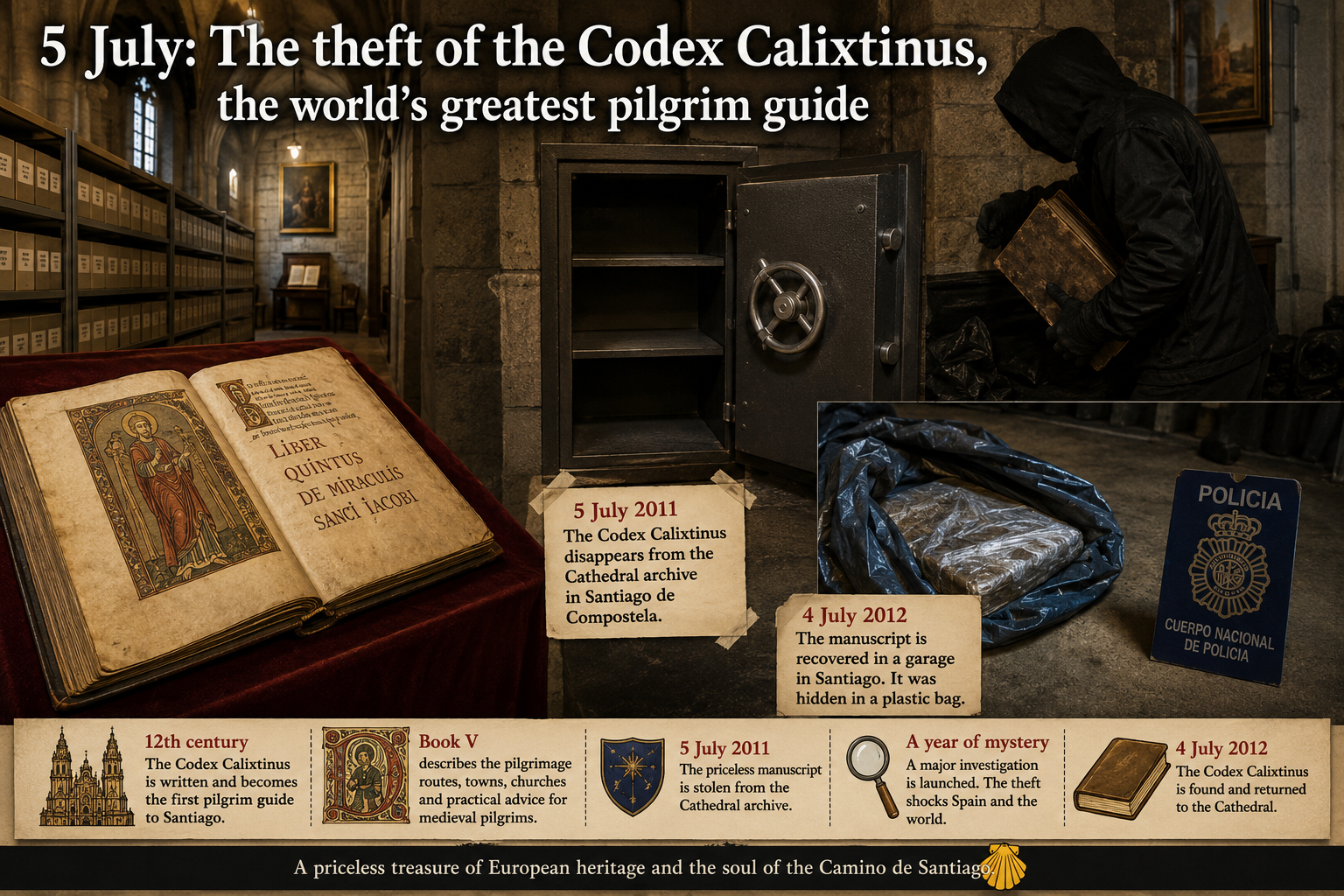
On 5 July, Spain remembers one of the most astonishing crimes in the history of the Camino de Santiago: the theft of the Codex Calixtinus, one of the world’s most valuable medieval manuscripts and the oldest surviving pilgrim guide to Santiago de Compostela.
The disappearance of the priceless manuscript in 2011 shocked historians, pilgrims and cultural institutions around the globe. For nearly a year, nobody knew where the famous book had gone, giving rise to countless theories ranging from an international art theft to an inside job.
The world’s first travel guide
The Codex Calixtinus, written during the 12th century, is considered one of the most important documents in European history.
Preserved for centuries inside the Cathedral of Santiago de Compostela, the manuscript contains sermons, miracles, liturgical texts, medieval music and, most famously, Book V, regarded as Europe’s first travel guide for pilgrims walking the Camino de Santiago.
The guide offers practical advice about the pilgrimage routes, describes towns, churches, bridges and local customs, and even warns travellers about dishonest innkeepers and dangerous places along the route. Today, it remains one of the most extraordinary testimonies of medieval pilgrimage.
A disappearance that shocked Spain
The theft was discovered on 5 July 2011, when archivists at Santiago Cathedral realised the manuscript was missing from its secure archive.
The Codex had been kept inside a reinforced safe and had survived wars, fires and more than 800 years of history. Few imagined it could simply vanish.
Police immediately launched one of the largest cultural heritage investigations ever carried out in Spain. Since the manuscript was impossible to sell openly on the art market, investigators initially suspected an organised criminal network or a wealthy private collector.
A mystery that lasted one year
For almost twelve months, the whereabouts of the Codex remained unknown.
The investigation examined cathedral employees, clergy, maintenance workers and researchers with access to the archives. The disappearance dominated headlines across Spain and attracted worldwide media attention.
The theft also exposed weaknesses in the cathedral’s security system, despite the enormous historical value of the manuscript.
The unexpected discovery
The mystery finally came to an end on 4 July 2012.
Spanish National Police recovered the Codex inside a plastic bag stored in a garage belonging to a former cathedral electrician.
The suspect, who had worked at the cathedral for years, was arrested along with members of his family. During the investigation, police also discovered large amounts of cash and other valuable objects that had allegedly disappeared from the cathedral over many years.
Remarkably, the manuscript was recovered in excellent condition, with no significant damage despite the circumstances in which it had been hidden.
A priceless symbol of the Camino
Today, the Codex Calixtinus has returned to its rightful place inside the Cathedral of Santiago de Compostela under much stricter security measures.
Beyond its artistic and historical value, the manuscript represents the spiritual origins of the Camino de Santiago and remains one of the most treasured documents in European cultural heritage.
In 2017, UNESCO included the Codex Calixtinus in its Memory of the World Register, recognising its outstanding global documentary importance.
A story that still fascinates pilgrims
Every year, hundreds of thousands of pilgrims arrive in Santiago without realising that the guide inspiring so much of the Camino’s history almost disappeared forever.
The theft of the Codex Calixtinus remains one of Spain’s most extraordinary cultural crimes—a reminder that protecting history is just as important as preserving the paths that lead to Santiago.