







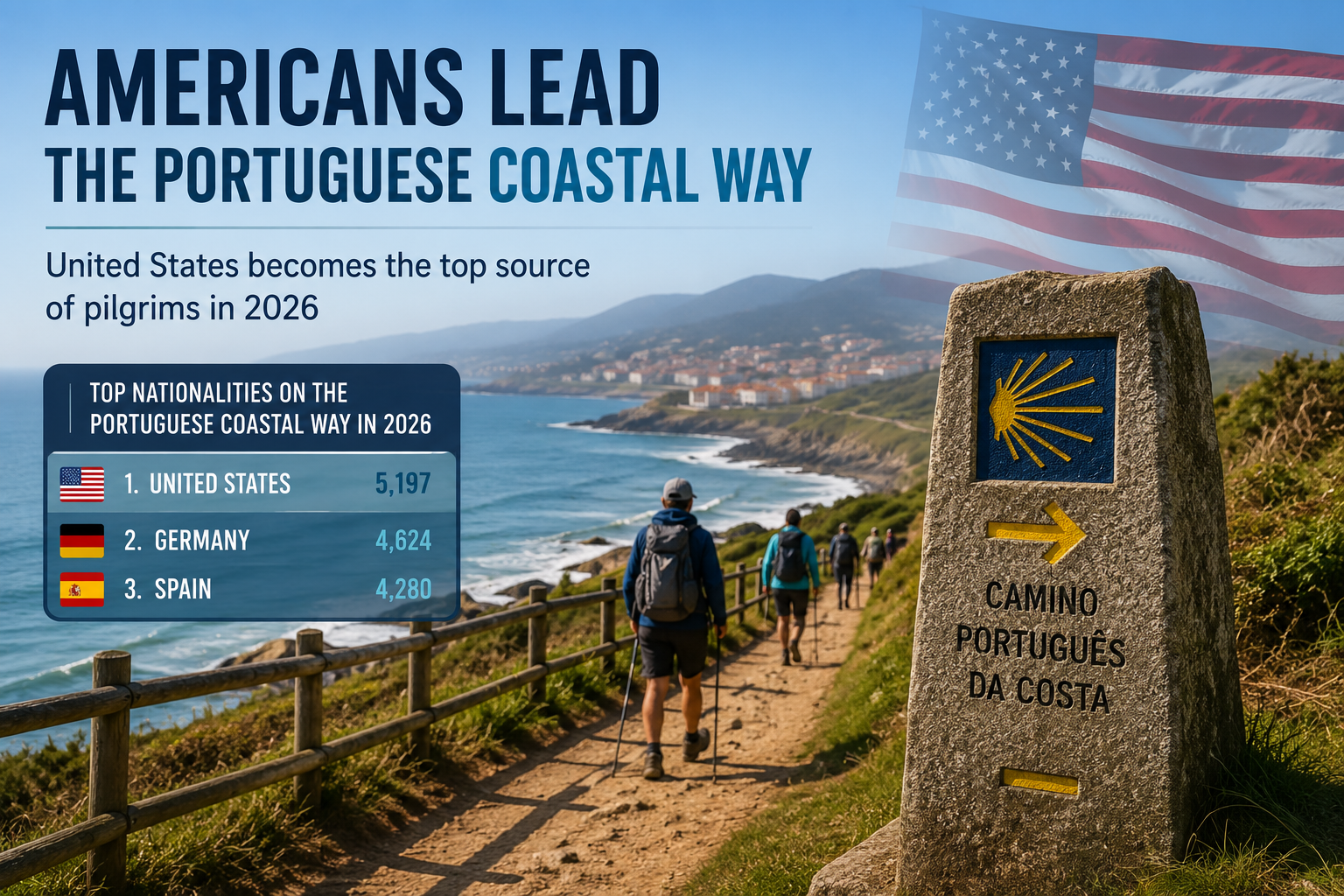
United States becomes the top source of pilgrims on the Portuguese Coastal Way
More than 5,000 American pilgrims have already chosen the route this year
The Portuguese Coastal Way continues to strengthen its position as one of the fastest-growing pilgrimage routes to Santiago de Compostela, with the United States now leading the ranking of international pilgrims.
According to the latest figures reported by the Pilgrim’s Office, a total of 5,197 American pilgrims have walked the Portuguese Coastal Way during the first months of 2026. Germany follows with 4,624 pilgrims, while Spain ranks third with 4,280 pilgrims.
These figures confirm the growing international appeal of the route, which runs along the Atlantic coast through northern Portugal and Galicia before joining other pilgrimage paths on the way to Santiago de Compostela.
The Portuguese Coastal Way is also closing the gap with the traditional Portuguese Inland Route. Current data show that the coastal variant has welcomed 38,713 pilgrims, compared with 39,469 pilgrims on the inland route.
To further promote the route, the Galician regional government (Xunta de Galicia) will organize the third edition of the Popular Coastal Stage on 21 June, covering the section between Vigo and Redondela. The initiative aims not only to encourage participation but also to highlight the need for improved waymarking along parts of the route in Vigo.
The event was presented by Ana Ortiz, the Xunta’s territorial delegate in Vigo, accompanied by representatives from the local hospitality and business sectors, including Iván Iglesias, president of the Provincial Federation of Commerce; Daniele Provezza, president of the Vigo Hospitality Association (Ahosvi); César Ballesteros, president of Feprotur; Pablo Louro, delegate of Gadisa; and Juan Mallo, president of Vodea.
With international interest continuing to rise, the Portuguese Coastal Way is rapidly becoming one of the most important Jacobean routes, attracting pilgrims from around the world and generating a significant economic impact for the communities through which it passes.
If current trends continue, 2026 could mark another record-breaking year for one of the newest — yet fastest-growing — routes to Santiago de Compostela.