



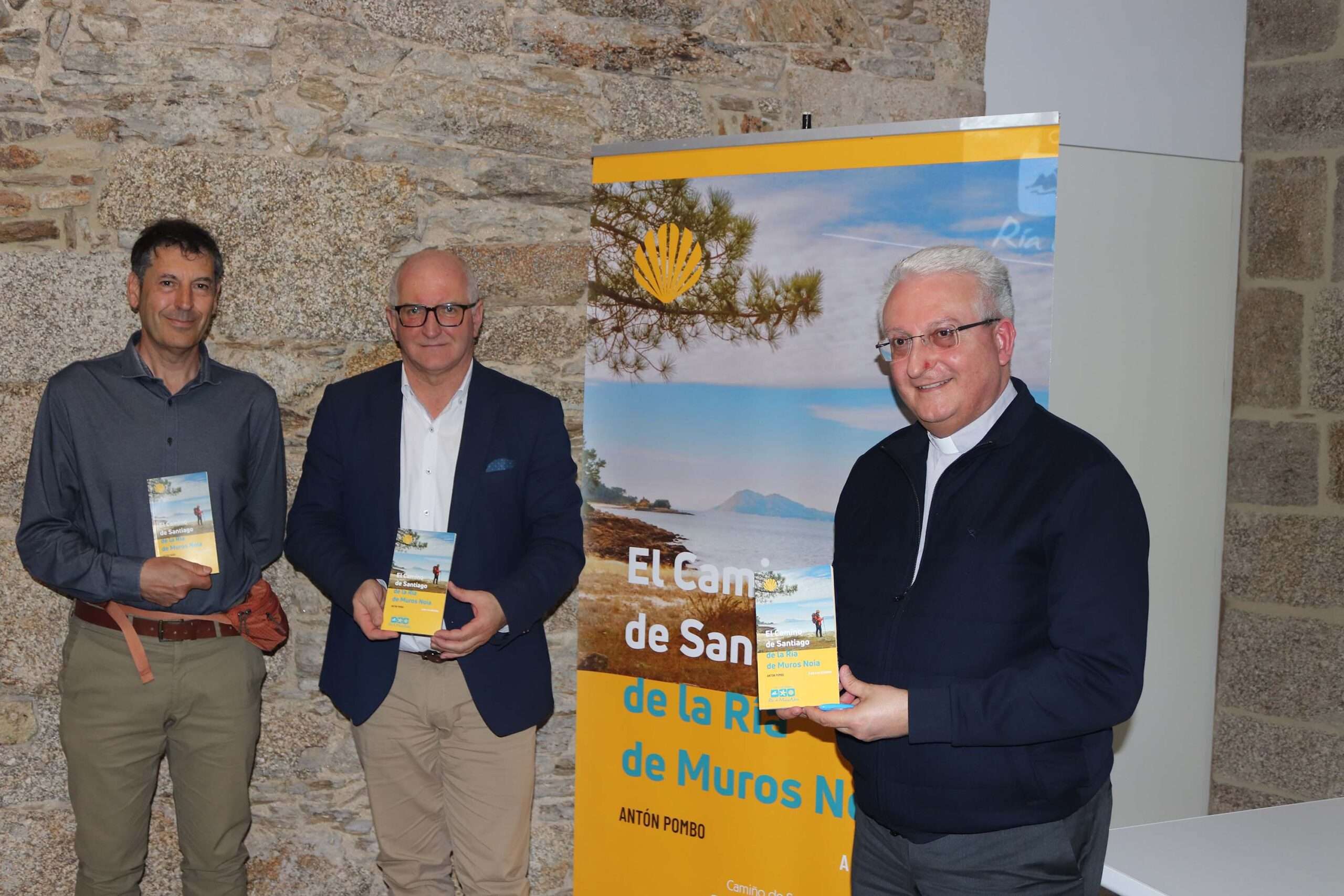
Antón Pombo, recognized expert on Jacobean routes, presented on Monday the first official guide of the Muros-Noia Estuary Road, a route that he described as "pleasant and short, which runs along the sea and offers exceptional scenery." The work, titled The Camino de Santiago de la Ría de Muros-Noia, was presented at the Pilgrim Reception Office in Santiago de Compostela, in an event that included the participation of Santiago Freire, president of the Association of Municipalities of the Camino de la Ría de Muros-Noia, and Daniel Lorenzo, director of the Cathedral of Santiago Foundation.
Santiago Freire highlighted that the guide "provides very valuable information and will be an indispensable tool for pilgrims who choose this itinerary." In addition, he expressed his gratitude to the municipalities that are part of the association (Muros, Outes, Noia, Porto do Son, Lousame, Rois, Brión, Ames and Santiago), as well as to the Archbishopric of Santiago and the business and associative entities of the Ría de Arousa.
Daniel Lorenzo stressed that the Camino de la Ría de Muros-Noia invites you to "walk, stop, contemplate, reflect and assimilate", with stages of moderate distance that facilitate the connection with the historical and artistic environment. «Often, pilgrims begin their march at dawn and quickly reach the end of the stage without taking time to enjoy the journey. “This guide promotes a more leisurely and pleasant experience,” he noted.
A landscape and heritage discovery tour
Antón Pombo, author of the guide, highlighted the natural beauty and variety of landscapes of this Jacobean route. «It is a pleasant and short route, with the added attraction of a 15 kilometer stretch from Porto do Son that runs between beaches and secluded coves, with views of Mount Louro and Cape Fisterra«he explained. He also mentioned that the guide, published by the Association of Municipalities of the Camino de la Ría de Muros-Noia with the support of the GALP Costa Sostible, is designed so that pilgrims can take notes and includes practical information on distances, difficulty, sources, bars, supermarkets, accommodation and prices.
"To write about the Camino, it is necessary to walk it," said Pombo, arguing that pilgrims value practical details more than historical data. In this sense, he highlighted places of interest such as the Caminos Reales de Muros and Noia, the Castro de Baroña and the Toxosoutos area, "a well-preserved riverside forest that extends for 10 kilometers, a unique experience in Galicia."

















