




The mobile phone is everywhere. Also on the Camino de Santiago.
In recent years, its presence has raised an uncomfortable but necessary question:
Are we still doing the Camino or are we just documenting it?
For many, the phone has become an extension of the body. You walk looking at the screen, you photograph every arrow and every coffee, you check notifications even in the middle of the mountain. And that changes the experience, whether we like it or not.
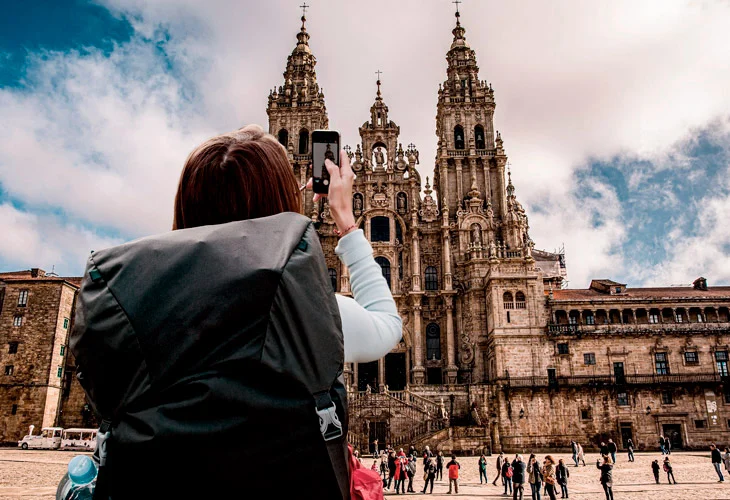
When the cell phone rules more than the Camino
There are increasingly common scenes:
- Pilgrims who do not look up from the GPS
- Groups walking in silence with headphones
- Constant photos without barely looking at the landscape
- Publications on networks before finishing the stage
The Camino, which has always been about encounter, silence and observation, runs the risk of becoming a simple decoration for the mobile phone.
It is not a criticism of the technology itself, but of the automatic and unlimited use that many of us make of it.
The paradox: never so connected, never so absent
It is curious that, on a Camino full of people, there is an increasing feeling of human disconnection.
The mobile phone provides information, but also creates distance.
When walking while looking at the screen:
- We talk less
- You hear less
- It is shared less
- It feels less
The Camino does not require constant attention, but it does require presence. And that's difficult when your cell phone takes up all your mental space.
What if the cell phone was not the problem?
The controversy is not in carrying a cell phone, but in not knowing how to let go.
The telephone can be useful, even necessary:
- Security
- Organization
- Emergencies
- Memories
But the problem appears when he becomes the protagonist.
Many pilgrims recognize that the best moments of the Camino come when their cell phone stays in their backpack. When you walk without music. When silence is accepted. When you talk to strangers without looking at the time.
El Camino does not need coverage
The Camino has survived centuries without WiFi, without apps and without social networks.
And it continues to offer the same: time, space and truth.
It is not about going back to the past, but about consciously choosing how we want to live this experience.
Because the Camino is not measured in likes, nor in stories, nor in messages sent.
Final reflection
You can take your cell phone on the Camino,
but make sure that he is not the one who takes you.
Sometimes turning off the screen is the best way to turn on the Camino.

















