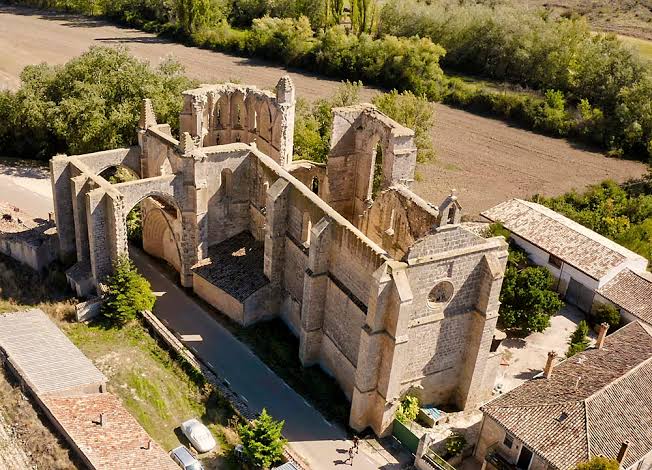
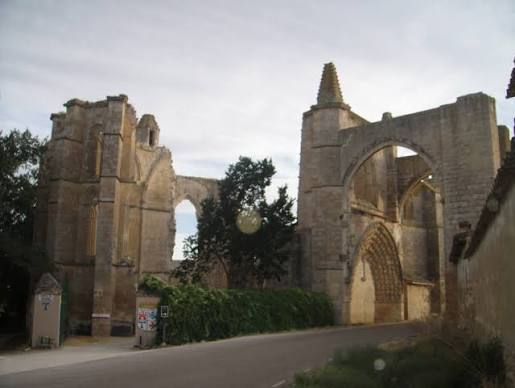
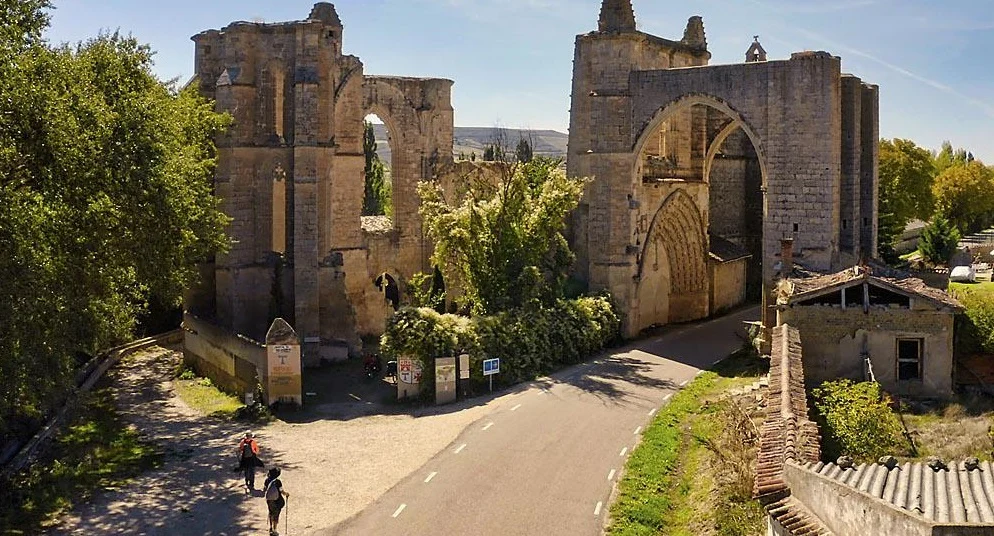
Between Hontanas and Castrojeriz, In the middle of the French Way, the ruins of San Antón appear. Today they impress with their beauty and the arch under which pilgrims still pass. But during the Middle Ages that place was much more than a monastery: it was a hospital specialized in treating one of the most feared diseases in Europe.
The Camino de Santiago preserves places that, seen today, seem peaceful.
Ancient stones.
Arches.
Ruins.
Cereal fields.
But some of those places had a much harsher history than they appear.
One of them is in Burgos.
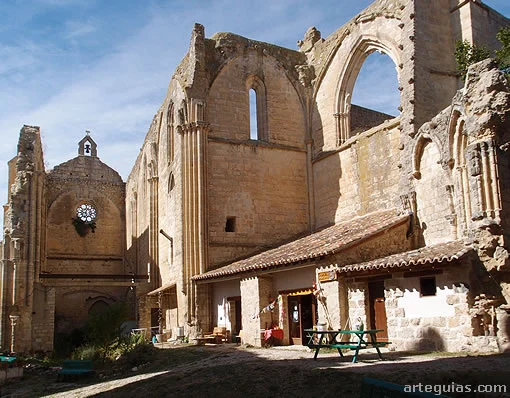
A few kilometers from Castrojeriz, the Camino literally crosses the ruins of the old convent and hospital of San Anton.
Thousands of pilgrims pass under its arches every year.
Many take a photograph.
Few know what happened there for centuries.
A hospital for a terrifying disease
San Antón was founded in 1146 by Alfonso VII and he remained linked to the Antonian religious.
The order became known for caring for people affected by a disease that for centuries received different names:
fire of San Antón, sacred fire or evil of San Antón.
The name was not coincidental.
Those suffering from the disease could experience an intense burning sensation in the extremities.
In severe cases, blood circulation problems, gangrene and loss of fingers, hands or feet appeared.
Seizures and neurological alterations could also occur.
For a medieval person, that must have seemed almost inexplicable.
A fire that was not seen.
But it seemed to consume the body from within.
The enemy was in the bread
Today we know that many cases of that so-called San Antón fire were related to the ergotism.
The problem could appear after consuming cereals—especially rye—contaminated by a fungus.
In a society where bread was one of the staple foods, the danger could spread quickly among entire communities.
But for centuries no one really knew the origin of the problem.
For those who fell ill, the pain could seem like a curse.
And for those who cared for them, alleviating that suffering was one of the most difficult tasks of medieval medicine.
The Antonians specialized in taking care of them
The religious of the Order of San Antón developed a special dedication towards this type of sick person.
Its hospitals spread throughout different parts of Europe.
On the Camino de Santiago, the presence of a center like the one in Castrojeriz also had another fundamental function: caring for sick or exhausted pilgrims during their journey.
As time went by, San Antón not only received people affected by the sacred fire.
He also offered assistance to other walkers.
In a time without ambulances, health centers or modern pharmacies, finding a hospital on the Camino could mean the difference between continuing the journey or not being able to do so.
The pilgrims passed under the convent
There is something especially unique about San Antón.
The Path passes directly under the remains of the old building.
The large Gothic arches are still part of the route.
The modern pilgrim today crosses exactly through a space that for centuries was linked to the sick, religious and medieval travelers.
This continuity makes the place one of the most special points of the French Way.
It is not simply a ruin that can be seen from afar.
The Camino goes through history.
Food for those who arrived late
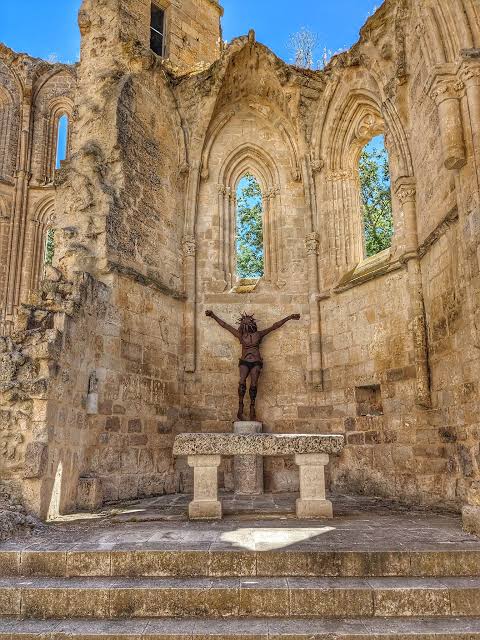
One of the most human details of the old hospital can still be seen on its walls.
Some small ones are preserved cupboards where the monks left food for pilgrims who arrived when the convent doors were already closed.
The traveler could find something to eat there.
It is a simple gesture.
But it perfectly summarizes an essential part of the medieval Camino.
Hospitality did not end when a door was closed.
They were looking for a way to help even the pilgrim who arrived late.
Bread, wine and hospitality
The Antonians were known for offering care to those who came to the hospital.
Tradition also remembers the delivery of bread and wine to pilgrims.
Behind those foods there was something more than charity.
For a person who had been walking for days, feeding, resting and finding a safe place could be urgent needs.
The Camino hospitals were not modern hospitals.
They were spaces of welcome, refuge, assistance and care.
Some pilgrims arrived simply tired.
Others arrived sick.
And some could be living their last days.
A disease that today seems almost impossible
The story of the San Antón fire reminds us of how vulnerable medieval life was.
Something as everyday as eating bread could become a threat.
Without modern medical knowledge, identifying the cause of a disease could take centuries.
The symptoms could be interpreted as punishments, religious signs or mysterious illnesses.
Today we know the relationship between certain fungi and ergotism.
But for those pilgrims there was no such explanation.
There was only pain.
El Camino was also a health network
When we talk about the medieval Camino we usually think of churches, monasteries and pilgrims.
But the Camino was also an enormous assistance network.
Hospitals, shelters, and religious establishments dedicated to serving travelers emerged along the routes.
Some even specialized in certain problems.
San Antón is one of the most impressive examples.
Its existence demonstrates that the Camino was not only a spiritual route.
It was also a human infrastructure.
Castrojeriz, one of the great places on the French Way
After passing through San Antón, the pilgrim arrives at Castrojeriz.
The Burgos town is one of the great historical enclaves of the French Way.
Its long main street practically follows the Jacobean route itself.
For centuries it received travelers, the sick, merchants and religious people.
The importance of the Camino left an exceptional heritage there.
But perhaps no image is as striking as the arrival from Hontanas and the sudden appearance of the ruins of San Antón.
A place that continues to speak to the pilgrim
Today, sick people no longer come looking for a cure for the San Antón fire.
There are no longer monks waiting behind the walls.
Those facilities are no longer used as a hospital.
But thousands of people continue to pass through the same place.
And maybe that's the most exciting part.
A 21st century pilgrim passes with a backpack, mobile phone and technical shoes under the same arch that people crossed hundreds of years ago.
People who walked in fear.
With diseases.
With faith.
And with the hope of reaching Santiago.
The Path that also healed
The story of San Antón reminds us of something that we sometimes forget.
The Camino was not born solely to take people to an apostolic tomb.
He also created hospitals.
Bridges.
Shelters.
Communities.
And a welcoming culture that helped thousands of travelers for centuries.
Today the ruins of San Antón seem silent.
But just stop for a few minutes to imagine everything that happened there.
Sick pilgrims.
Monks attending.
Food left on the walls.
Pain.
Hope.
And a Path that, even in the Middle Ages, tried to take care of those who walked along it.