



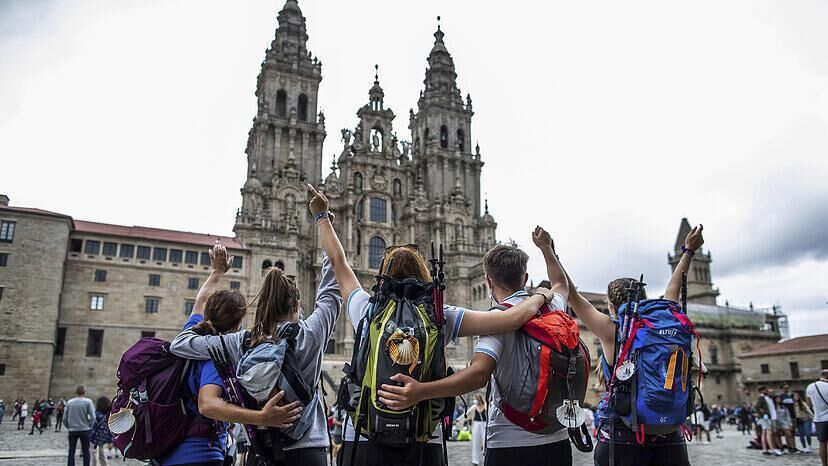
Infocatholic Report that for the third consecutive year, the record of pilgrims on the Camino de Santiago has been broken. In 2022 there were 438,307 pilgrims, in 2023 there were 446,082 and in 2024, 499,239 diplomas were issued for pilgrims who arrived at the Sanctuary in the northwest of Spain, pilgrims from all over the world.
Towards the Sanctuary where the tomb of the holy apostle is located, and since the Middle Ages, various paths have led that cross all of Europe but that join in their final sections in Portugal, Spain and France. The influx and enthusiasm that the arriving walkers demonstrate every day has made Santiago de Compostela one of the three main destinations of the Christian pilgrimage.
The months in which the most pilgrims arrive are May, with 72,645 arrivals, and August with 71,639 arrivals, constituting an average of 2,300 arrivals per day, which sometimes exceeds the patience of local residents, among other reasons because these walkers are joined by millions of additional visitors, including busloads of pilgrims, cultural tourists and cruise ship excursionists.
Routes from Portugal increase
To obtain the desired diploma, pilgrims must demonstrate that they have traveled the last 100 kilometers of the journey on foot, or the last 200 kilometers by bicycle, a fact that is still commendable.
The majority of pilgrims (236,378) arrive via the main route, the so-called “French Way; however, the routes from Portugal have increased in popularity: the second busiest route is the “Portuguese Way” (95,453 pilgrims), followed by the “Portuguese Coastal Way” (74,758 pilgrims).
Statistics by nationality
Spaniards constitute the largest national group, with 208,000 pilgrims (42% of the total), followed by Americans (38,052 pilgrims). 28,599 Italians and 23,462 Germans. 2,459 pilgrims arrived from Austria. At the bottom of this statistic are countries such as Gambia, Suriname, Laos and the Solomon Islands, with only one pilgrim from each.
The motivations
Jorge Martínez-Cava, president of the European association of Friends of the Camino de Santiago, assures that "approximately between 30 and 35 percent feel motivated by the Catholic faith. A similar percentage is motivated by spiritual reasons. The rest have other reasons, since the Camino is also a path of art, nature, friendship, gastronomy and sport."
Martínez-Cava assures that the roads leading to Santiago continue to be safe, but recommends the use of the “Alertcops” app, which has a button with the SOS option and the location option for the police. The application, from the Ministry of the Interior, is only available in Spanish, but work is being done to make it appear in other languages. He also says that the beginning of spring and the end of autumn are suitable times to perform the pilgrimage.
FOUNTAIN: GAUDIUMPRESS

















