



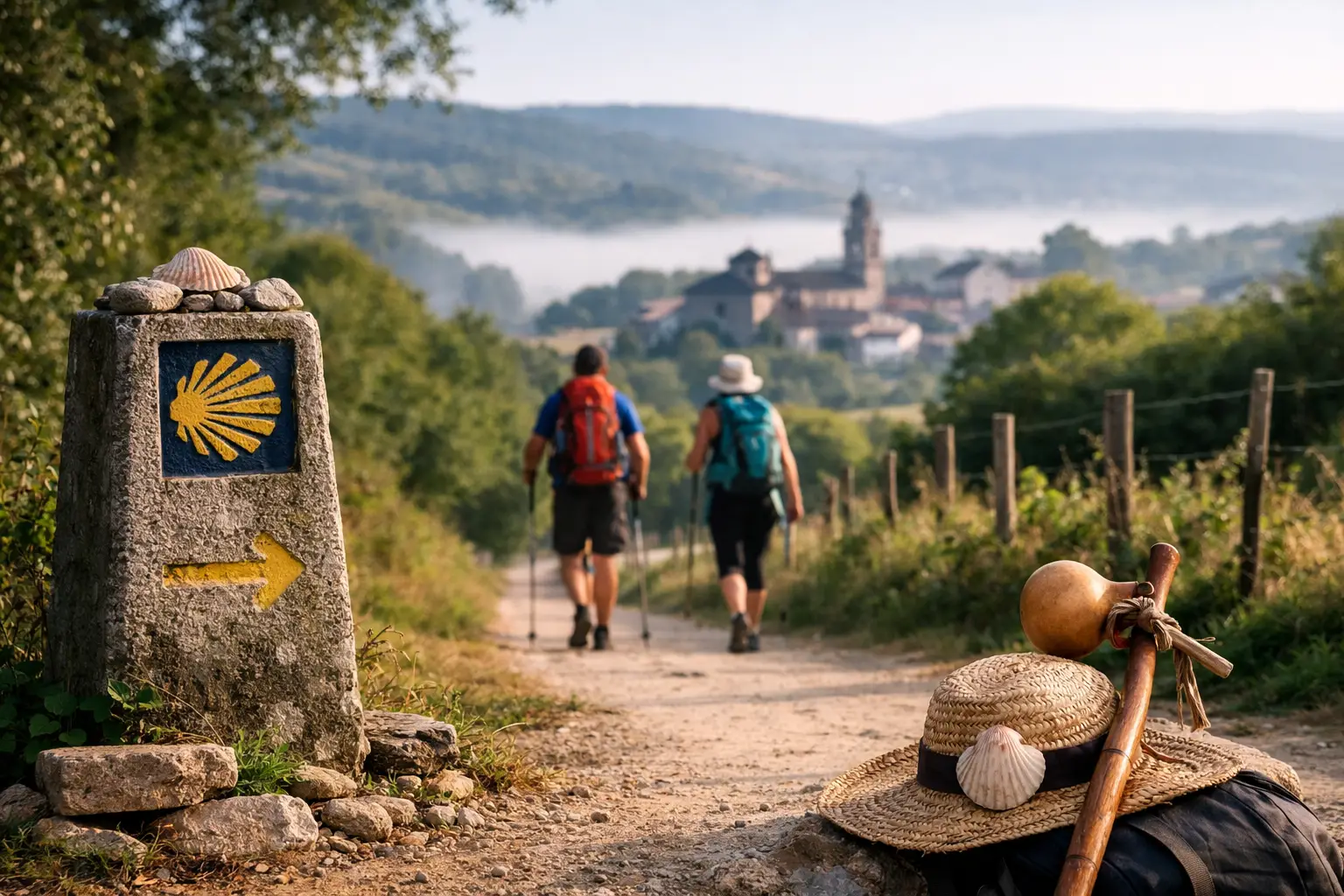
Sarria is not the beginning of the Camino, but for thousands of people it is the beginning of a decisive story. The search for French Way stages from Sarria It answers a very specific question: how to travel the last kilometers to Santiago without turning the pilgrimage into a race. They are just over 100 kilometers, enough to obtain the Compostela if the established conditions are met, but also to discover that the Camino is not measured only in stamps, steps or photographs.
From here, the itinerary enters Galicia and changes pace. Corredoiras appear between oaks and chestnut trees, stone villages, possible rain in any season and a much greater pilgrim presence than in other sections. There are services, yes, but also more demand. Planning well makes the difference between walking with serenity or spending the day worrying about your reserve, your backpack, and your watch.
Stages of the French Way from Sarria: the classic route
The most common division proposes five days. It is a comfortable formula for a person with reasonable physical preparation and allows you to reach Santiago without major beatings, except for one stage that should be watched carefully: that from Palas de Rei to Arzúa.
Sarria – Portomarín: 22.2 kilometers
The departure from Sarria brings excitement, new backpacks and a lot of nerves. It is advisable to get up early, especially in spring, summer and long weekends, but it is not necessary to go out at night. The Camino descends towards the river and soon enters a rural landscape that anticipates the Galician character of the following days.
Barbadelo, Morgade, Ferreiros and Mercadoiro are names that remain in memory. The profile is leg-breaking, with short climbs and repeated descents, so the kilometers weigh more than they appear on the map. Portomarín awaits at the end next to the Belesar reservoir, with its church of San Nicolás moved stone by stone when the dam was built.
It is an appropriate stage to start, although those who arrive with little shape should walk slowly and not wear brand new boots or a loaded backpack. The typical mistake is wanting to make up time on the first day. No need: the Camino has just opened.
Portomarín – Palas de Rei: 24.8 kilometers
The day begins with a sustained climb at the exit of Portomarín. It is not a mountain, but it requires warming up with patience. Then comes a Galicia of small towns, dirt tracks and local roads, with the area around Ligonde as one of the places with the greatest Jacobean tradition.
It is a long stage, although quite regular. On hot days, the central stretch can become monotonous if you leave late; On rainy days, some areas of land ask for more attention. Palas de Rei has everything you need to rest, eat and replenish, but in high season it is wise to book accommodation reasonably in advance.
Palas de Rei – Arzúa: 29.3 kilometers
Here is the key planning decision. Completing the almost 30 kilometers to Arzúa is possible for trained walkers and for those who have already found their rhythm during the first two days. However, it is not mandatory to do so. In fact, splitting the day in Melide is usually a much kinder choice.
The road descends towards the Seco River and reaches Pontecampaña before crossing the province of A Coruña. Melide is a historic stop, popular for its restaurant offerings and the arrival of the Camino Primitivo. From there, the route is once again filled with voices, accents and pilgrims who join the flow towards Santiago.
If you continue to Arzúa, you have to count on accumulated fatigue. It is not advisable to be guided by who walks faster or by the idea that a long stage gives more merit. The merit is in taking care of the body and preserving joy. Arzúa offers a good network of accommodation and is known for its cheese with designation of origin, a very Galician reward after a demanding day.
Arzúa – O Pedrouzo: 19.3 kilometers
After the previous effort, this is a more contained stage. The route goes through forests, small villages and eucalyptus areas, with gentle slopes and generally comfortable terrain. It is the day when many conversations change: there is already talk of the arrival, the pilgrim's mass, the photo in the square and what each person hopes to find in Santiago.
O Pedrouzo, also known as Arca, functions as a large Compostela anteroom. It has numerous services, but precisely for this reason it can register a high occupancy. If you are traveling in a group, with a pet or need an adapted room, don't leave this stop until the last minute.
O Pedrouzo – Santiago de Compostela: 20 kilometers
The last stage begins with excitement and, often, with a mixture of haste and nostalgia. Leaving early allows you to arrive in Santiago in time to pick up the Compostela, leave your backpack and experience the entry without stress. Passing through Lavacolla and Monte do Gozo announces that the finish line is near, although there are still urban kilometers left.
The arrival through San Lázaro and the entrance into the historic center prepares a moment that does not need great speeches: the Plaza del Obradoiro appears at the end of the street and each pilgrim receives it in a different way. Some celebrate, others cry, others remain silent. Anything goes.
The six-stage alternative: a smart decision
Dividing Palas de Rei – Arzúa into two days is one of the best options for those who are starting to walk in Sarria, are traveling with their family, have physical discomfort or simply want to enjoy more time. The distribution would be like this: Sarria – Portomarín, Portomarín – Palas de Rei, Palas de Rei – Melide, Melide – Arzúa, Arzúa – O Pedrouzo and O Pedrouzo – Santiago.
This alternative reduces the longest stage and allows you to get to know Melide without looking at the clock. In exchange, it demands one more night, one more day of budget, and additional accommodation planning. There is no perfect division for everyone. There are pilgrims who enjoy five intense days and others who find their best Camino in six or seven days.
It is also possible to shorten the first day by sleeping before Portomarín or extend your stay in a location. What is not advisable is to design a rigid plan if you do not yet know how your feet, knees or back will respond. Leave, when you can, a small margin.
Credential, stamps and Compostela from Sarria
Sarria is located at a distance greater than the 100 kilometers required to apply for the Compostela on foot. But distance alone is not enough. During the last 100 kilometers it is necessary to prove the route with the duly stamped credential, normally with at least two stamps per day. Hostels, parishes, tourist offices, bars and other establishments linked to the Camino usually facilitate this.
Don't turn the credential into an obsessive collection, but don't neglect it either. Store it in a waterproof case, especially if you walk in the fall or winter. When you arrive in Santiago, check that your personal information is complete before going to request the certificate.
The Compostela is given to those who make the pilgrimage for religious or spiritual reasons. Those who experience it from a cultural, sporting or personal motivation can request the corresponding distance certificate. Honesty with one's own motivation is also part of respect for the Camino.
Practical tips to walk better
There are frequently fountains, bars and towns along this stretch, but that doesn't mean you should walk without water. Always carry a canteen or bottle and some simple food: fruit, nuts or a sandwich. In summer, the heat can appear strongly; In winter, humidity and mud completely change the experience.
The backpack should be light. For five or six days it is not necessary to carry half a wardrobe. Layers of clothing, rain protection, spare socks, a small first aid kit and documentation are the basis. If you use backpack transport, perfect, but keep water, medication, raincoat and valuables with you.
The blisters do not resolve when they already hurt a lot. Check your feet every day, dry well between your toes and act at the first touch. A ten-minute rest before the pain sets in is worth more than an hour of suffering at the end. And if an injury arises, don't dress it up as an epic: there are taxis, transportation and health professionals. Asking for help is also knowing how to make a pilgrimage.
In high season, book the first nights and keep an eye on availability for the following ones. In low season, check openings, because some services reduce hours. The Camino has hospitality, but it does not guarantee a specific bed or eliminate the need for foresight.
Beyond reaching Santiago
From Sarria you will walk accompanied many times, even if you leave alone. There will be noisy groups, cyclists, families, people praying and those just looking for a few days of air and silence. The challenge is to live with that diversity without losing your own pace.
Walk carefully towards the towns that receive you. Buy when you can at local businesses, say hello, respect the rest of the neighbors and don't leave trash on the trails. The Camino lives because there are villages, hospital workers, workers and communities that support it every day.
When fatigue sets in, don't think about Plaza del Obradoiro just yet. Look at the next intersection, listen to your footsteps and look up at the forest. Santiago will arrive. The truly valuable thing is that you also reach each of the days that separate you from her.

















