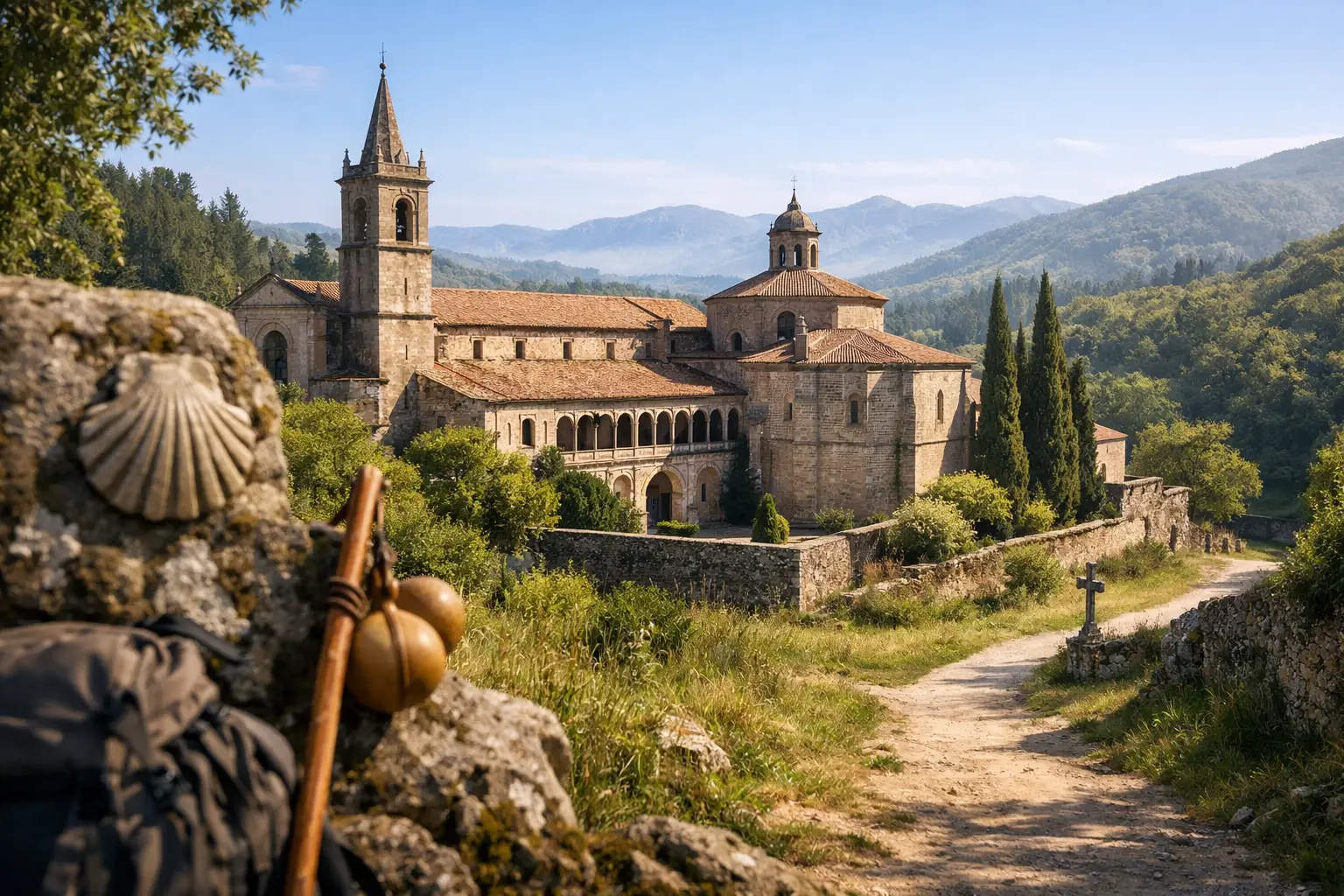
There are places on the Camino where the noise of the backpack suddenly drops. A cloister, a Romanesque doorway, the smell of wet stone or the sound of bells can change the rhythm of a stage. The monasteries on the Camino de Santiago are not a simple cultural visit: they are part of the spiritual, healthcare and human network that supported pilgrims for centuries.
Many were born next to mountain passes, medieval hospitals, bridges or commercial roads. They guarded relics, offered food and shelter, copied manuscripts and helped establish the routes that we travel today with boots, mobile phones and credentials. But it is important to arrive with a clear idea: a living monastery is not a museum open at any time. It is, above all, the home of a religious community.
Monasteries on the Camino de Santiago: a meaningful stop
Not all the buildings that the pilgrim identifies as monasteries maintain monastic life, nor are all of them exactly on the main layout. Some are old abbeys converted into cultural or hospitality spaces; others maintain an active community and worship schedules that must be respected. This difference matters a lot when organizing the day.
The best way to visit them is without the anxiety of crossing a monument off a list. If your stage allows it, arrive early, check the schedule at the place itself and enter discreetly. A mass, a few vespers or a few minutes in silence can say more about the Camino than a hasty photograph.
There is also a practical issue: the opening of churches, museums, inns and shelters may vary by season, liturgical celebrations, works or community needs. In the busiest months, calling or confirming before diverting the route avoids disappointment and added kilometers.
Samos, the great reference of the French Way
The monastery of San Julián de Samos, shortly after Sarria, is one of the most powerful images of the French Way. Its relationship with pilgrimage dates back to the Early Middle Ages and its presence continues to impress even the walker who arrives tired after a long day. The monumental façade, the cloisters and the church speak of centuries of fires, reconstructions and Benedictine continuity.
Samos invites you to stop, but you should not confuse a visit with a retreat experience. There may be organized tours, celebrations and non-accessible areas. The key is to adapt to what the monastery offers that day. Whoever seeks art will find painting, architecture and memory; Those who arrive with a spiritual concern will find, above all, a place that asks them to lower their voices.
Furthermore, on this part of the Camino, many pilgrims enter the last week of their march. Taking a conscious pause in Samos can help put order in everything you experienced before Santiago appears on the horizon.
Irache and the heritage that changes its function
In Ayegui, at the gates of Estella, the monastery of Santa María la Real de Irache reminds us that the Jacobean heritage has had many lives. Its monastic and hospitable origin is closely linked to the passage of pilgrims through Navarra. Today the complex combines history, worship and cultural uses, while the famous wine fountain concentrates much of the popular attention.
The photo by the fountain may be fun, but it shouldn't overshadow the place. Irache talks about a central idea of the Camino: hospitality is not a recent invention. Of course, prudence is also part of the pilgrimage. A symbolic sip should not become a problem for the stage or for coexistence in the hostel.
From the Pyrenees to La Rioja: Roncesvalles, Leyre and Nájera
Roncesvalles is not a monastery in the strict sense, but rather a collegiate church, but it deserves to be on any tour of the great Jacobean shelters. For those who start from Saint-Jean-Pied-de-Port, getting there after crossing the Pyrenees has an emotional burden that is difficult to explain. Its history is linked to the care of walkers, the memory of the mountain and the need for refuge in a demanding environment.
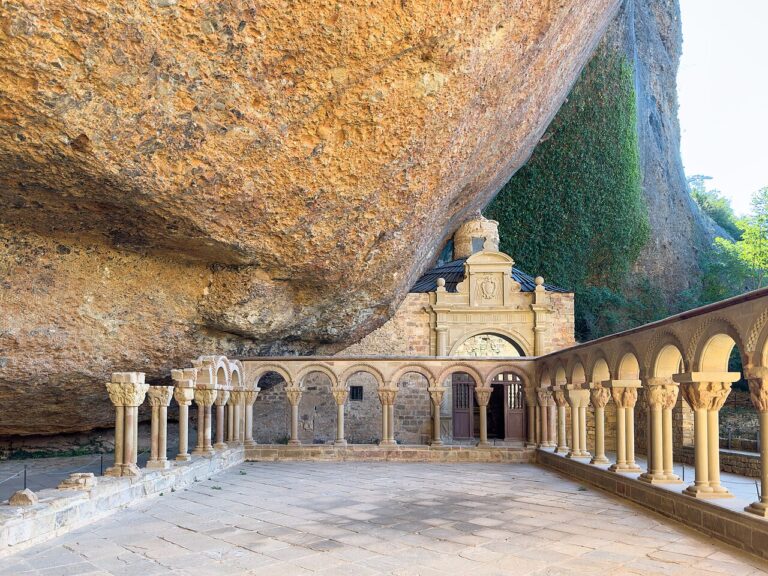
Further south, the monastery of San Salvador de Leyre offers a stop of enormous value for those who travel the Aragonese Way or have time to visit it from their itinerary. Its Romanesque crypt is one of those spaces that forces you to look slowly. It is not intended for a five-minute visit: the detour is only worth it if it really fits into your plan and you can enjoy it without rushing.
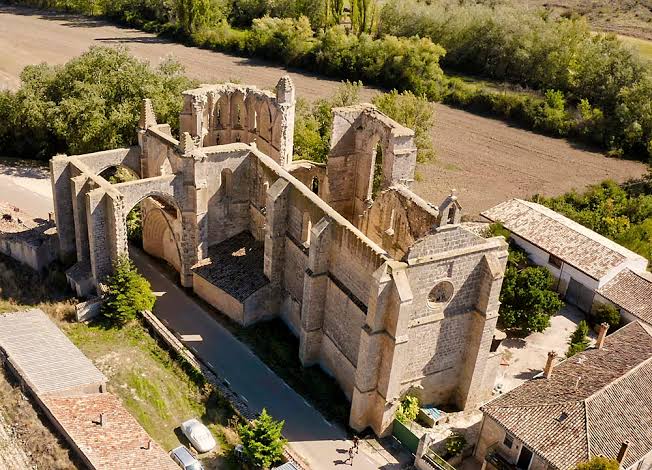
Santa María la Real de Nájera, on the French Way, is another essential stop. Its royal pantheon, its church and its cloister connect the route with the political and religious history of the ancient Kingdom of Navarra. It is a visit especially recommended for pilgrims interested in understanding that the Camino was not a single medieval road, but a network of power, devotion, commerce and hospitality.
Monasteries that change the route: Liébana, Oseira and Sobrado
There are pilgrims who choose a path for its landscape; others do it for a sanctuary or a monastery. In it Lebaniego Road, the monastery of Santo Toribio de Liébana is the great reason for arriving. There the Lignum Crucis is venerated and the atmosphere has a very marked religious weight, especially in celebrations and jubilee years in Lebanese. The visit can be deeply significant for believers, but also for any traveler sensitive to the history of popular devotion.
In Galicia, the monastery of Santa María la Real de Oseira is one of the great jewels linked to the Camino Sanabrés. Its monumental Cistercian church and its rural surroundings justify specific planning. It is not an improvised stop for those who follow the stage measured to the minute: you have to carefully review the chosen route, the unevenness and the availability of accommodation in the area.
The monastery of Santa María de Sobrado dos Monxes, associated with the connections of the Camino del Norte to the Galician interior, offers another very different experience. Its monumental scale coexists with the silence of a place away from large cities. For many pilgrims, it is one of the points where traditional hospitality is perceived most strongly. Precisely for this reason, whoever stays or enters its premises must understand that they are sharing a living space, not consuming any tourist service.
Armenteira and the rhythm of the Spiritual Variant
The Armenteira monastery, on the Spiritual Variant of the Portuguese Way, summarizes very well the relationship between nature and contemplation. Located in a green and humid landscape of the Rías Baixas, it is linked to the Cistercian tradition and allows the pilgrim to experience a less linear route than the usual Portuguese route.
The Spiritual Variant is not for all calendars or for all physical conditions. It may require more organization, and the subsequent stage includes the well-known sea crossing linked to the Traslatio tradition. But for those looking for landscape, heritage and a less rushed experience, Armenteira leaves its mark.
How to visit a monastery without breaking its calm
The monastic hospitality It has simple rules, although sometimes they are forgotten in the middle of the season. Dress respectfully if you are going to enter a temple, silence the phone, avoid speaking loudly in cloisters and chapels and ask before taking photographs. If there is a celebration, do not occupy reserved areas or enter and leave unnecessarily.
If the monastery has a guest house or hostel, read the rules carefully. Some houses welcome pilgrims with specific schedules, others prioritize reservations, and others do not allow conventional tourist stays. Donation does not mean free or without responsibility: it means that the trust and collaboration of the pilgrim sustain a model of reception that deserves care.
You don't have to idealize everything either. You may arrive to find construction, a closed church, a community with limited access, or a guided tour that doesn't fit your schedule. It is part of the Camino. Sometimes the lesson is not in entering, but in understanding that those walls do not exist for our agenda.
When preparing your next stage, leave room for these places. You may not see all the monasteries, and that's okay. It is enough for one to really make you stop: then the Camino will have found a silent way to walk with you.