



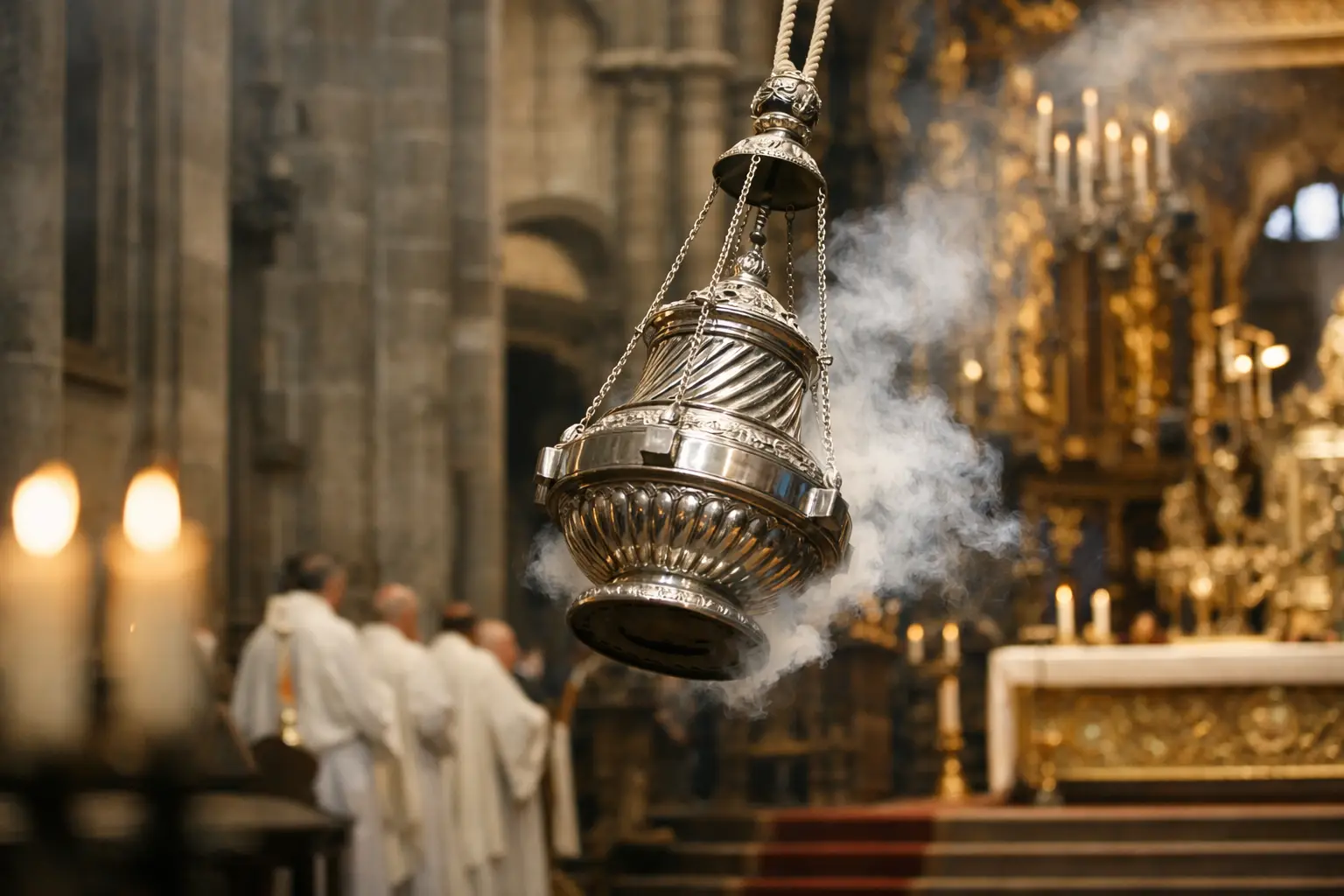
Arriving at the Cathedral and seeing the great censer fly is one of those images that many pilgrims keep forever. But he Botafumeiro Santiago schedule It does not function like that of a tourist attraction: it is linked to the liturgical life of the basilica, to the great celebrations and to decisions that may vary. If you dream of living it, it is advisable to prepare for your arrival with enthusiasm, yes, but also with information and time margin.
The Botafumeiro does not come out every day
The first answer, and the most useful, is clear: the Botafumeiro does not operate at all masses nor does it have a guaranteed daily departure. Its use is usually reserved for notable solemnities of the religious calendar and for some specific celebrations authorized by the Cathedral of Santiago.
This may surprise those who finish the French Way, the Portuguese Way or any other route convinced that they will see the rite upon arrival. The excitement of Plaza del Obradoiro is enormous, but the end of a pilgrimage does not need a scheduled function to have meaning. Still, if Botafumeiro is important to you, plan your final stages with that possibility in mind.
The liturgical calendar, worship needs, security and the cathedral organization itself determine when it is used. Therefore, a date that has traditionally included Botafumeiro should not be understood as an absolute guarantee until the Cathedral confirms the celebration.
Botafumeiro Santiago schedule: traditional dates
The great censer is usually present in several of the most important solemnities of the year. Among the dates that are traditionally associated with its use are the Epiphany, Easter Sunday, the Ascension, Pentecost, the solemnity of the Apostle James on July 25, the Assumption on August 15, All Saints, Christ the King, the Immaculate Conception, Christmas and the Translation of the Apostle, on December 30.
There is a key idea to avoid disappointment: these dates indicate a tradition, not an entrance ticket. The time of mass can be modified and a celebration can have its own particularities. There are also extraordinary events, institutional visits and group celebrations in which it can be used, but they are not free access events that can be taken for granted without confirmation.
On July 25, big day of Santiago, is the best known date. Precisely for this reason it is also one of the most demanding days for the pilgrim: a lot of influx, access controls, full streets and the need to arrive very early. Seeing the Botafumeiro that day can be unforgettable, but it may not be the quietest experience for those looking for silence at the end of their Camino.
What time does it move?
There is no single time that works for the entire year. The Botafumeiro is used during a specific mass, normally at a specific liturgical moment, not as an independent spectacle before or after the service. Therefore, looking for a fixed time such as “it leaves at twelve” can lead to errors.
The practical recommendation is to check, a few days before your arrival, the schedule of masses and the celebrations planned by the Cathedral. If you are already in Santiago, confirm it again the day before or that same morning. On busy dates, a logistical modification can change the way of access even if the mass is maintained.
Don't just trust old videos, comments on social networks or calendars copied from previous years. On the Camino, as in the mountains, useful information is updated.
How to organize your arrival at the Cathedral
If your last stage ends in Santiago and you want to attend a mass with Botafumeiro, avoid designing a plan at the minute. Arriving on foot from O Milladoiro, from Monte do Gozo or after a long stage from Arzúa can be exciting, but also tiring. Booking an extra night in the city gives you the freedom to collect the Compostela, rest and go to the Cathedral without rushing.
Arrive early enough. In an ordinary celebration, the wait will depend on the influx that day. On a solemnity or during the heavy months of pilgrimage, access can be concentrated long before the mass begins. Being left out is not unusual, and turning that possibility into anger only tarnishes a moment that deserves to be lived with serenity.
Respect the instructions of the staff and the signage. The Cathedral is a living temple, with a security protocol necessary to protect those who attend and a heritage of extraordinary value. This is not the time to push, to raise your cell phone above others or to occupy hallways. A photograph can wait; the memory, if you are truly present, no.
It also helps to dress appropriately for a place of worship and maintain a respectful tone. Many attendees come by faith, others by culture, others because they have come walking from very far away. All of these motivations fit into the basilica when the space is thoughtfully shared.
What are you seeing when the censer flies
The Botafumeiro is not a decorative object or a theatrical piece created for visitors. It is a huge incense burner, a unique piece of Compostela tradition, which swings through the naves of the Cathedral suspended from a system of ropes and pulleys.
Eight tiraboleiros are in charge of its movement. Their work requires coordination, technique and absolute attention. When the censer gains speed, the gesture impresses with its scale: it crosses the transept leaving a trail of aromatic smoke and seems to touch the vaults. But behind that image there is a liturgical tradition and a very precise office.
Incense has a deep religious meaning. Expresses prayer, honor and solemnity. In Compostela, furthermore, the Botafumeiro is part of an imaginary built for centuries around the welcome of pilgrims and the universal importance of the sanctuary of the Apostle.
It is often repeated that it was used to mask the smell of medieval pilgrims after weeks of marching. There is some truth in that ancient travel conditions were very different, but to reduce the Botafumeiro to that explanation is to lose sight of its main meaning: it is a liturgical element linked to worship and solemnity.
Can an exit from Botafumeiro be contracted?
In certain circumstances, groups, institutions or individuals can request its use for a specific mass through a contribution established by the Cathedral. This possibility exists, but requires planning, availability and authorization. It is not equivalent to reserving a tourist pass nor does it allow you to freely modify the order of the celebrations.
If you are traveling with a Jacobean association, a parish, a family group or Camino companions, it is advisable to manage any queries well in advance. The Cathedral may have already committed dates, organizational limits or pastoral criteria that condition the request. The more relevant it is to the group, the less advisable it is to leave it for the last few days.
Furthermore, it is worth asking yourself what you are looking for. For some people, participating in an intimate mass after completing the Camino has more value than trying to gather a group just to witness the flight of the censer. There is no single correct way to celebrate your arrival in Santiago.
If it does not coincide with your arrival, Santiago continues waiting for you
Not being able to see the Botafumeiro does not mean that your end of the route has been less complete. Santiago offers other moments of enormous strength: entering the Cathedral calmly, stopping in front of the tomb of the Apostle, listening to the murmur of the pilgrims in the square, walking the streets of the historic center or sharing a meal without looking at the clock with those who have walked beside you.
For many pilgrims, the truest moment comes outside the planned program. It could be when hugging a colleague in Praza do Obradoiro, when remembering a hard stage or when sending a message home after sealing the Compostela. The Camino is not measured by the images we get, but by what has changed us as we moved forward.
A final piece of advice for pilgrims
Check the current schedule, arrive early and have a plan B for your day in Santiago. If the Botafumeiro flies during your visit, enjoy it with respect: you are witnessing a living tradition, not an obligation of the route. And if it doesn't match, let the city give you another way to arrive. Sometimes the best end of the Camino begins when we stop chasing the schedule and allow ourselves to be present.

















