




What remains on the Camino will no longer be a waste
There is a scene that is repeated every year on the Camino de Santiago. Pilgrims who reach the end of their trip and decide to leave behind part of what has accompanied them for days or weeks: worn boots, a lifeless t-shirt or a lighter backpack.
Until now, many of those things ended up simply being thrown away. But that is starting to change.
The Xunta has launched a pioneering project in several hostels along the Camino to collect clothing, footwear and textiles used by pilgrims and give them a second life.
The first steps of the project
The initiative starts at very specific points along the Camino, places where the flow of pilgrims is constant and where many end their experience. In these shelters, specific spaces are already being set up to deposit clothing, shoes and other textile materials.
Also included are elements of the shelters' own operation, such as sheets, which can be reused or transformed into new products.
From used to useful
The interesting thing about this project is not only the collection, but what happens after. That material that apparently no longer works becomes a new raw material.
Footwear can be transformed into components for floors or surfaces.
Clothes can be recycled to create new fabrics.
Textiles can be converted into other useful products within a sustainable chain.
It is one more step towards a model in which the Camino is not only traveled, but also cared for.
A more conscious path
The growth in the number of pilgrims in recent years has put an obvious challenge on the table: how to maintain the essence of the Camino without increasing its environmental impact.
These types of initiatives seek precisely that balance. Not change the experience, but make it more sustainable.
Because every gesture counts, even what is left behind.
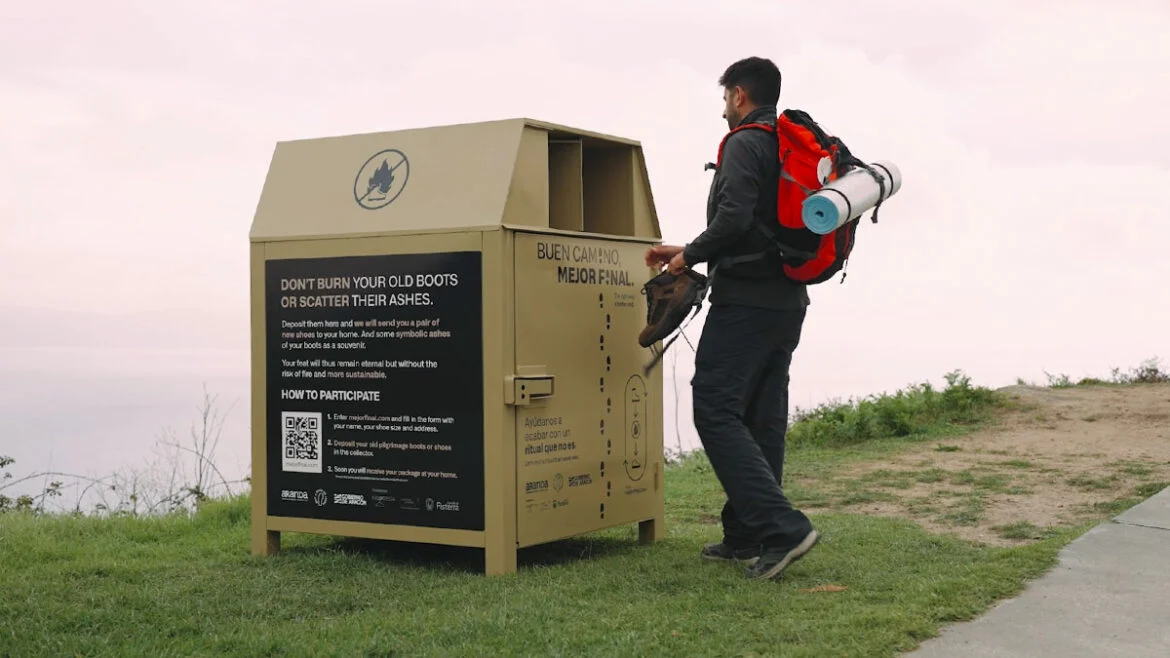
More than a symbolic gesture
For many pilgrims, leaving something at the end of the Camino has a special meaning. It is a way to close a stage, to get rid of what is unnecessary.
Now, in addition, that gesture can have a real impact. What is left does not disappear, it is transformed.
A project with a future
This is just the beginning. The intention is to expand the system to more shelters and consolidate a network that allows better management of the waste generated by pilgrims.
The Camino de Santiago has always known how to adapt to the times. And today, that change also involves sustainability.
Because the Camino is not only lived... it is also cared for.

















