



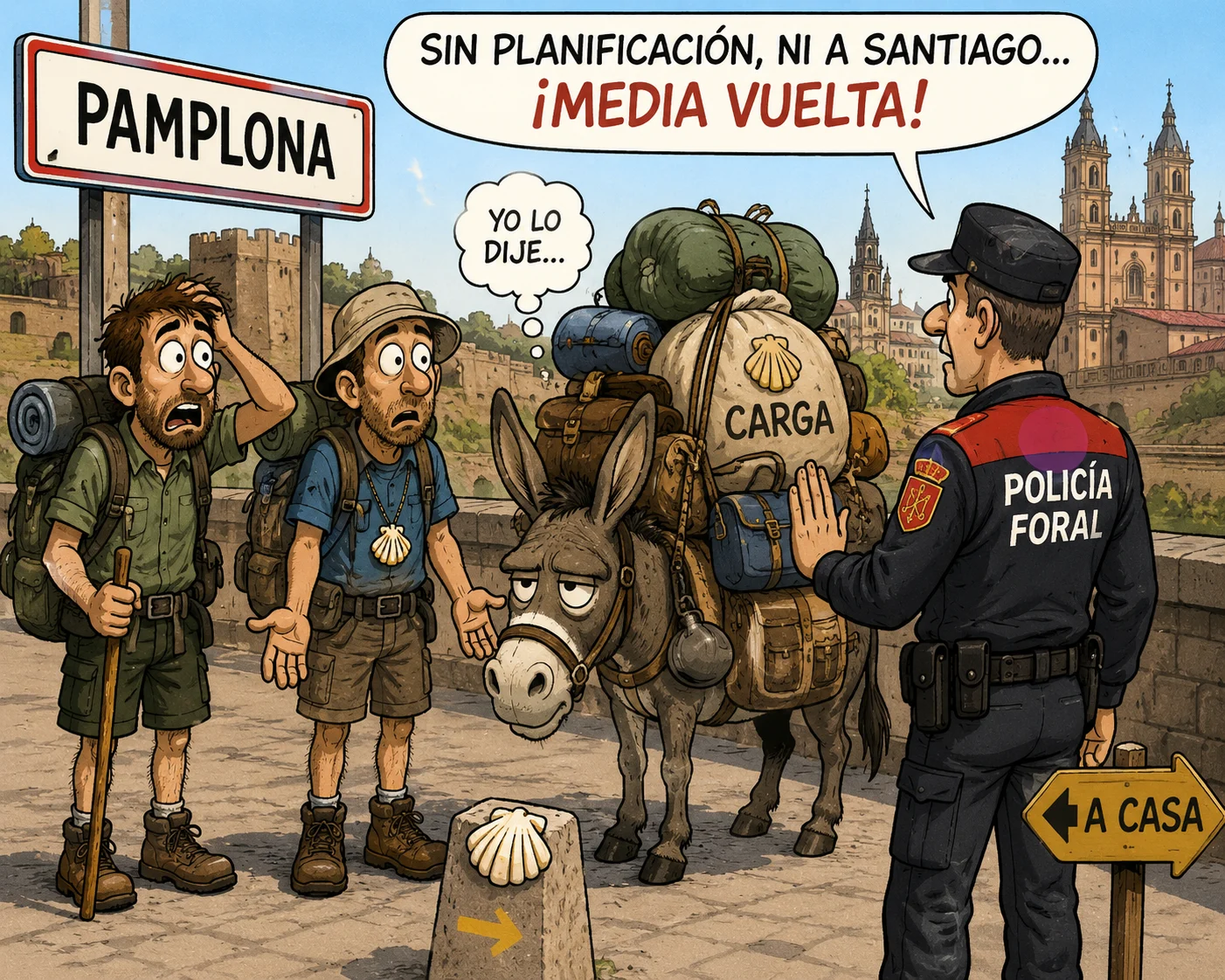
The adventure ended in Pamplona after discovering that doing the Camino with an animal requires much more preparation than expected.
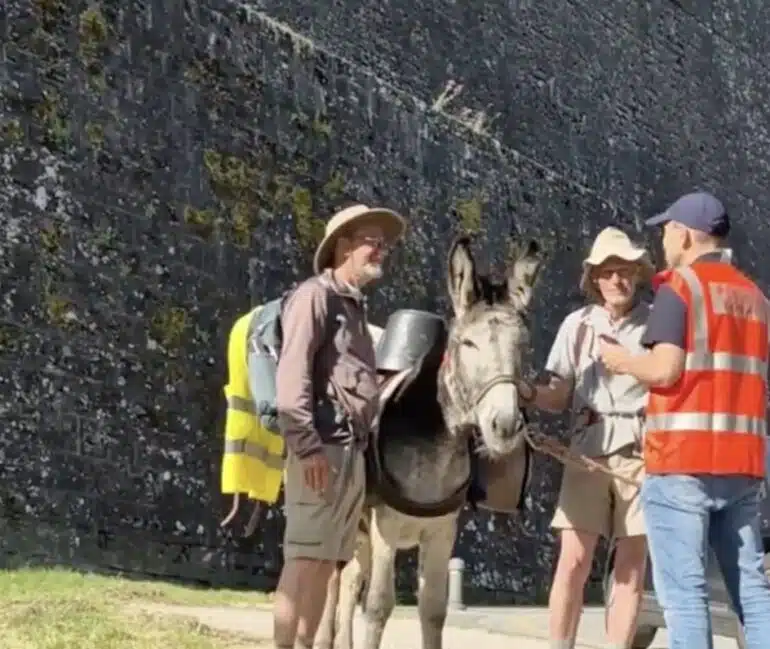
The Camino de Santiago is full of surprising stories, but rarely does an adventure end so soon and in such an unexpected way as that experienced by two pilgrims who were trying to travel the Jacobean route accompanied by a pack donkey.
The image seemed taken from another era:
two walkers,
a donkey,
backpacks
and the dream of walking the Camino in the most traditional style.
But reality ended up being much less romantic.
Upon reaching Pamplona, the pilgrims had to turn around when they realized that they had not correctly planned everything necessary to travel with an animal during the Camino de Santiago.
The story, spread by the Foral Police of Navarra, has quickly gone viral on social networks and has opened a huge debate among pilgrims about the limits between adventure, improvisation and animal welfare.
The problem was not the donkey... it was the logistics
Although walking the Camino with animals has a historical tradition, doing it in 2026 is much more complicated than many imagine.
According to the Foral Police, the pilgrims had not anticipated fundamental aspects such as:
adapted accommodation,
authorized areas for animals,
municipal regulations
and mandatory documentation of the donkey.
And there the big problem appeared.
Most traditional hostels on the Camino do not allow animals or do not have adequate facilities for them.
In addition, many municipalities prohibit leaving animals tied or unsupervised in public spaces, shops or urban accesses.
Added to this is another important aspect:
the load.
The authorities recalled that the weight transported must always adapt to the physical capabilities of the animal, especially on long routes and with high temperatures.
The Camino de Santiago is no longer the same as it was 50 years ago
The story has attracted special attention because it perfectly reflects how the modern Camino has changed a lot with respect to the romantic image that many travelers still have in mind.
Decades ago it was relatively common to see pilgrims accompanied by mules, horses or donkeys.
Today the reality is different.
The Camino moves millions of people, crosses highly regulated cities and increasingly depends on tourist infrastructure, accommodation and regulations related to:
animal welfare,
security,
rural tourism
and urban coexistence.
For this reason, many veteran pilgrims recognize that improvising on the current Camino can quickly become a problem.
Especially when traveling accompanied by animals.
Social networks turn the story into a viral phenomenon
The publication of the Foral Police spread quickly on social networks and generated thousands of comments among users that mixed humor, tenderness and criticism.
Many took the situation with irony, stating that the donkey had probably been “the most sensible of the group.”
Others, however, highlighted something more important:
the need to plan well any experience related to animals and the Camino de Santiago.
Especially now that more and more travelers are trying to take alternative routes looking for original experiences for TikTok, Instagram or YouTube.
The Camino continues to attract different adventures
The news also reflects how the Camino de Santiago continues to constantly reinvent itself.
Today pilgrims arrive looking for:
adventure,
digital disconnection,
slow travel,
spiritual experiences,
physical challenges
or content for social networks.
And some try to do it in increasingly original ways.
In recent years, pilgrims have appeared walking the Camino:
in an adapted chair,
with dogs,
with horses,
pushing cars
or even carrying out viral solidarity challenges.
But experts remember that the Camino, although it may seem simple on social networks, requires real preparation.
Especially when animals are involved.
The least “instagrammable” side of the Camino
Many users on networks also took advantage of the story to talk about the less visible side of the modern Camino.
Because behind the beautiful photos, the sunrises and the emotional posts, the Camino implies:
fatigue,
logistics,
reservations,
regulations,
changing climate
and constant planning.
And precisely that was what ended up stopping this peculiar pilgrimage before even leaving Navarra.
The donkey that became famous without reaching Santiago
Although they were finally unable to continue the route, the story has already become one of the most talked about on the Camino at the beginning of summer 2026.
And curiously, the donkey is probably already more famous than many pilgrims who will arrive in Santiago de Compostela.
Because on the Camino, sometimes, the most remembered stories are not the ones that end well.
But the ones that no one expected to live.

















