



A school in Navarra turns the Camino de Santiago into an accessible experience for everyone
There are projects that go far beyond education. Stories that show that the Camino de Santiago continues to be a tool capable of uniting people, exciting and transforming lives. And that is precisely what is happening in Navarra, where a special education school has managed to bring the experience of the Camino closer to students with great needs for physical support.
The project is developed at the Virgen de Orreaga Special Education School, in Aspace Navarra, and it has achieved something very simple to explain, but enormous emotionally: that all students can feel like pilgrims.
The initiative, called “We are going to Santiago”, adapts the essence of the Camino de Santiago to the day-to-day life of the center. The students add symbolic kilometers through adapted exercises, physical activities and inclusive dynamics, recreating the experience of advancing stage by stage towards Santiago de Compostela.
But speed or distance doesn't matter here. The important thing is to participate, share and feel part of the group.
To make this possible, the school uses different adapted tools: treadmills, assisted pedals, support harnesses and specific systems for students with reduced mobility. Everything is designed so that no student is left out of the experience.
And that is precisely the strength of the project.
While in many places the Camino de Santiago is associated only with tourism or sports, this initiative remembers something essential: the Camino is also about inclusion, community, improvement and humanity.
The center's own professionals explain that the emotional changes in many students are enormous. Some students look forward to “their stage” of the day, others constantly ask how many kilometers are left to get to Santiago, and many have found in this activity a special motivation to participate more actively.
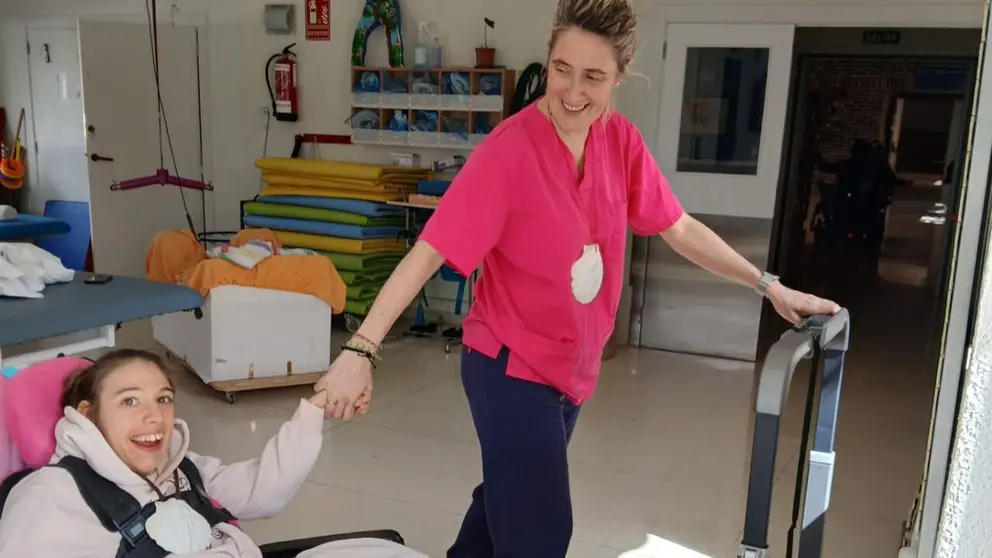
The families are also experiencing the project in a very emotional way. For many fathers and mothers, seeing their children participate in something as symbolic as the Camino is an experience that is difficult to describe.
In addition to physical activity, the school has incorporated typical elements of pilgrim culture: symbolic credentials, murals, maps of the Camino and activities related to hospitality, coexistence and Jacobean values.
The project is arousing interest even outside of Navarra for its ability to combine special education, universal accessibility, educational innovation and emotional well-being.
Because in the end, the Camino de Santiago has always been about that: walking together, each at their own pace.
And perhaps initiatives like this are the ones that best represent the true pilgrim spirit.

















