



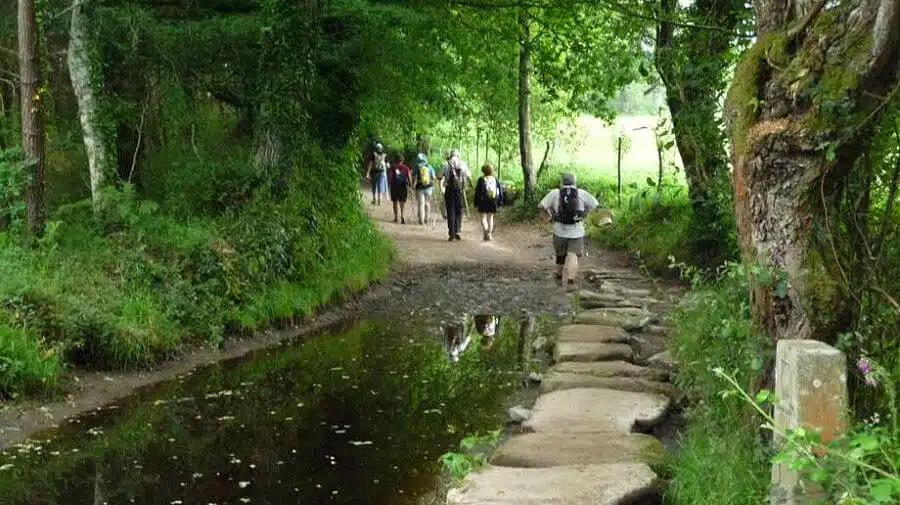
The French Way reinforces its infrastructure in the face of overcrowding and the rise of international tourism
He Camino de Santiago It continues to grow... but also becoming tense. One of the most saturated sections of the French Way, especially in its final part towards Santiago, will have a new hostel for pilgrims, a measure that seeks to relieve the pressure and recover part of the essence of the route.
The initiative comes at a key moment, where the increase in international tourism, organized trips and the rise of experiential tourism They are changing the reality of the Camino.
According to the information published, this new hostel will have an important differential characteristic:
👉 It will be aimed especially at long-distance pilgrims
An increasingly saturated road
The growth of Camino de Santiago 2026 It is generating an obvious impact in certain sections, especially in the last kilometers before reaching Santiago.
Areas such as Sarria or the final stretch of the French Way concentrate a large part of the pilgrims, which causes:
- accommodation saturation
- difficulty finding a place
- and an increasingly crowded experience
This phenomenon is directly linked to the increase in global tourism, low-cost travel, tourist packages and online reservations, which have facilitated access to the Camino for new traveler profiles.
A hostel with a clear focus
The key to this new hostel is not only in increasing places.
It's in who they are directed to.
The priority will be for pilgrims who are really doing the Camino over a long distance, trying to balance a situation that many consider unbalanced.
Because the debate is on the table:
👉 Is doing 700 km... the same as the last 100?
This type of measures attempts to answer, even partially, that question.
Tourism vs essence of the Camino
The success of the Camino is indisputable. But so is the risk.
The growth of active tourism, international hiking and spiritual tourism has turned the Camino into one of the most powerful products in Europe.
But that same growth generates tensions.
More people.
More business.
More pressure.
And less space for the traditional experience.
The rise of the tourism model on the Camino
Today, the Camino is not only a pilgrimage.
It is also:
👉 premium tourism
👉 organized trips
👉 guided routes
👉 personalized experiences
All this has boosted sectors such as:
- rural hotels
- private hostels
- backpack transport
- digital services for pilgrims
A complete ecosystem of tourism economy and travel services.
Solution or patch?
The opening of new shelters is necessary.
But not enough.
The underlying problem is not only the lack of places, but the concentration of pilgrims at certain points along the Camino.
Experts and associations have been insisting for some time on the need to:
👉 redistribute the flow of pilgrims
👉 promote other less saturated paths
👉 balance the tourism model
Because the risk is clear:
👉 die of success
The Camino continues to evolve
He Camino de Santiago It has never been static.
From the first medieval pilgrimages to the current boom of international tourism, the route has been able to adapt.
But now it faces one of its biggest challenges:
👉 maintain its essence in an increasingly commercial environment
A necessary balance
This new shelter represents more than just infrastructure.
It is an attempt to regain balance.
Between:
tradition and tourism
experience and business
walk… and consume
Because in the end, the Camino is not just a destination.
It's a way of living.
And that... cannot be saturated.

















