



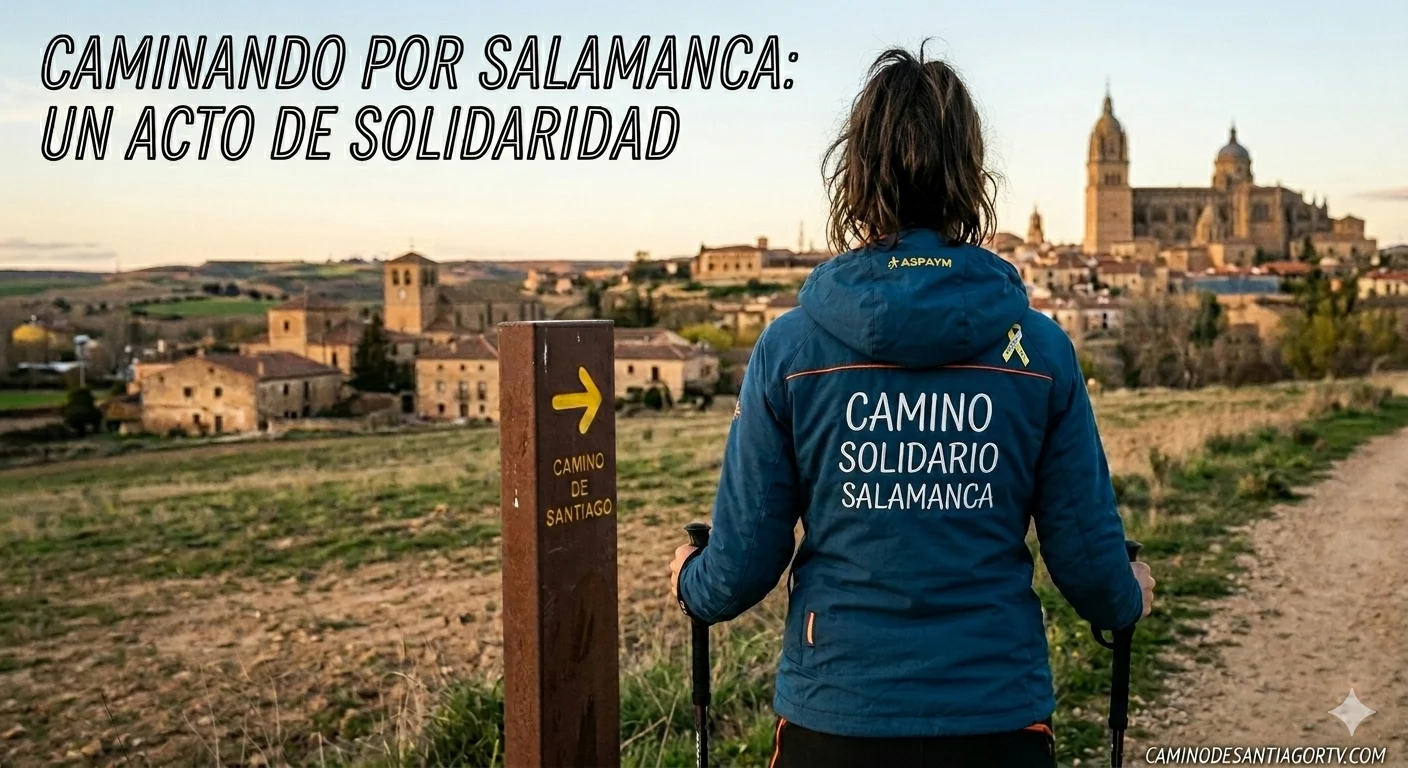
He will walk hundreds of kilometers to help those who need it most
In 2026, the Camino de Santiago will once again become the scene of one of those stories that excite far beyond the yellow arrows and the stages marked on the map.
A woman from Salamanca has decided to transform her pilgrimage into a solidarity challenge with a very clear objective: walking to help. An initiative that mixes personal effort, solidarity, responsible tourism and social commitment in a route that is already awakening interest among pilgrims and residents of Salamanca.
Every year stories related to personal improvement, health, emotional well-being, sports, hiking and charitable causes appear on the Camino. However, these types of projects still have a special ability to connect with people.
Because behind every kilometer traveled there is not only fatigue.
There is also an intention.
And in this case, helping has become the true destiny.
The Camino as a tool to change lives
The protagonist of this initiative has decided to take advantage of the enormous visibility and symbolic force of the Camino de Santiago to promote a solidarity action that seeks to mobilize support and raise awareness about a specific social cause.
The idea perfectly reflects how the Jacobean phenomenon has changed in recent years.
Today the Camino is not only a religious or tourist experience.
It has also become a space where:
solidarity projects,
sports challenges,
health campaigns,
charitable actions,
sustainable tourism
and personal growth experiences.
Many pilgrims take advantage of the impact of their routes to raise funds, give visibility to diseases, support associations or send awareness messages.
And that is precisely what makes these stories so special.
Salamanca maintains a strong connection with the Camino
The province of Salamanca preserves a very deep historical relationship with the Jacobean routes.
The Silver Way It continues to be one of the great itineraries of the Camino de Santiago in Spain and crosses some of the most representative landscapes of the Salamanca territory.
Furthermore, in recent years, other historical variants such as the Camino de Torres or the Camino de San Francisco have gained prominence, seeking to recover ancient, less-known pilgrimage routes.
This growing interest in historical paths is also promoting rural tourism, accommodation for pilgrims, local gastronomy and numerous activities related to cultural heritage.
More and more solidarity challenges on the Camino
The charitable challenges linked to the Camino are currently experiencing a moment of great growth.
Many people use the Jacobean routes to promote campaigns related to:
medical research,
fight against cancer,
rare diseases,
social inclusion,
mental health
or humanitarian aid.
The emotional force of the Camino means that these types of initiatives have an enormous capacity for dissemination.
Each stage generates stories.
Each meeting adds visibility.
And every pilgrim who listens to the cause helps the message continue to advance.
More than walking
Those who participate in solidarity challenges usually repeat the same idea.
There comes a time when fatigue stops being important.
Because the objective goes far beyond reaching Santiago.
Many claim that charitable causes end up becoming the true energy that drives the trip.
Especially on the hardest days.
When the blisters appear.
The rain.
The heat.
Or the kilometers seem endless.
The most human side of the Camino
Stories like this continue to demonstrate why the Camino de Santiago continues to excite millions of people around the world.
Because beyond monuments, cultural tourism, hotels, gastronomy or historical heritage, there is still something that differentiates the Camino from any other trip.
Humanity.
The ability to connect unknown people.
To help.
To share.
And to turn a simple act of walking into something much bigger.
While thousands of pilgrims are already preparing their backpacks for this summer, the initiative of this woman from Salamanca reminds us that some paths cannot be traveled solely with our feet.
They are also traveled with the heart.

















