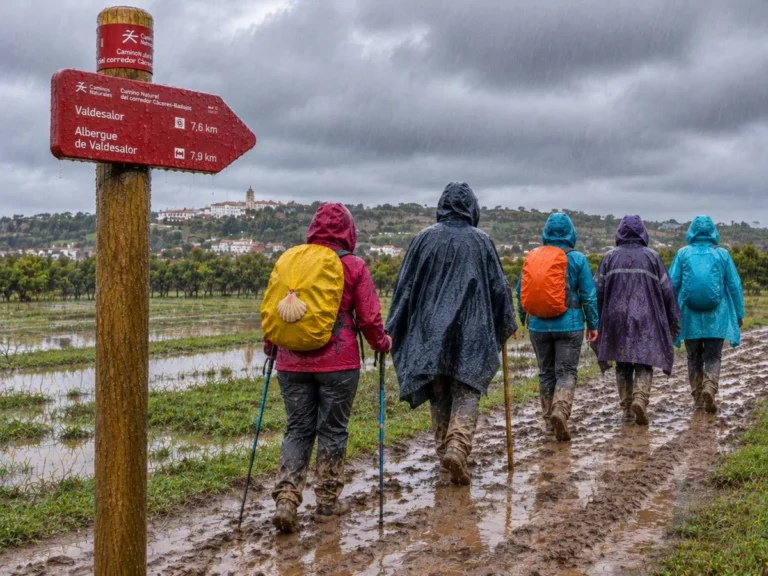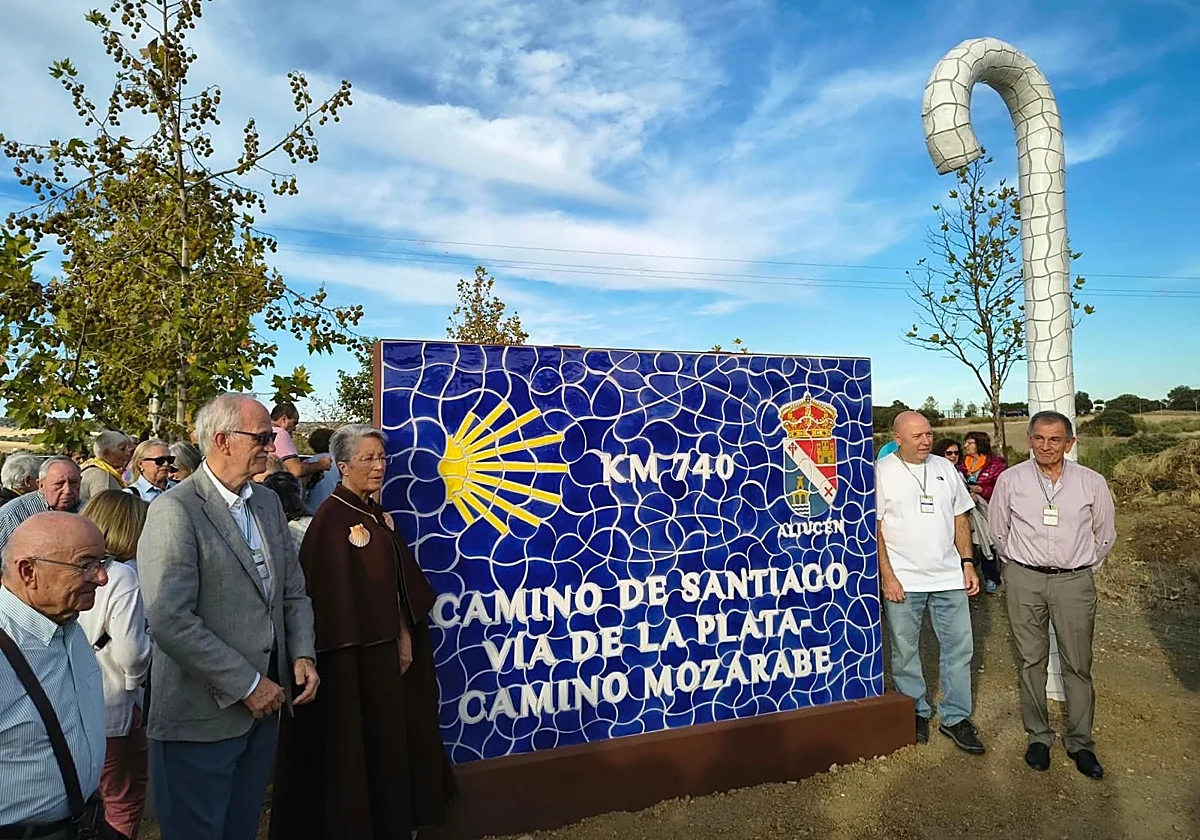
A few kilometers from Mérida, Aljucén keeps among its streets the traces of a history that began long before the yellow arrows pointed the way to Compostela. Romans, knights of the Order of Santiago and pilgrims of our days are part of the past and present of this small Extremaduran town, which has also found in mural art a way to celebrate its Jacobean identity.
Current events once again put the spotlight on the town, the protagonist of a TODAY report this November 16. The interest of Aljucén is not limited to providing accommodation for walkers: its heritage allows us to understand how an ancient itinerary ends up becoming part of the daily life of a town.
Whoever walks the Vía de la Plata from Mérida can take a break here after about 17 kilometers of walking. It is an opportunity to look with different eyes at the architecture, the paths and the symbols that accompany the pilgrim from the moment they enter the town.
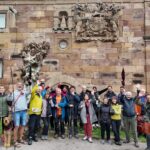
Opening photo: attendees next to the mural at kilometer 740 in Aljucén. Fountain: TODAY.
The Vía de la Plata, long before the yellow arrow
The old road that connected Augusta Emerita (Mérida) with Asturica Augusta (Astorga) explains a fundamental part of the history of this territory. Its layout favored the transit of people and goods and left an archaeological heritage that can still be studied in Extremadura.
In the area of Aljucén, the documentation of the Vía de la Plata protection file, published in the BOE in January 1998, includes specific vestiges of that infrastructure. Among them is a Roman milestone located to the north of the town, reused as a container for animals and in which remains of its inscription were still recognized.
It is a revealing detail: a piece that originally served to mark distances ended up integrated into the needs of the population. Today these remains allow us to reconstruct the relationship between the road and the nearby settlements. The file also documents the historical journey through lands near the Aljucén River.
The current Jacobean route does not necessarily coincide in every meter with the old road. However, the Vía de la Plata has inherited the role of corridor between the south and north of the peninsula. The Spanish Federation of Associations of Friends of the Camino identifies Aljucén as a crossing point for the Mérida-Alcuéscar stage of the Mozárabe-Vía de la Plata Way.
San Andrés, a church that preserves centuries of history
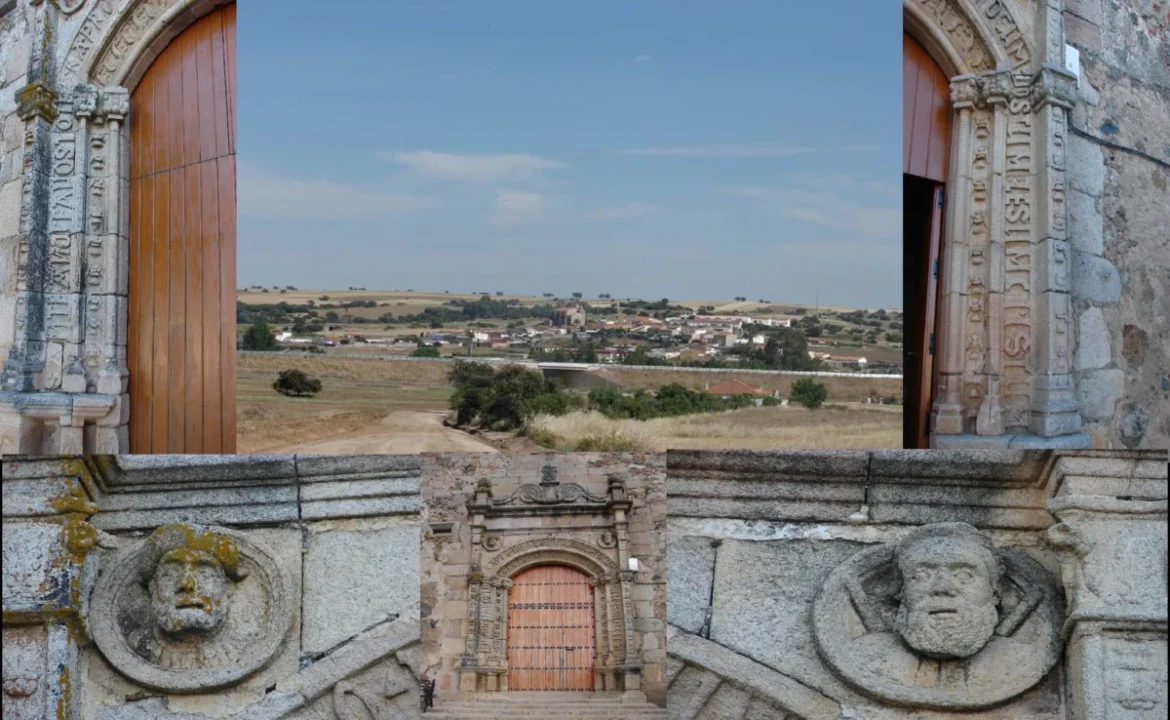
The parish church of San Andrés Apóstol is the main monumental reference in Aljucén. Its factory preserves elements from the late 15th and 16th centuries, a period in which the architecture of these lands was linked to the activity of the military orders.
On the outside, the tower integrated into the façade and, especially, the Renaissance façade stand out. The worked stone and the inscription that runs along the entrance make the entrance one of the details worth observing without haste. The Provincial Council of Badajoz highlights both its architectural composition and the invocation to San Andrés that appears in it.
The temple allows you to get closer to the legacy of the Order of Santiago in the region. The dedication of the church, dedicated to Saint Andrew, should not be confused with the military order to which the historical development of the town was linked. They are two different elements that help explain their religious heritage.
Murals, a new way of telling the Camino
Aljucén's heritage does not end with ancient architecture. In December 2024, the City Council announced the completion of the first phase of a mural on Santiago de Compostela Street, carried out by Pablo Herreros Art with the support of the Badajoz Provincial Council. The initiative sought to improve one of the accesses used by pilgrims and give visibility to the local identity.
More recently, the council called for the inauguration of another mural tribute to the Camino on October 24, 2026, in the park of the old waste dump, next to the entrance from El Carrascalejo. The event coincided with the XIV International Congress of Jacobean Associations, held in Mérida from October 22 to 25.
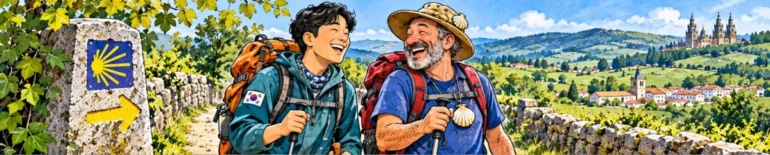
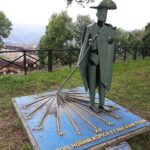
The new set includes a blue panel with the yellow scallop, the municipal shield and the inscription "KM 740", along with a large pilgrim's staff. The reference to the Vía de la Plata and the Mozárabe Way occupies a central place in the composition.
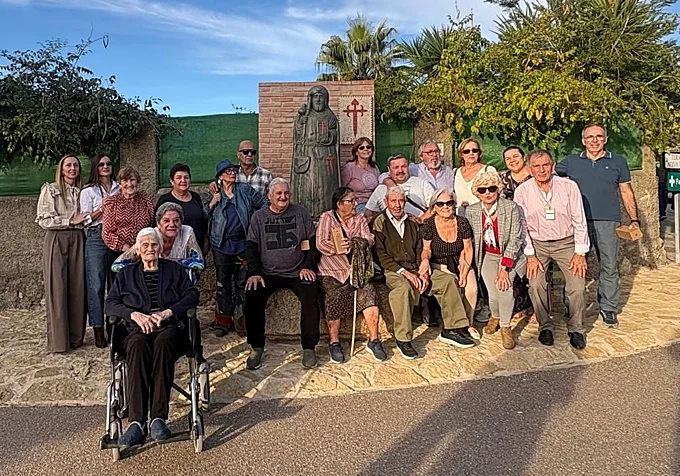
These projects bring Jacobean memory closer to public space. The pilgrim does not need to enter a museum to discover them: they are part of the streets and the landscape through which he walks. They also offer a way to recover spaces and make visible the town's relationship with its visitors.
A stop worth time
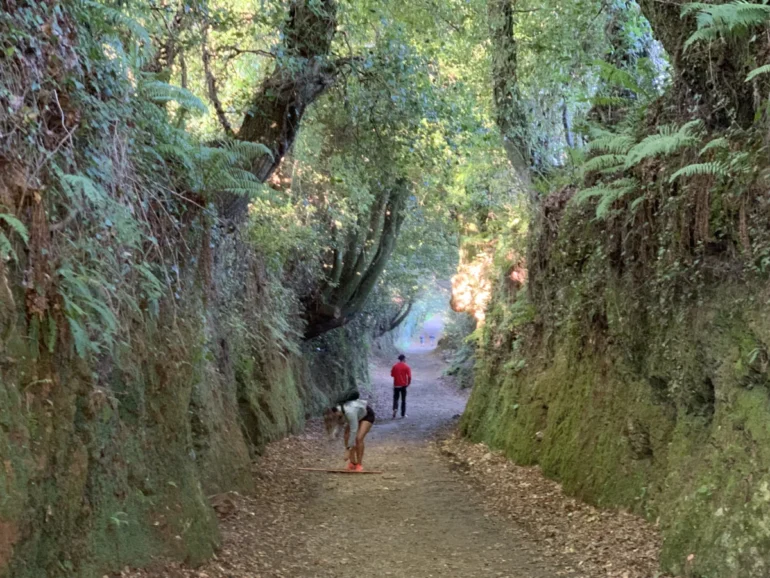
Aljucén is a good place to divide the long day between Mérida and Alcuéscar. From here the itinerary continues between holm oaks and cork oaks towards the surroundings of the Cornalvo Natural Park. Before leaving, it is advisable to confirm accommodation and stock up on water and food.
But there is another recommendation that does not require a service guide: stop in front of San Andrés, walk down Santiago de Compostela Street and discover the public art of the municipality. The landscape helps to understand why historic roads continue to have importance for those who live along them.
Aljucén remembers that the Jacobean heritage is not only found in the great cathedrals. It is also preserved in the stones of the towns, in their churches and in the murals that today welcome those who walk towards Santiago.
Sources: TODAY, November 16, 2026 (reference report); Aljucén City Council, call for the mural; City Hall, mural from 2024; BOE, protection file for the Vía de la Plata; Badajoz Provincial Council; Spanish Federation of Associations of Friends of the Camino de Santiago.
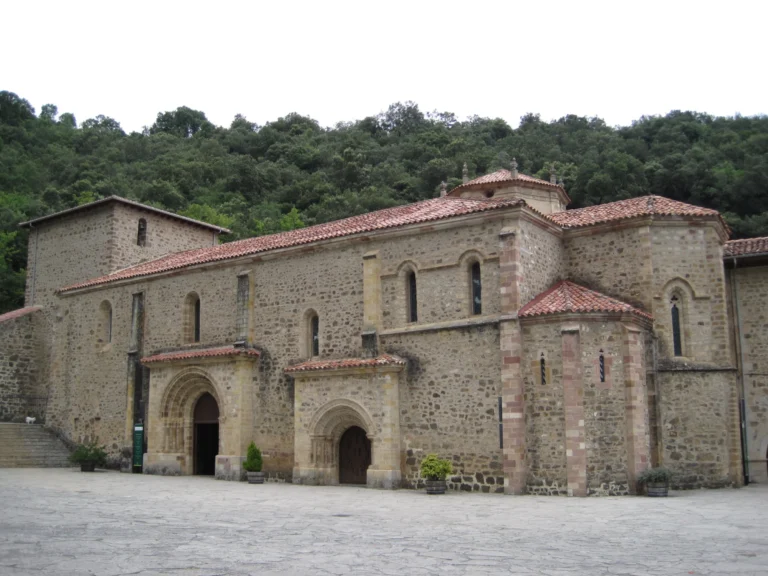
Images: Jjmolina, Wikimedia Commons, CC BY-SA 3.0; resized image.