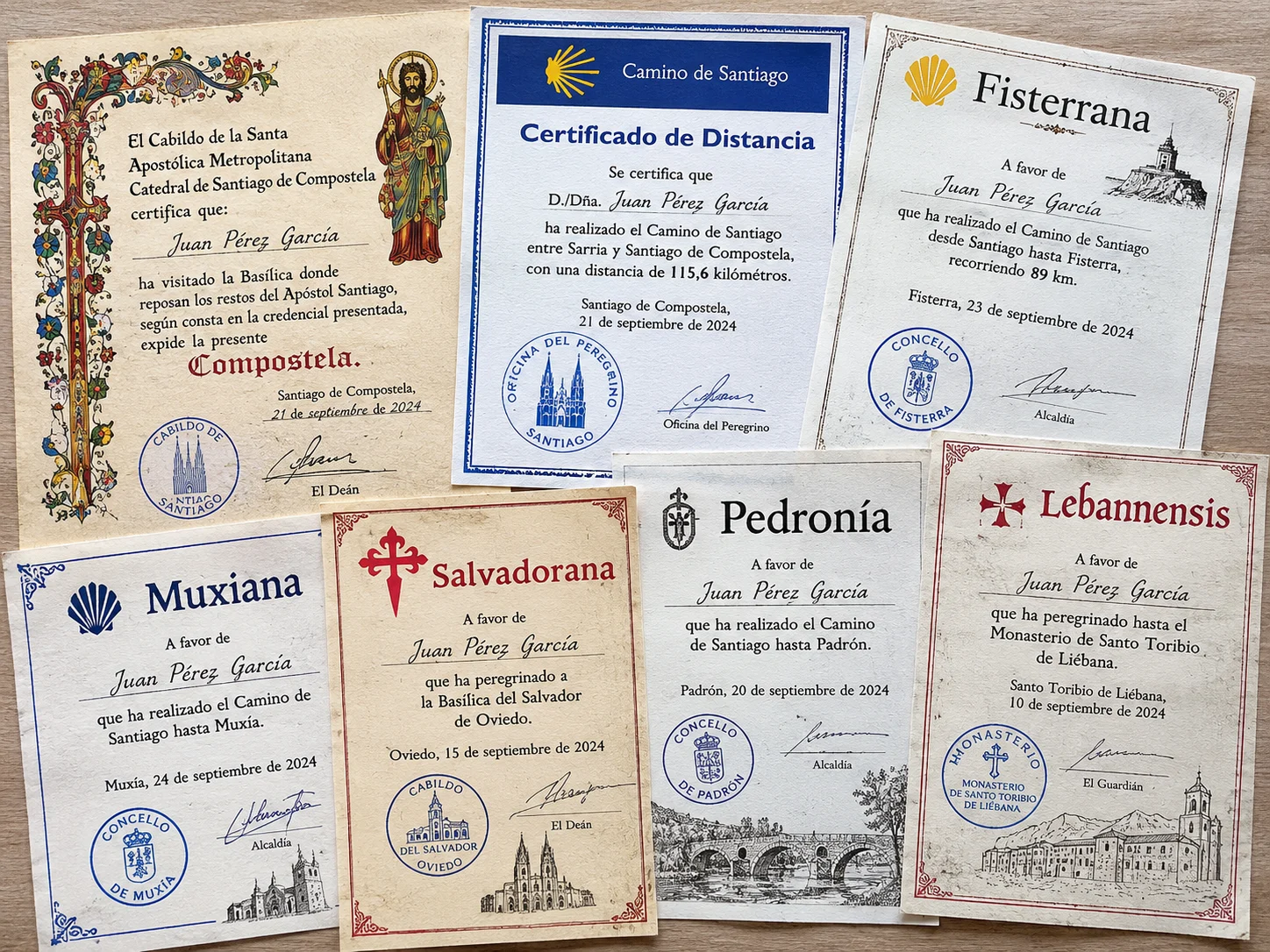
Thousands of pilgrims arrive every year in Santiago de Compostela with one goal: to achieve the Compostela. However, many are unaware that there are other certificates linked to the Camino de Santiago and different historical pilgrimage routes. The Fisterrana, the Muxiana, the Salvadorana, the Pedronía or the new Lebannensis are some examples. How many documents really exist, who issues them and what value do they have?
The Camino de Santiago is much more than a route with a beginning and an end. Over the centuries, an extensive network of itineraries has developed that connect cities, monasteries, sanctuaries and places of deep spiritual tradition.
Each retains its own particularities, and some have developed documents intended to recognize the efforts of those who complete the pilgrimage.
But it is worth clarifying one issue: there is not a single category of certificates with identical recognition for all Paths. Some are issued by ecclesiastical authorities, others by town councils and others by entities linked to certain routes.
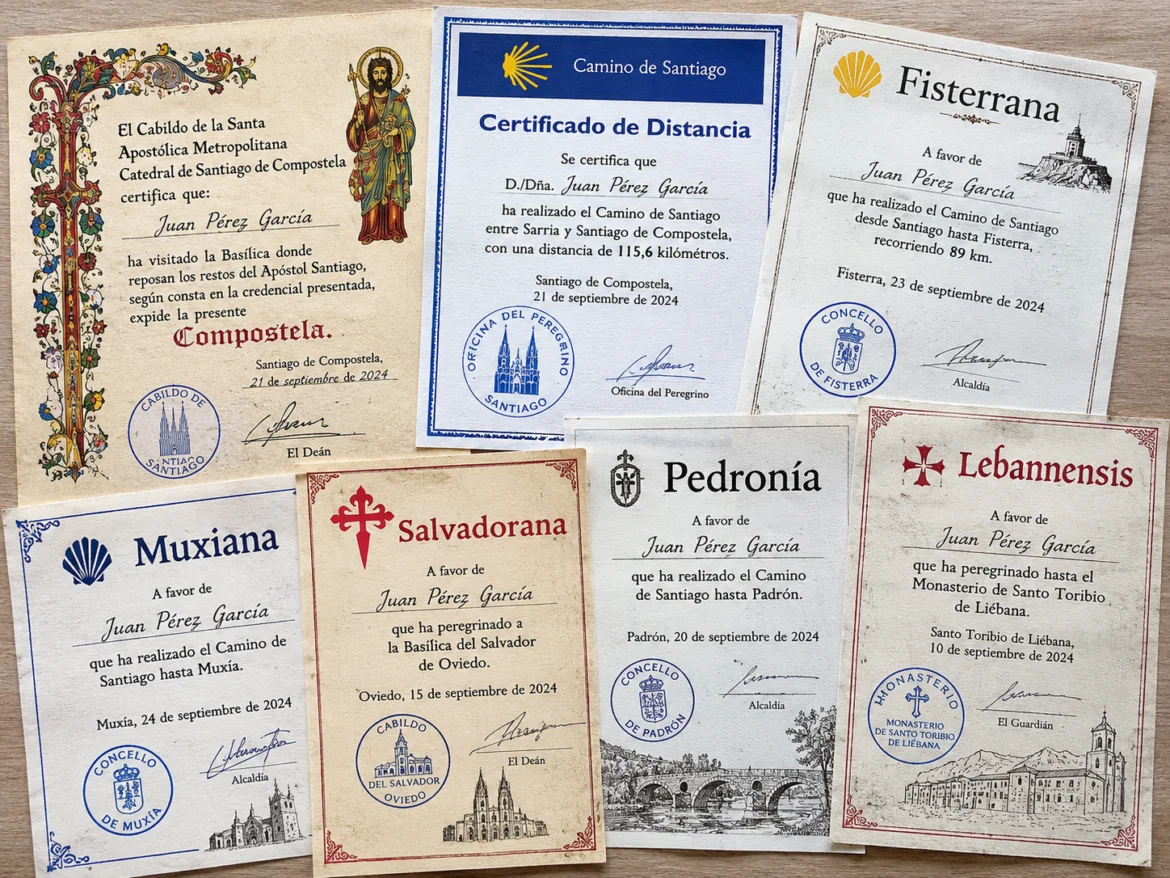
These are seven supporting documents whose existence and issuing entity can be verified. They do not constitute a closed list of all pilgrim recognitions.
Credential and certificate: are they the same?
Before knowing them, we must distinguish two concepts that are often confused.
The pilgrim credential is the document that accompanies the walker during their journey. The seals of hostels, churches, tourist offices and other establishments are stamped on it, allowing the stages carried out to be accredited.
The certificate, on the other hand, is obtained upon arrival at the corresponding destination, provided that the requirements established by the institution that issues it are met.
In the case of Santiago de Compostela, the Cathedral recognizes an official credential model and others expressly authorized by it.
Therefore, not all souvenirs, diplomas or tourist passports that can be found during the Camino have the same meaning.
1. La Compostela: the best-known certificate
It is the historical document that certifies having made the pilgrimage to the tomb of the Apostle Santiago with a Christian, religious or spiritual meaning, in accordance with the conditions established by the Cathedral.
To obtain it, you must have traveled at least 100 continuous kilometers on foot or on horseback, or 200 kilometers by bicycle, following a recognized itinerary and meeting the conditions regarding the route and arrival in Santiago.
It is not necessary to complete the entire Camino Francés or start in Sarria. There are numerous starting points and routes that allow you to meet the requirements.
The Compostela is issued free of charge at the Pilgrim Reception Office of Santiago de Compostela, located on Carretas Street.
It is the most emblematic recognition of the Jacobean pilgrimage, but not the only document that a pilgrim can obtain.
2. The Distance Certificate: kilometers also count
Many pilgrims are unaware that the Cathedral of Santiago offers another document different from the Compostela.
This is the Distance Certificate, issued by the Cathedral Chapter.
It includes the kilometers traveled, the starting point and date, the arrival date and the route traveled.
It is especially interesting for those who complete long routes, such as the French Way from Saint-Jean-Pied-de-Port, the Camino del Norte or the Vía de la Plata.
This certificate allows you to record the distance traveled and is subject to the conditions established by the Cathedral for recognized pilgrimages.
3. La Fisterrana: reaching the end of the world
For some pilgrims, Santiago de Compostela does not represent the end of the adventure.
Many decide to extend their journey to Fisterra, on the Costa da Morte, a place full of symbolism that for centuries was associated with the western end of the known world.
Those who complete this route can request the Fisterrana.
This is a certification issued by the Fisterra City Council to recognize the arrival of the pilgrim to this town.
It can be obtained at the Municipal Pilgrims' Hostel or at the Tourist Office, certifying the route with the stamped credential.
The Fisterrana has municipal recognition, but it does not replace the Compostela nor does it constitute a certificate issued by the Cathedral of Santiago.
4. La Muxiana: another ending next to the Atlantic
Muxía is another of the great goals of those who wish to continue walking beyond Santiago.
Its sanctuary of the Virgen de la Barca, next to the Atlantic Ocean, constitutes one of the most representative places of the spiritual tradition of the Costa da Morte.
Pilgrims who arrive in this town can request the Muxiana, a diploma created by the City Council as a symbolic recognition upon arrival.
It is delivered to the Muxía Tourism Office and also to certain collaborating establishments.
According to information from the Boat Sanctuary, it can be requested by those who arrive on foot, by bicycle or on horseback, without it being mandatory to present a credential.
La Fisterrana and Muxiana are independent, so a pilgrim who visits both locations can obtain both documents.
5. La Salvadorana: from León to Oviedo
The Camino del Salvador connects León with Oviedo and constitutes one of the great historical pilgrimage routes in the north of the peninsula.
Your destination is the Cathedral of San Salvador de Oviedo, a place of enormous importance in medieval religious tradition.
Pilgrims who complete this route can obtain the Salvadorana, a certificate signed by the dean of the Cathedral of Oviedo.
To request it, it is necessary to present the credential with the stamps that prove the route taken.
The Cathedral itself indicates that one seal per stage is enough and that, although there is a specific credential for the Camino del Salvador, other models are also accepted.
La Salvadorana is delivered free of charge.
6. La Pedronía: the memory of the Jacobean origin
Padrón occupies a fundamental place in the history and tradition of the Camino de Santiago.
According to tradition, it was here that the boat carrying the remains of the apostle Santiago arrived by sea.
Since 2010, the City Council has awarded the Pedronía, a diploma intended to recognize the pilgrimage to this town.
It can be obtained by completing certain itineraries, such as the route from Santiago to Padrón, the Portuguese Way, the maritime-river route from the Arousa estuary or a pilgrimage from a town located at least 18 kilometers from Padrón.
It is necessary to prove the route and stamp it in the established places.
The diploma can be requested at the Tourist Office or at the Municipal Pilgrims Hostel. Its published price is two euros.
The Pedronía constitutes one of the local recognitions most closely linked to the traditional origins of the Jacobean pilgrimage.
7. La Lebannensis: the new Liébana certificate
Cantabria has another great historical pilgrimage route: the Camino Lebaniego, whose destination is the Monastery of Santo Toribio de Liébana.
In May 2026, the Camino Lebaniego Foundation and the Bishopric of Santander presented a new official credential and certificate called Lebannensis.
The novelty is especially relevant because it establishes a specific procedure to accredit the royal pilgrimage to the monastery.
The Lebannensis is processed in Santo Toribio and has the signature of the guardian of the monastery and an exclusive dry seal as a guarantee of authenticity.
It can be issued in Spanish or Latin and its design is inspired by the tradition of the Beatos of Liébana.
The new official credential of the Camino Lebaniego can be obtained in Santander, San Vicente de la Barquera, Potes and the monastery itself.
This accreditation takes on special interest in view of the celebration of the next Lebaniego Jubilee Year of 2028.
And the Lebaniega? It is not the same as Lebannensis
Here appears a difference that many pilgrims are still unaware of.
The Camino Lebaniego Foundation currently distinguishes between the Lebannensis, which certifies the effective pilgrimage to Santo Toribio, and the Lebaniega, which functions as a certificate of visit to the monastery.
The latter can be purchased at the temple office for a symbolic price of one euro.
Therefore, although both documents are related to the same destination, they do not prove exactly the same thing.
It is an especially important distinction since the presentation of the new official documentation in May 2026.
How many certificates are there really?
The seven documents described are accredited examples, but do not represent the entirety of available recognitions.
There are also other initiatives linked to specific routes, local traditions, Jacobean associations and special forms of pilgrimage.
The problem with establishing a single figure is that not all of them have the same institutional nature.
The Compostela and the Distance Certificate depend on the Cathedral of Santiago. La Salvadorana corresponds to the Cathedral of Oviedo. The Lebannensis is linked to the Monastery of Santo Toribio and the institutions responsible for the Camino Lebaniego.
For their part, the Fisterrana, the Muxiana and the Pedronía are municipal recognitions.
They all have an identifiable issuing entity, but that does not mean that they are equivalent or that they can be substituted for each other.
For this reason, it is more accurate to speak of religious, municipal or pilgrimage certificates than to indiscriminately use the expression "legal credentials."
A documentary heritage that also tells the story of the Camino
Beyond the administrative requirements, these documents represent a unique part of the cultural heritage of the pilgrimages.
Each one is linked to a tradition, a territory and a way of understanding the trip.
La Compostela remembers the arrival at the tomb of the apostle Santiago. The Fisterrana and the Muxiana evoke the extension of the Way to the Atlantic. The Salvadorana keeps the pilgrimage to Oviedo alive, while the Pedronía and the Lebannensis remember the historical importance of Padrón and Santo Toribio de Liébana.
For those preparing a new Camino, knowing these accreditations can help discover lesser-known itineraries and destinations.
And for those who have already traveled several paths, it is an invitation to recover the memories of each pilgrimage.
Because each seal tells a stage, but behind each certificate there is a story that deserves to be remembered.
And you, pilgrim, how many of these documents do you have at home?