Can a ray of sunlight become the narrator of a story carved eight centuries ago? In the church of San Juan de Ortega, on the Camino Francés as it passes through Burgos, a Romanesque capital receives direct light around the spring and autumn equinoxes. The lighting covers scenes from the Annunciation and the childhood of Jesus and has turned this small stone work into one of the artistic curiosities of the Jacobean itinerary.
The phenomenon is known as the equinoctial light. According to the sanctuary and the Provincial Council of Burgos, it occurs around March 21 and September 22, when the solar position allows a beam to reach the capital from a window of the temple. Observation depends on light conditions and whether access is allowed.
San Juan de Ortega: a church born to welcome pilgrims
San Juan de Ortega is located in the province of Burgos, within the French Way. Its church is linked to Juan de Quintanaortuño, disciple of Santo Domingo de la Calzada, whose work is related to caring for walkers and preparing steps along the route.
The building allows us to read different periods of architecture. The chancel is Romanesque, from the 12th century, while other parts, such as the door and various extensions, belong to the Gothic period. The Provincial Council of Burgos places important interventions in the 15th century.
Whoever crosses its doors does not visit, therefore, a monument of a single era. Find a group that grew over time, linked both to the cult and to the reception of those who headed to Compostela.
The capital of the Annunciation: a story in stone
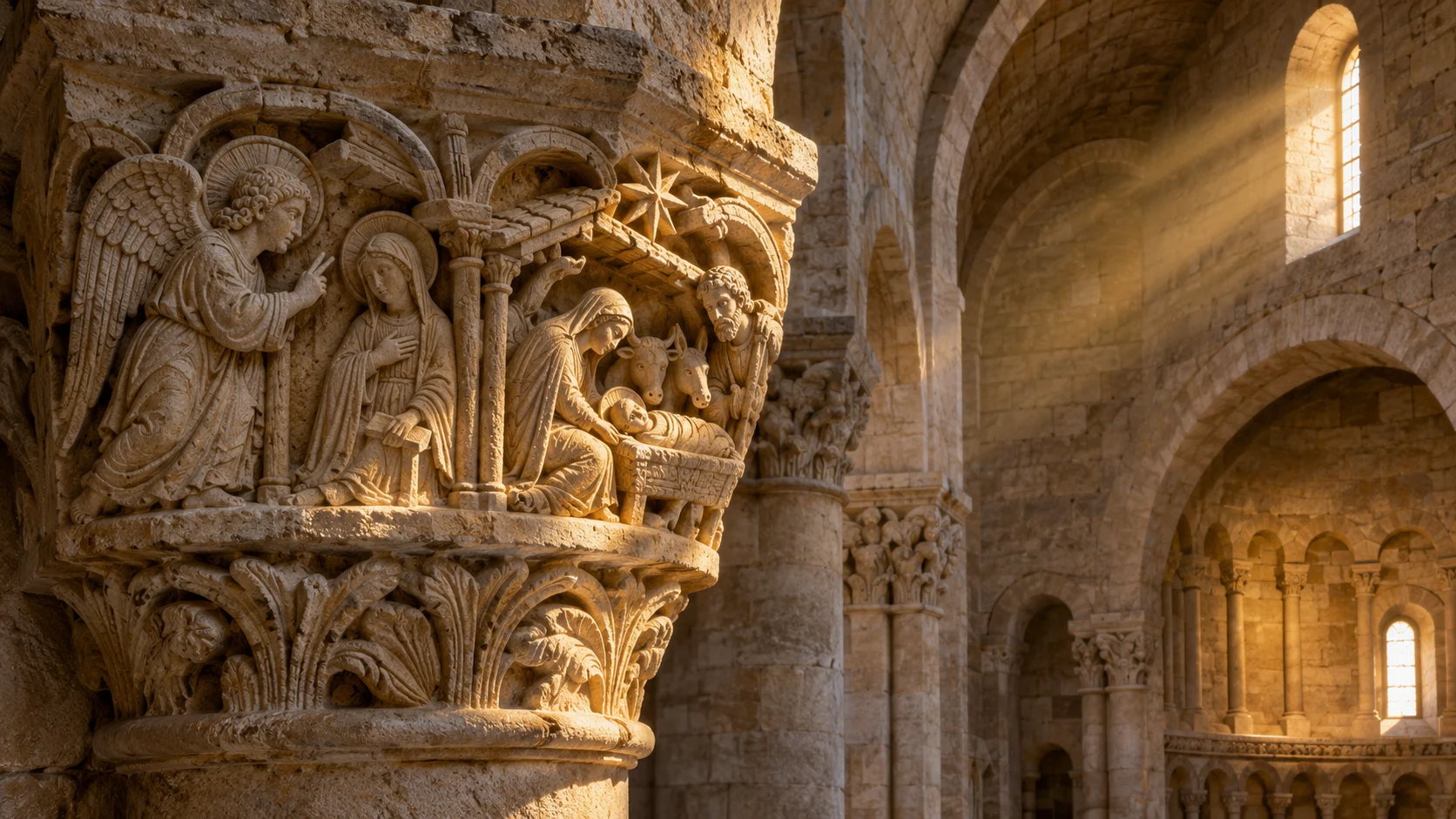
The main piece is known as the Annunciation or Christmas capital. Instead of a purely vegetal decoration, it offers a sequence of religious scenes that the viewer can follow around the stone.
First the archangel Gabriel appears before Mary. The Visitation is represented below, with the embrace between Mary and her cousin Elizabeth. The story continues with the Birth, where the manger, the figures that attend to Mary and the presence of Saint Joseph are recognized. The cycle also includes the angel's announcement to the shepherds.
For a society in which images had a fundamental didactic function, these reliefs allowed religious episodes to be transmitted without depending on a written text. The capital synthesizes a complex story in a very small space.
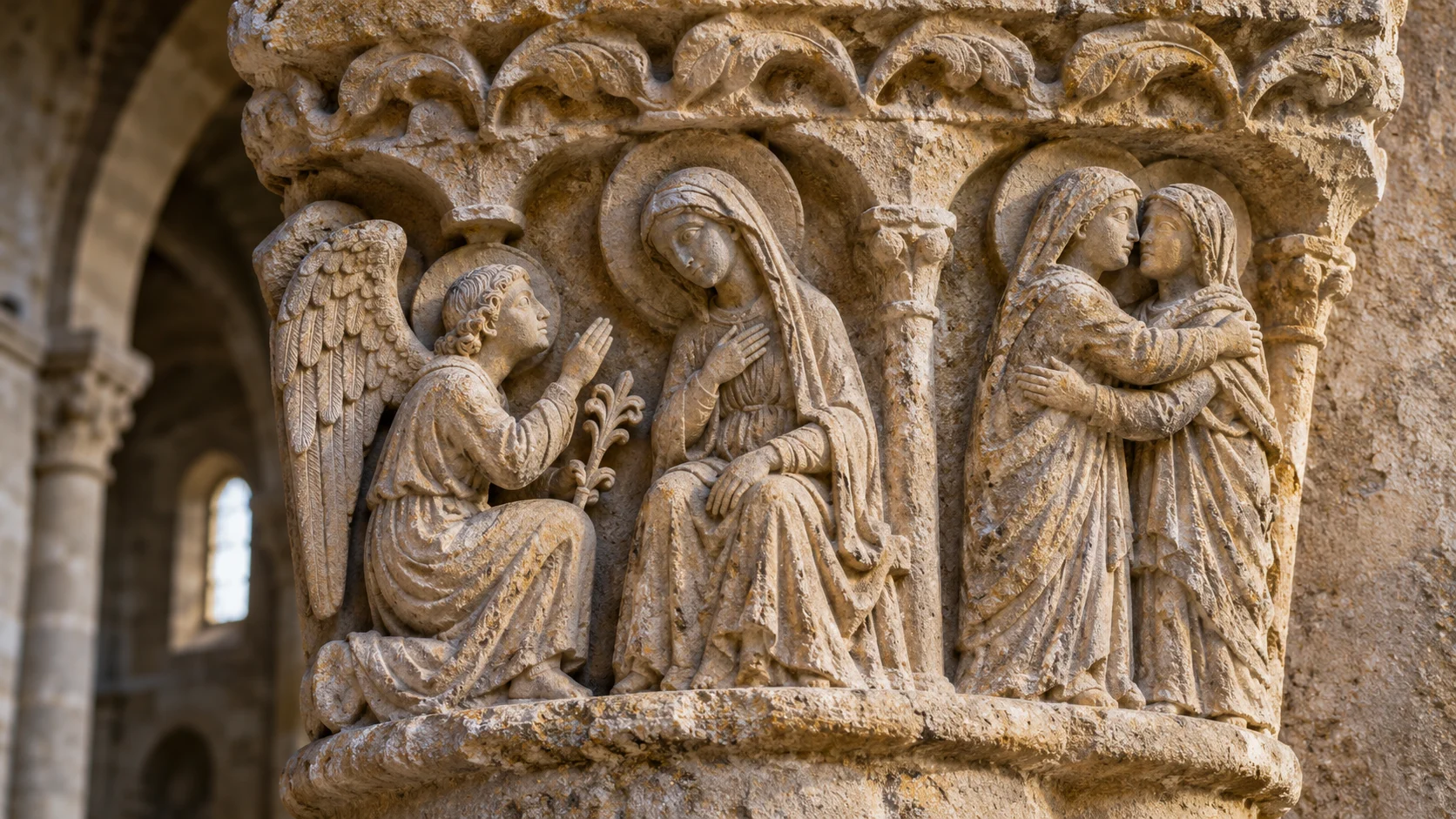 Artistic recreation inspired by Romanesque sculpture. It is not a photograph of the original capital.
The equinoctial light of San Juan de Ortega
Twice a year, on dates close to the equinoxes, the afternoon sun enters the temple at an angle that illuminates the relief. Heritage sources place the phenomenon around five in the afternoon in solar time, which should not be directly confused with clock time.
The sanctuary website offers as references 6:00 p.m. on March 21 and 7:00 p.m. on September 22. These are indicative dates and times associated with the phenomenon, not a guarantee of visibility for any year or day. Cloud cover and specific conditions may prevent it from being observed.
The symbolic reading is especially suggestive: the light that advances over the scenes evokes the Annunciation and the Birth. However, it is important to distinguish this religious interpretation from the physical fact of enlightenment. Nor can it be simply stated that we know with certainty all the intentions of the medieval builders.
He Romanesque spread through pilgrimage routes, where monasteries, churches and hospitals offered the walker spaces for rest, images and shared rituals.
A stop to look slowly on the French Way
San Juan de Ortega invites you to stop beyond quick photography. It is worth contemplating the chevet, distinguishing the Romanesque elements from the later extensions and patiently looking for the characters on the capital. The Cervantes Institute also collects this piece in its cultural tour along the Camino de Santiago.
If the objective is to observe the equinoctial light, it is advisable to consult the visiting conditions with the sanctuary in advance and not organize a stage counting on the phenomenon to be necessarily seen.
At RTV Camino de Santiago we have covered other aspects of this heritage, from the historic temples of the Camino until the surprising figures of its medieval sculpture.
In San Juan de Ortega, the stone tells the story and the light allows you to discover it in another way: one more reason to walk with your eyes open to the heritage.
Sources: Provincial Council of Burgos, Sanctuary of San Juan de Ortega e Cervantes Institute.