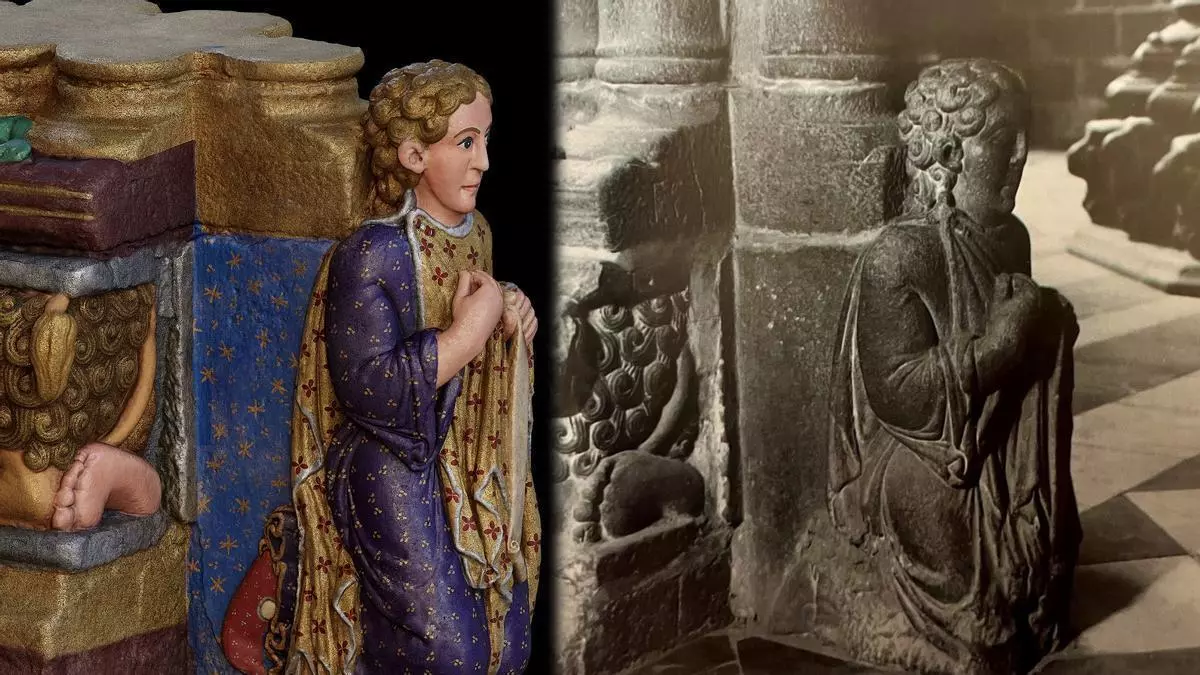
The virtual restoration of Maestro Mateo reveals new secrets in the Cathedral of Santiago
An innovative digital work allows us to discover what the art of the Portico of Glory was really like more than 800 years ago
The Cathedral of Santiago de Compostela is once again at the center of cultural news thanks to an advance that connects past and technology. The recent virtual restoration by Master Mateo has allowed us to discover unpublished details of the most emblematic sculptural group of the temple, the Portico of Glory, one of the great jewels of European Romanesque art linked to the Camino de Santiago.
This project, developed using advanced digital techniques, has managed to accurately reconstruct what the sculptures created by Master Mateo in the 12th century may have originally looked like. For thousands of pilgrims who arrive in Santiago every year, this discovery represents a new way of understanding the end of the Camino, not only as a spiritual goal, but also as a space full of history and meaning.
The lost color of the Portico of Glory
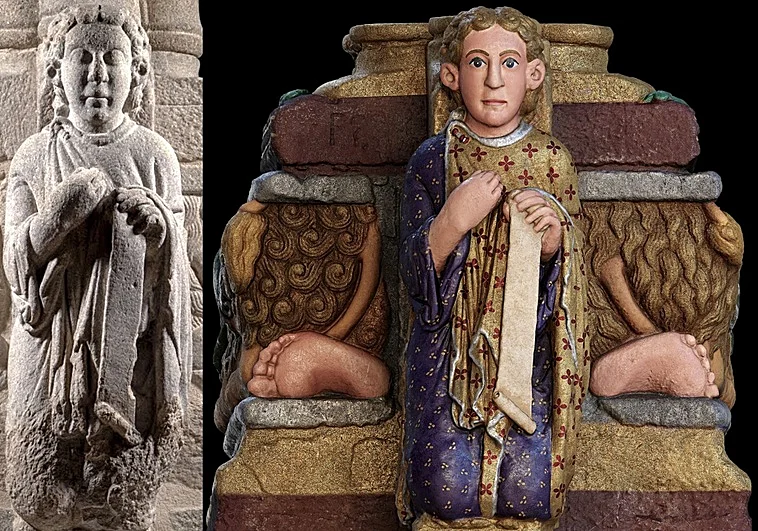
One of the most surprising aspects of this virtual restoration has been the recovery of the original polychrome. For centuries, the figures of the Portico have been contemplated in bare stone, which has conditioned the perception of medieval art. However, thanks to digital reconstruction, it is now known that these sculptures were full of color, completely transforming their visual impact.
This discovery changes the way we understand the art of Master Mateo and the Romanesque itself. The images were not only sculptures, but authentic visual stories full of life, designed to move and transmit messages to the pilgrims who arrived at the Cathedral of Santiago.
Technology at the service of the heritage of the Camino de Santiago
The use of tools such as photogrammetry and digital recreation has made it possible to analyze every detail with a precision never seen before. Thanks to this, researchers have been able to reinterpret the position, expression and composition of the figures, providing new clues about their meaning.
This type of progress demonstrates that the Camino de Santiago is not only a pilgrimage experience, but also a space for research and heritage conservation. The union between technology and culture is allowing us to recover elements that seemed lost forever.
- English Way passes 30,000 pilgrims
- Luján promotes religious tourism
- The sign that baffles pilgrims
- Your debate or future of the Portuguese Road
- Joy returns to the Camino accompanied
A new way of looking at the Cathedral for pilgrims and visitors
For those who arrive in Santiago after walking the Camino, this type of project provides a completely new dimension. The Cathedral is no longer just the end of the journey to become a place that is constantly rediscovered.
The virtual restoration of Master Mateo allows us to imagine how medieval pilgrims experienced their arrival, facing an artistic ensemble full of color, symbolism and emotion. Today, thanks to technology, it is possible to get closer to that original experience.
The Camino de Santiago continues to demonstrate that it is much more than a route. It is living history, evolving heritage and a constant source of discoveries that continue to surprise the world.