



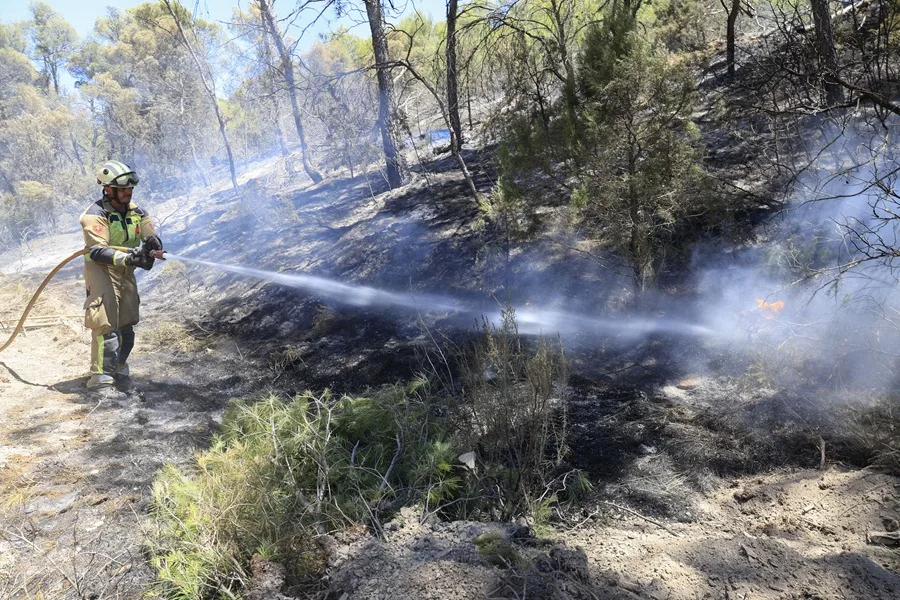
A serious forest fire in Las Peñas de Riglos forces the evacuation of several towns and mobilizes more than 200 troops. Pilgrims traveling the Camino de Santiago through Aragon must exercise extreme caution and check the situation before starting any stage near the affected area.
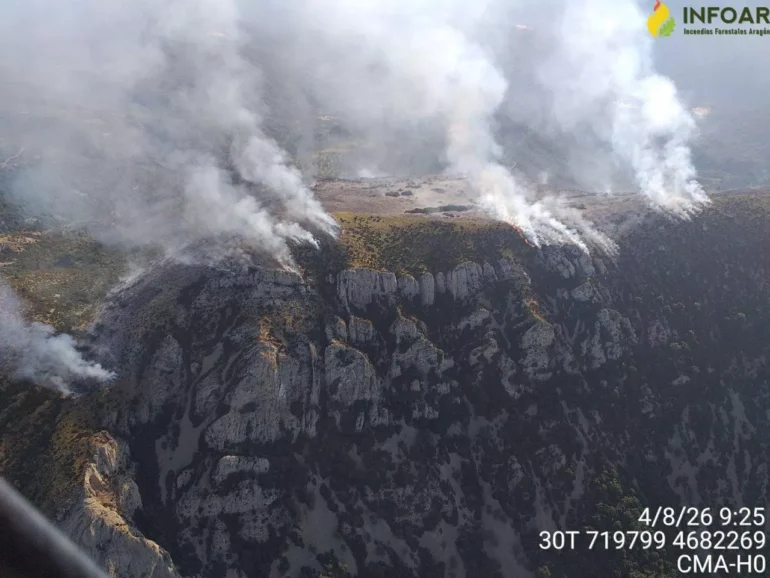
HUESCA, August 11, 2026. — Maximum attention for those who are traveling these days the routes of the Camino de Santiago in Aragon. The serious forest fire declared in the area of The Peñas de Riglos, in Huesca, had already affected around 2,500 hectares on Monday night, in an emergency that has forced the evacuation of populations and the deployment of a huge extinction device.
The situation acquires special importance for the pilgrim world because it takes place in a province crossed by the historic French Way in Aragon and through other Jacobean itineraries. This It does not mean that the entire Aragonese Way is closed nor that the fire is directly affecting all its stages.. It is essential not to generate unnecessary alarm.
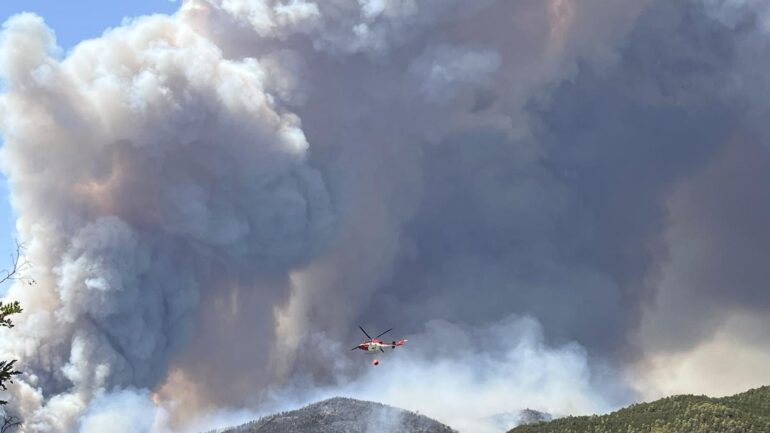
But this is not the time to improvise either.
With a fire of this size active in Huesca, any pilgrim who is in the area should check the official instructions before setting out and never approach an affected area out of curiosity, to take photographs or trying to continue along a closed path.
A fire of enormous speed
The fire broke out on Monday afternoon in Santa María de la Peña, within the municipality of Las Peñas de Riglos, and evolved extremely quickly.
The authorities went so far as to describe a spread of around 700 hectares per hour during some moments of the emergency. In the first hours they were evacuated Villalangua, Salinas de Jaca, Ena and Centenero, while other nuclei remained on pre-alert.
Around 120 people had to be evacuated, part of them transferred to facilities enabled in Ayerbe and Jaca.
The road A-132 It was also affected and was cut off due to the emergency.
More than 200 people fighting the flames
The magnitude of the fire has forced a major operation to be deployed.
More than 200 troops They work against the flames, with the participation of the Military Emergency Unit (UME) and numerous land and air resources. Among the resources mobilized are amphibious aircraft, bomber helicopters and coordination aircraft.
The Government of Aragon activated the PROCINFO Operational Situation 2, Level 1, and the system was also used ES-Alert to warn the population.
Behind the figures are hundreds of professionals working in extremely difficult conditions to protect towns, roads, mountains and lives.
From RTV Camino de Santiago, our recognition to forest firefighters, agents, Civil Protection, Civil Guard, UME, health services, volunteers and all the people who participate in the device.
Does the fire affect the Camino de Santiago?
This is probably the most important question for pilgrims.
This alert should not be interpreted as a general closure of the French Way in Aragon.
The fire is located in the area of Las Peñas de Riglos and the reported evacuations and outages affect that area of the province of Huesca. With the information available, it is not correct to affirm that the main Aragonese Jacobean stages are all directly affected.
However, a wildfire is an emergency that can evolve quickly.
The wind can change the direction of the flames, new road and road closures may appear and emergency services may establish additional restrictions.
That's why, Any pilgrim who is in Huesca or plans to walk through Aragon must inform themselves before starting the stage.
⚠️ NOTICE TO PILGRIMS
On days like this there is a rule that must be above any planning:
No stage is worth taking a risk.
If the authorities order you to leave an area, you must do so immediately.
If a path is closed, it cannot be crossed.
If there is intense smoke, a nearby fire or a column of smoke whose origin is unknown, we should not continue to check what is happening.
And much less try to cross a mountain thinking that "it's only a few kilometers."
The Camino will be there tomorrow.
Life has no repetition stage.
Smoke can also become a danger
It is not necessary to be in front of flames for a fire to represent a risk.
Smoke can travel many kilometers depending on the wind and reduce visibility, in addition to causing respiratory problems.
Pilgrims spend many hours outdoors and make considerable physical effort. If a significant presence of smoke is detected during a stage, especially in people with respiratory problems, it is prudent to stop and check the situation.
You also have to pay attention to the roads.
Fires generate extraordinary movements of emergency vehicles, heavy machinery and extinguishing means. Pilgrims must always facilitate their circulation.
August requires maximum caution on the Camino
The Huesca episode once again reminds us of a particularly important reality during the summer.
The Camino crosses thousands of kilometers of natural spaces.
Forests.
Mountains.
Fields.
Thickets.
And during periods of high temperatures and dryness, any carelessness can have devastating consequences.
A poorly extinguished cigarette, lighting a fire where it is prohibited or any negligent behavior can cause a tragedy.
The pilgrim must also be guardian of the territory through which he walks.
If you see fire or smoke, do not attempt to investigate
When detecting a possible fire, the priority should be to get away from the danger and notify the emergency services.
There is no photograph, video or publication on social networks that justifies approaching a fire.
In addition, those who come unnecessarily close can make the work of the professionals who are trying to extinguish it difficult.
In emergency situations you must always obey the instructions of the authorities.
The Camino can wait
We pilgrims tend to become obsessed with finishing the stage.
We have reserved the hostel.
We want to get to the next town.
We have certain kilometers left.
But when an emergency like a forest fire appears, all that ceases to matter.
You can take a bus. You can take a taxi. You can skip a stage. You can even return another year.
That doesn't make anyone any less of a pilgrim.
The truly responsible decision is knowing when to stop.
While hundreds of professionals fight the Las Peñas de Riglos fire, from RTV Camino de Santiago we especially ask pilgrims who are in Aragon to remain attentive to official instructions.
Today the most important yellow arrow is not the one that points towards Santiago.
It is the one that points to a safe place.

















