



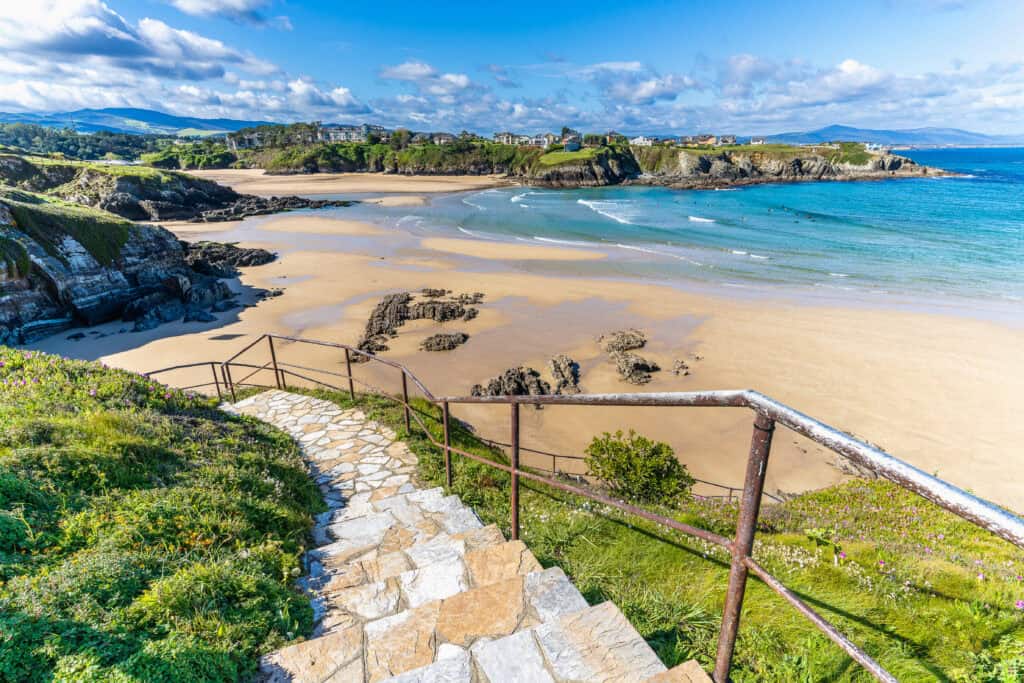
Cliffs, beaches, fishing villages and the sound of the Cantabrian Sea accompany the pilgrim on some of the most spectacular stages of the Camino de Santiago
There are pilgrims who seek silence. Others want history, spirituality or the atmosphere of large lodges. And there are those who dream of something different: walk towards Santiago with the sea appearing again and again on the horizon.
For them there is an especially beautiful Camino.
He Camino de Santiago along the coast, mainly associated with North Road and its coastal variants, it runs through a good part of the Cantabrian coast before heading towards the interior of Galicia. It is a succession of beaches, cliffs, green mountains, small fishing ports and towns where seafaring tradition mixes with centuries of pilgrimage.
It is not necessarily the simplest Path.
But it can be one of the hardest to forget.
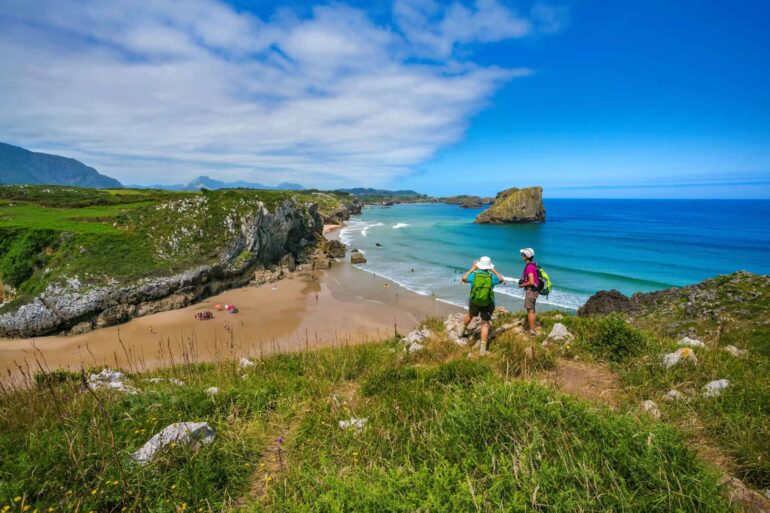
Wake up and find the Cantabrian Sea again
One of the big differences compared to the French Way is the landscape.
Here the pilgrim can begin a stage listening to the waves, walk through meadows for several hours and end by contemplating a sunset over the Cantabrian Sea.
The ocean appears and disappears.
Sometimes it is located a few meters away.
Other times it is seen from the top of a hill.
And in certain sections, after a demanding climb, rediscovering the blue of the sea at the bottom becomes almost a reward.
A Path between green and blue
The north of Spain offers a combination that is difficult to find on other Jacobean routes.
On one side, mountains and forests.
On the other, the Cantabrian Sea.
Between both, the Camino.
The route crosses the Basque Country, Cantabria, Asturias and Galicia, passing through cities, fishing villages and small villages.
San Sebastián, Zarautz, Castro Urdiales, Laredo, Santander, Santillana del Mar, Comillas, San Vicente de la Barquera, Llanes or Ribadesella are some of the names that are part of the universe of the Camino del Norte.
But many times it is the smallest places that end up surprising the pilgrim.
Cantabria, one of its great settings
The passage through Cantabria offers some prints especially linked to the sea.
The pilgrim finds enormous beaches, bays, cliffs and historic towns as he advances towards Asturias.
There are times when it is difficult to know if one is making a pilgrimage or going through a succession of postcards.
But the landscape can be deceiving.
Behind so much beauty there also appear unevenness, accumulated kilometers and days that require good physical preparation.
It's not all walks on the beach
Saying “I walk along the coast” can make you think of long, completely flat stages by the sea.
The reality is quite different.
The Camino del Norte presents continuous ups and downs. Furthermore, depending on the itinerary chosen, you do not always walk close to the coast.
There are roads, tracks, country roads and interior sections.
Precisely that variety is part of his personality.
That is why it is advisable to prepare the stages in advance, especially if you are doing it for the first time or if you are carrying a heavy backpack.
The weather is also part of the adventure
The green of the north has a price.
The rain.
Even during the summer it can appear unexpectedly, so a good raincoat and backpack protection are practically essential companions.
But after the rain also come some of the most beautiful moments.
The smell of the forests.
Fog rising over the mountains.
The sky opening over the Cantabrian Sea.
And that special light from the north that completely transforms the landscape.
Towns where the Camino tastes like the sea
Doing the Camino along the coast also means discovering another gastronomy.
Freshly arrived fish in port, shellfish, anchovies, cheeses, cider, fabada, stews and traditional dishes accompany the tour.
After twenty or twenty-five kilometers, sitting in a small establishment in a fishing village can become one of the great moments of the day.
Because the Camino is also known around a table.
Is it better than the Camino Francés?
No.
It's not worse either.
It's different.
The French Way offers an extraordinary infrastructure, an enormous historical heritage and that international atmosphere that has turned certain stages into authentic meeting points for pilgrims from all over the world.
The Camino del Norte offers another sensation.
In many sections there is greater tranquility and the landscape takes on enormous prominence.
For those who especially enjoy nature and the sea, it can be an extraordinary choice.
The price of so much beauty
Also be warned: this route can be physically demanding.
The legs notice the unevenness.
Distances between certain services may require planning.
And the weather can change quickly.
That is why it is not advisable to face the Camino del Norte thinking only of the spectacular photographs that appear on social networks.
Behind every perfect image there are miles of effort.
And precisely for that reason the reward tastes better.
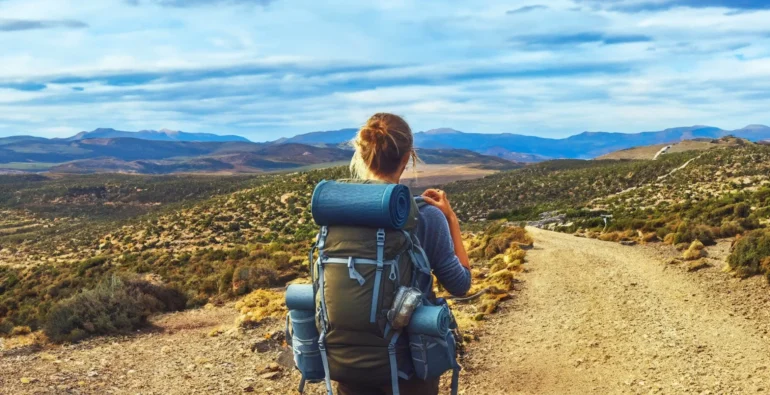
Until the sea is left behind
There will come a time when the pilgrim will have to progressively say goodbye to the Cantabrian Sea.
The Camino will seek the interior.
Santiago will be closer and closer.
And then something curious will probably happen.
After so many days walking by the ocean, you will begin to miss yourself.
Its noise.
Its smell.
The wind.
The small ports.
The beaches at dawn.
Because there are many ways to get to Santiago de Compostela.
But few allow you to walk for so many kilometers accompanied by one of the best possible travel companions:
the sea

















