



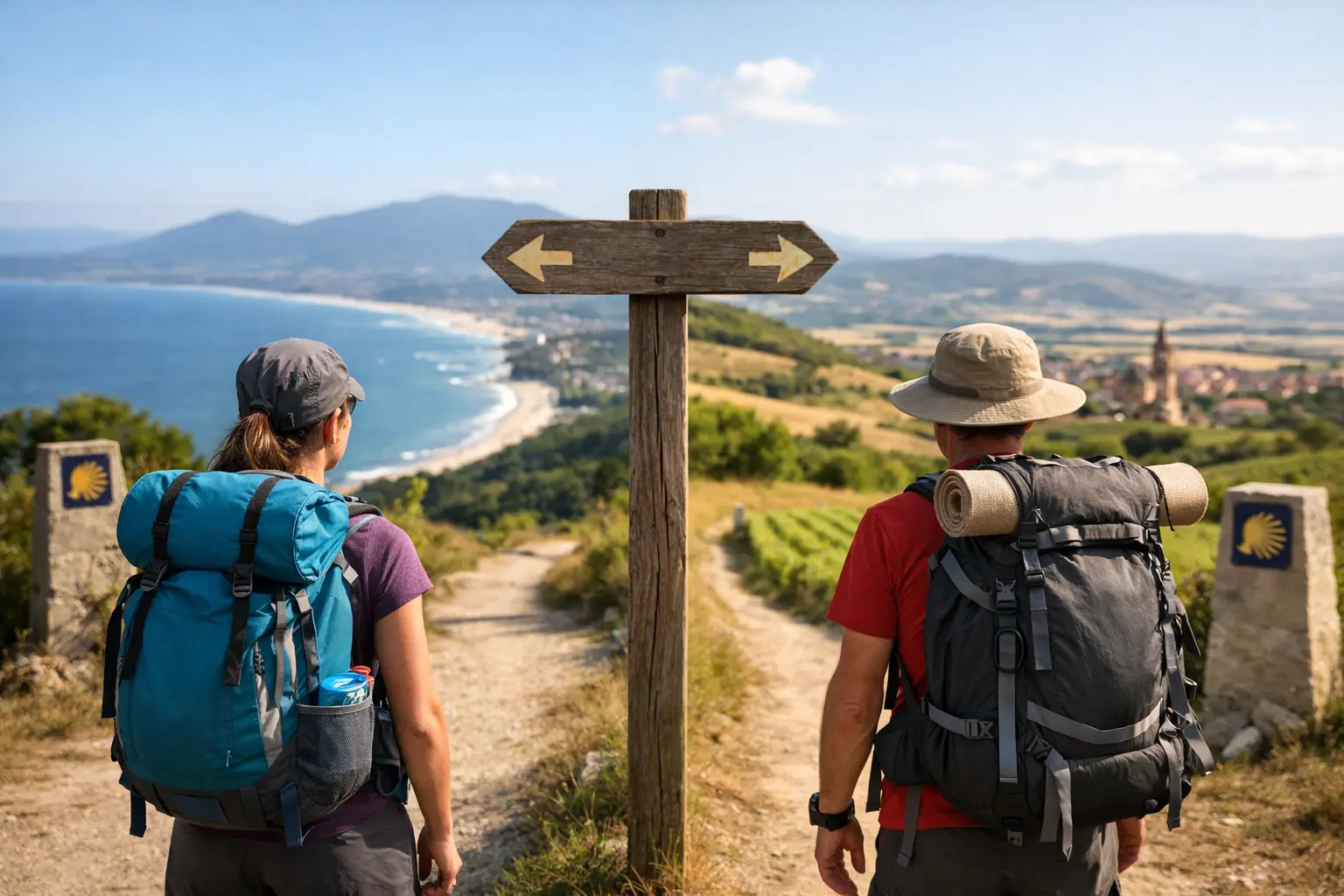
There is a question that is repeated in shelters, associations and preparation groups: Northern Way vs French Way, which one do I start with? The answer is not which is “better,” because both routes lead to Santiago and both can leave a deep mark. It's knowing what you're looking for when you adjust your backpack: a constant community and towns born in the heat of pilgrimage, or the Cantabrian Sea, mountains and an experience with more stretches of silence?
The French Way is the great Jacobean backbone. The North, its Atlantic alternative, more demanding and with a beauty that demands time. Choosing well will prevent you from turning an illusion into an uncomfortable journey. Let's put our feet on the ground!
Northern vs French Way: the essential difference
The French Way, from Saint-Jean-Pied-de-Port to Santiago, totals nearly 780 kilometers. It is the route with the greatest tradition of continued pilgrimage, an immense welcoming network and the international atmosphere that many imagine before leaving home. Its landscapes change radically: the Pyrenees, the vineyards of La Rioja, the Castilian plateau, the Montes de León and the most rural Galicia.
The Camino del Norte runs along the northern coast from Irún, approximately 825 kilometers to Santiago. It crosses Euskadi, Cantabria, Asturias and Galicia, between fishing villages, historic centers, cliffs, forests and constant ups and downs. In Arzúa it joins the Frenchman to face the last kilometers to the Cathedral.
The key is not only geographical. In French, the Camino is an almost permanent protagonist: the signage, the services and the daily conversation revolve around the pilgrim. In the North, especially in its first few hundred kilometers, you walk through tourist and urban territories where the Camino shares space with local life, beaches and coastal roads. It has a different pulse.
Pilgrim atmosphere: company or greater autonomy
If it's your first full Camino and you're worried about walking alone, the French offers a clear advantage. You will find pilgrims of all ages and nationalities from the first stage. It is easy to meet the same people several times, form a small route family and find updated information at each stop. It is also easy to divide stages, rest a day or modify the plan if blisters, rain or fatigue appear.
That popularity has a counterpart. Between the end of spring and the beginning of autumn, and very markedly in August, some sections and towns can feel crowded. It does not mean that the essence of the Camino has been lost, but it requires booking in advance on peak dates and being patient when it comes to departures, hostels and pilgrim menus.
The North offers a more dispersed experience. There are pilgrims, of course, but the groups are smaller and the days can pass with long moments of independence. For many people, that space is a gift: you can listen to the sea, talk without haste and look at the landscape with a different attention. For those who need the emotional support of a daily community, it can be harder.
Let's not confuse fewer people with absence of hospitality. The welcome exists on both routes and can be extraordinary. But in the North it is advisable to arrive with the stages studied, especially if you want to sleep in specific hostels or walk outside the most active season.
Landscape and heritage: two ways to cross Spain
The North wins if your great motivation is the Cantabrian Sea. The arrival in San Sebastián, the fishing ports, the Cantabrian coast, the entry into Asturias and the Galician estuaries form a succession of images that are difficult to forget. But it is not a route that always follows the water. There are interior days, asphalt, urban centers and slopes that surprise those who expect a continuous seafront promenade.
The French does not offer that coastal continuity, but it has a cultural diversity that is difficult to match. Pamplona, Logroño, Burgos, León, Astorga, Ponferrada or O Cebreiro are not just names in a guide. They are places where Jacobean history is touched on in churches, bridges, pilgrim hospitals, squares and bar conversations. The plateau, often judged before walking it, is one of its great emotional filters: spaciousness, slow pace and a solitude very different from that of the North.
There is no winner here. If you dream of the blue horizon and Atlantic cuisine, look to the North. If you want to understand the great historical route that articulated peoples and cultures for centuries, French has a special strength.
Physical toughness: the slope is more important than the kilometers
The idea that the French Way is easy and the North is impossible does not help anyone. Both require preparation. The difference is that the French usually offers a more progressive profile and more options to adapt the daily distance. There are demanding climbs, such as the departure from Saint-Jean-Pied-de-Port, the Alto del Perdón, the Cruz de Ferro or the arrival at O Cebreiro, but also very flat days.
In the North, the accumulation of slopes is constant. Many stages go up from the coast, go down again and repeat the effort. They are not always spectacular climbs, but they punish calves, knees and feet, especially if you are carrying too much weight. The surface alternates tracks, paths, city, highway and trails that, with rain, can change a lot.
For a person with good physical shape, experience in the mountains or a margin of days, the North is perfectly acceptable. For those who are new to a backpack, have joint discomfort or only have a very tight schedule, French usually allows for more friendly learning. In both cases, training by walking several days in a row with the shoes already used is worth more than any promise of “I'll get in shape there.”
Weather: the factor that can change the plan
The North is cooler in summer, an important advantage when other routes suffer high temperatures. In return, rain, humidity and rapid changes in weather are part of the trip. A real waterproof jacket, backpack protection and clothes that dry quickly are not whims.
The French have a much more varied meteorology. The heat can be intense in Navarra, La Rioja, Castilla y León during July and August, while the Pyrenees, Montes de León and Galicia can provide cold and water even outside of winter. Consulting forecasts every day and following official notices is a sensible pilgrim decision, not a lack of adventure.
Services, budget and daily organization
El Francés has the widest network of hostels, shops, pharmacies, bars and alternative transport. This makes it easier to walk briskly, resolve a material breakdown or stop earlier if the body asks for it. It also allows you to do short stages without too much juggling. In highly sought-after locations, booking private accommodation can increase expenses, but there are more alternatives.
In the North the services are sufficient, although they are more separated in certain sections. Some stages require greater attention to schedules, purchases and bed availability. Don't go out trusting that a bar will appear every few kilometers. Bring water, some food, and enough battery to check your planning if necessary.
Regarding the budget, none are automatically cheap or expensive. In the North, cities and coastal tourist areas can make accommodation and meals more expensive, especially in summer. In France, the enormous supply allows spending to be better adjusted, although the demand pressure in high season is also noticeable. Sleeping in hostels, cooking when possible and avoiding last minute reservations helps in both cases.
What route to choose according to your moment?
Choose the French Way if you are looking for your first great pilgrimage, you want to meet people easily, you need flexibility of stages or you are especially moved by the most recognizable Jacobean history. It is also a very suitable option if you can only travel one section and want simple logistics. Sarria-Santiago concentrates many walkers, but starting earlier, from León, Astorga or even Saint-Jean, completely transforms the experience.
Choose the Camino del Norte if a more physically intense route appeals to you, you have enough days and you accept a somewhat more autonomous organization. It is especially recommended for those who have already experienced another Camino and want to discover another cadence, or for those who prefer the Atlantic landscape to the great inland plains. Don't choose it just to avoid crowds: in summer there are also busy spots and the effort should not be underestimated.
There is a third very strange possibility: choosing by time, not by prestige. Ten, fifteen or twenty days well walked on an honestly chosen route can say more than trying to complete an entire itinerary with pain, haste or constant worry.
Before deciding, check your dates, your physical condition, the actual days available and the type of souvenir you want to take with you. Then leave a part of the Camino to good chance: to the sound of an open church, to a conversation at the table or to a rainy morning that, against all odds, ends up being the stage that you will never forget.

















