



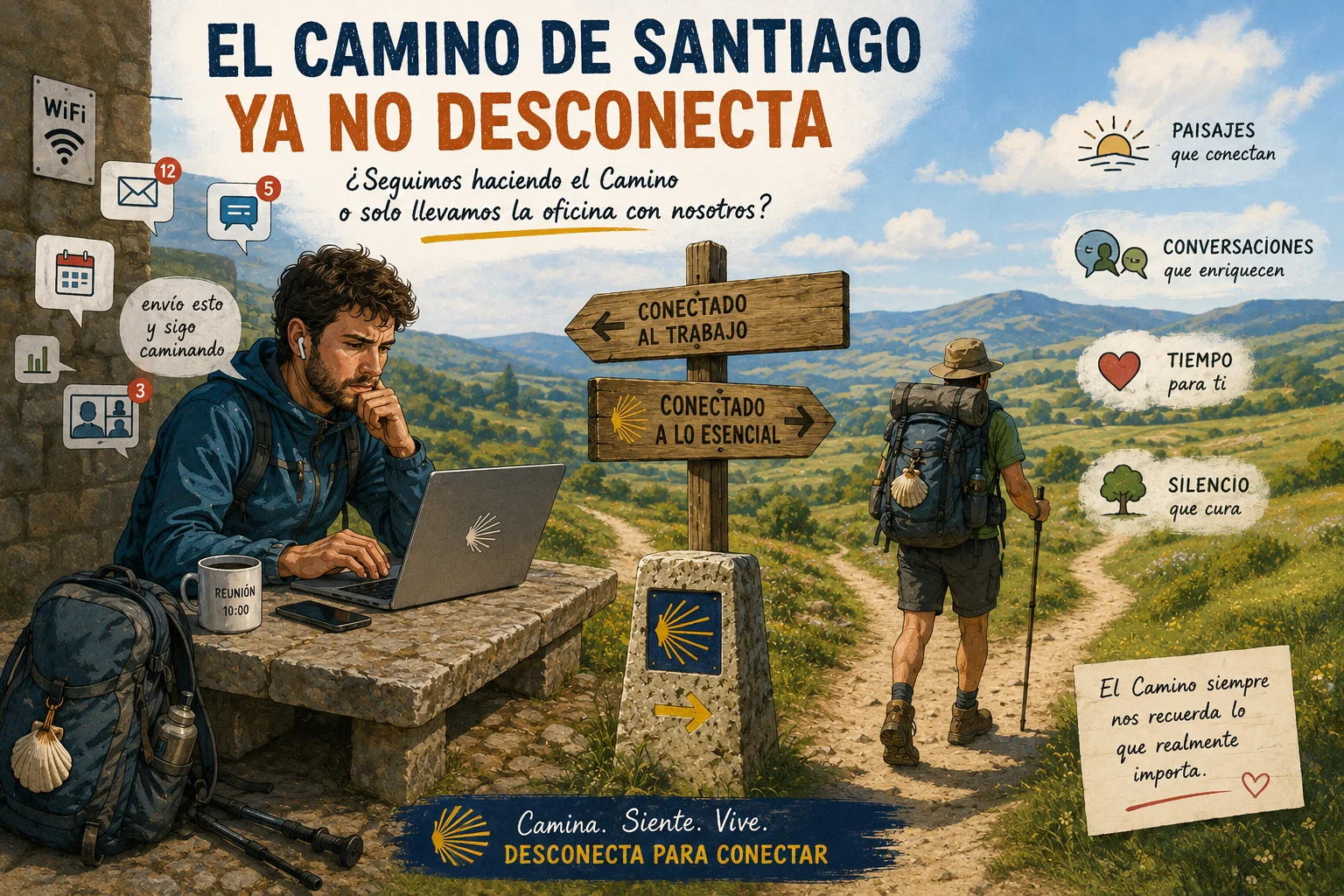
More and more walkers answer emails, attend meetings and stay connected during the pilgrimage
For centuries, the Camino de Santiago was synonymous with pause. A time to get away from obligations, walk without haste and leave behind, even if only for a few days, the noise of the everyday world.
However, something is changing.
It is increasingly common to find pilgrims walking the Camino while answering emails, answering work calls, participating in video conferences or managing businesses from a hostel cafeteria. The phenomenon of the so-called "hyperconnected pilgrims" grows at the same pace as technology and raises an uncomfortable question: do we continue doing the Camino or simply move the office to the Camino?
Just look at any end of stage. Where once conversations between pilgrims, letters written home or simple rest predominated, today screens abound. Open laptops, wireless headphones, smart watches and mobile phones take up much of the free time of many walkers.
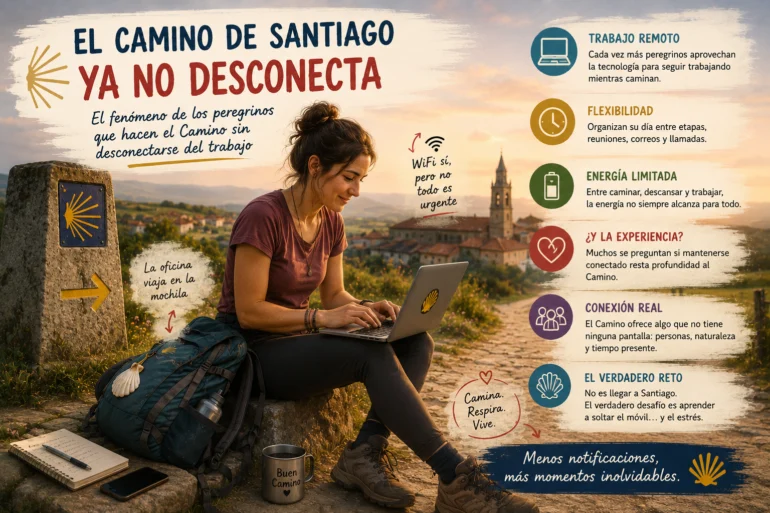
The economic reality partly explains this situation. Not everyone can afford to disappear for several weeks. Freelancers, entrepreneurs, remote workers and digital professionals find on the Camino an opportunity to travel without completely abandoning their work responsibilities.
But this new way of pilgrimage also has consequences.
One of the greatest treasures of the Camino has always been the ability to break routines. Walking for hours, observing the landscape, listening to the silence or having unexpected conversations with strangers is part of an experience that can hardly be measured in productivity. That is precisely where much of its value lies.
Many hospitaleros and veterans of the Camino observe this transformation with some concern. Not because working is a negative thing, but because there is a risk of turning a unique experience into an extension of everyday life. The Camino was born to walk, reflect and share, not to chase notifications every few minutes.
Paradoxically, many pilgrims who start out connected end up disconnecting naturally. After several days of physical effort, early sunrises and accumulated kilometers, the rhythm of the Camino forces us to slow down mentally. Screens are no longer so important and conversations are gaining ground again.
Perhaps that is the great lesson that the Camino de Santiago continues to offer in the 21st century. It doesn't matter how many devices we carry in our backpack. Sooner or later, the path ends up reminding us that there are more important things than responding to an urgent message.
Because while the modern world requires us to be available twenty-four hours a day, the Camino continues to whisper exactly the opposite: that for a few hours, a few days or a few weeks, there is absolutely nothing wrong with stopping.
And perhaps therein lies the true challenge of our time. Don't walk hundreds of kilometers to Santiago. The really difficult thing is learning to turn off the phone.

















