



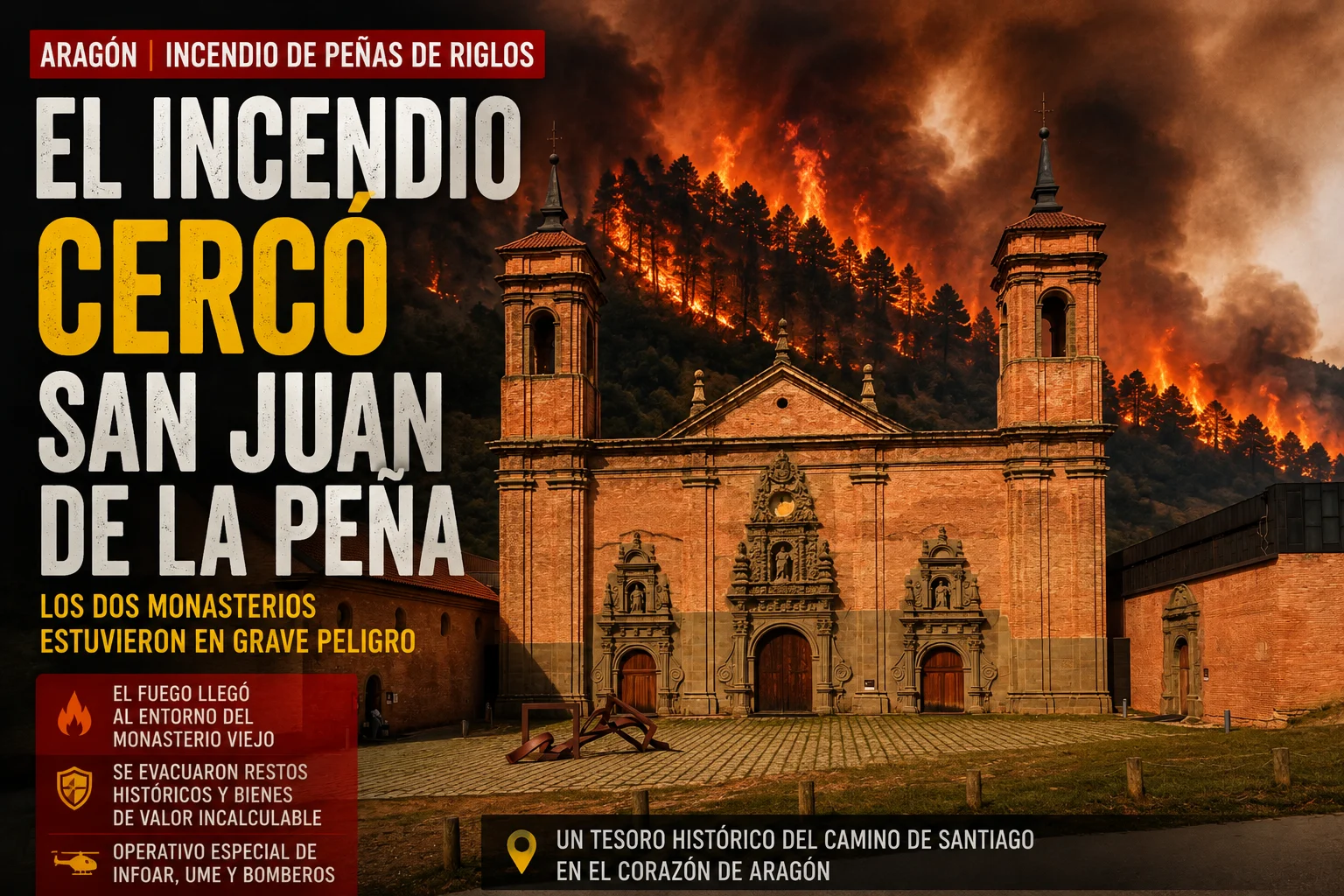
The two monasteries were in "serious danger of disappearance" for hours. The fire reached its surroundings, forced the removal of historical assets and put one of the great treasures linked to the Camino de Santiago on high alert.
SAN JUAN DE LA PEÑA (HUESCA).— For a few hours, Aragón contemplated a possibility that seemed unimaginable: that the flames could destroy one of the most extraordinary places in its history.
He Old Monastery and the New Monastery of San Juan de la Peña This Thursday they were in "serious danger of disappearance" due to the advance of the Las Peñas de Riglos forest fire, as recognized by the Minister of the Interior of the Government of Aragon, Roberto Bermúdez de Castro.
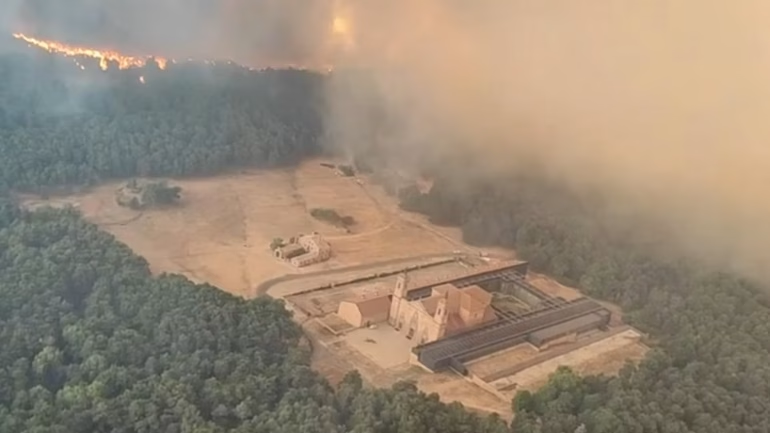
The most critical moment occurred approximately between 1:00 p.m. and 5:00 p.m.. The fire evolved faster than expected and reached the cuts of San Juan de la Peña. The intensity became such that some extinguishing means had to be temporarily withdrawn from certain points to protect the troops themselves.
The monasteries did not burn.
But they were too close.
The fire reached the Old Monastery
The threat was not just a prediction on a map.
The flames reached the upper part of the surrounding area. Old Monastery, even burning elements falling on the area. According to the information provided by the authorities, the structure of the historic building was not burned.
Emergency crews arrived break down a door to access the interior and be able to save some of your most valuable assets.
As the fire advanced, a nature protection agent and specialists from the Military Emergency Unit (UME) They entered the monastery to carry out an operation that alone explains the seriousness of those hours.
Everything that could be saved had to be saved.
The remains of the first kings of Aragon, evacuated
Among the assets removed were bone remains linked to the Royal Pantheon of San Juan de la Peña, in addition to other heritage pieces, which were preventively transferred to the Museum of Huesca.
Clothing related to the Count of Aranda and other elements of historical value.
The image is shocking.
Centuries of history emerging from a monastery while, outside, emergency teams fought to prevent the fire from permanently reaching the complex.
It wasn't just about protecting walls.
Memory was being protected.
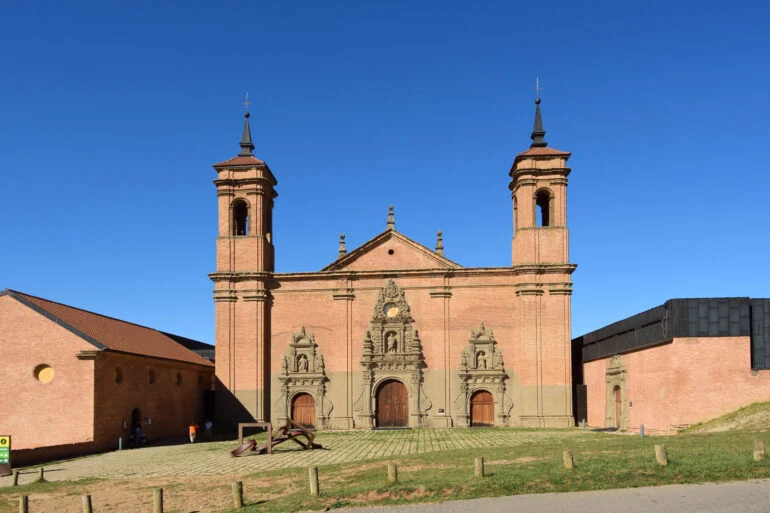
A technical fire to defend the New Monastery
In the surroundings of New Monastery, the INFOAR and UME teams had to make another extraordinary decision.
They made a technical fire on the meadow located in front of the building to create a defense zone that would reduce the intensity of the fire and make it difficult for the flames to advance towards the monastery.
Therefore, the burned surface that can be observed in that area does not necessarily correspond to the direct advance of the fire: part of it was a deliberate action by the extinguishing teams to defend the building.
It was a race against fire.
And for several hours no one could guarantee how it would end.
San Juan de la Peña is not just any monastery
To understand the dimension of what happened you have to look much further back.
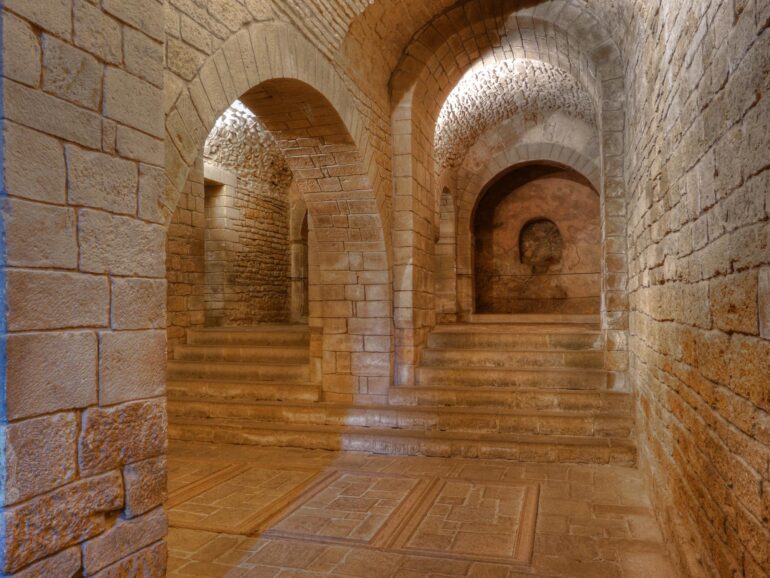
The origins of San Juan de la Peña date back to the Early Middle Ages and the complex ended up becoming one of the great religious and political centers linked to the birth of the Kingdom of Aragon.
Under a gigantic rock is the spectacular Old Monastery, whose architecture seems to literally merge with the mountain.
There we find his famous Romanesque cloister, churches from different periods, the Pantheon of Nobles and the Royal Pantheon related to the first Aragonese monarchs.
The place was also linked for centuries to traditions and legends, among them those related to the Holy Grail.
And its history is deeply connected to the pilgrimage territory that runs through this part of Aragon.
A place linked to the Camino de Santiago
For pilgrims who arrive from France through Somport and travel the Aragonese Way, San Juan de la Peña represents one of the great historical and heritage detours of the Jacobean environment.
For centuries, pilgrimage, monasteries and medieval routes were deeply related.
That is why this fire cannot be considered solely as a forest emergency.
It has also threatened one of those places that help explain how the Camino de Santiago was built culturally and spiritually.
Today's pilgrim can find yellow arrows, mobile applications and accommodations.
The medieval pilgrim found monasteries.
They were places of prayer, protection, knowledge and welcome.
He has already survived another terrible fire
There is also a historical coincidence that is difficult to ignore.
San Juan de la Peña already knows the destruction caused by fire.
In 1675, a serious fire lasted for three days and left the Old Monastery in conditions that ended up making the continuity of monastic life in that location unfeasible.
As a consequence, it was decided to build a new monastery in the nearby Llano de San Indalecio.
The works of the current New Monastery began in 1676.
More than three centuries later, the fire once again came dangerously close to both.
More than 9,000 hectares burned
The Las Peñas de Riglos fire has acquired enormous dimensions.
The latest information already places the burned surface above the 9,000 hectares, with a perimeter that is around 50 kilometers. Hundreds of residents have had to leave their towns and during the early hours of this Friday there have been new evacuations after a reproduction of the fire.
A huge device is planned for this Friday with 33 aerial means, the maximum that can operate without compromising the safety and control of airspace.
The emergency, therefore, it's not over.
A heritage that was too close to disappearing
Today we can write that the monasteries continue standing.
And that's the best news.
But for a few hours another scenario had to be seriously contemplated.
One in which a fire could destroy in one afternoon what entire generations had preserved for centuries.
San Juan de la Peña has survived wars, abandonments, political transformations, centuries of weather and even other fires.
This time, firefighters, INFOAR, UME, forestry agents, Civil Guard and the rest of the professionals deployed have once again stood between the fire and history.
Perhaps when this emergency is over and we can once again calmly contemplate the monastery under its enormous rock, we will do so with different eyes.
Because there are monuments that seem eternal.
Until one day we discovered that a few hours may be enough to lose them forever.

















