



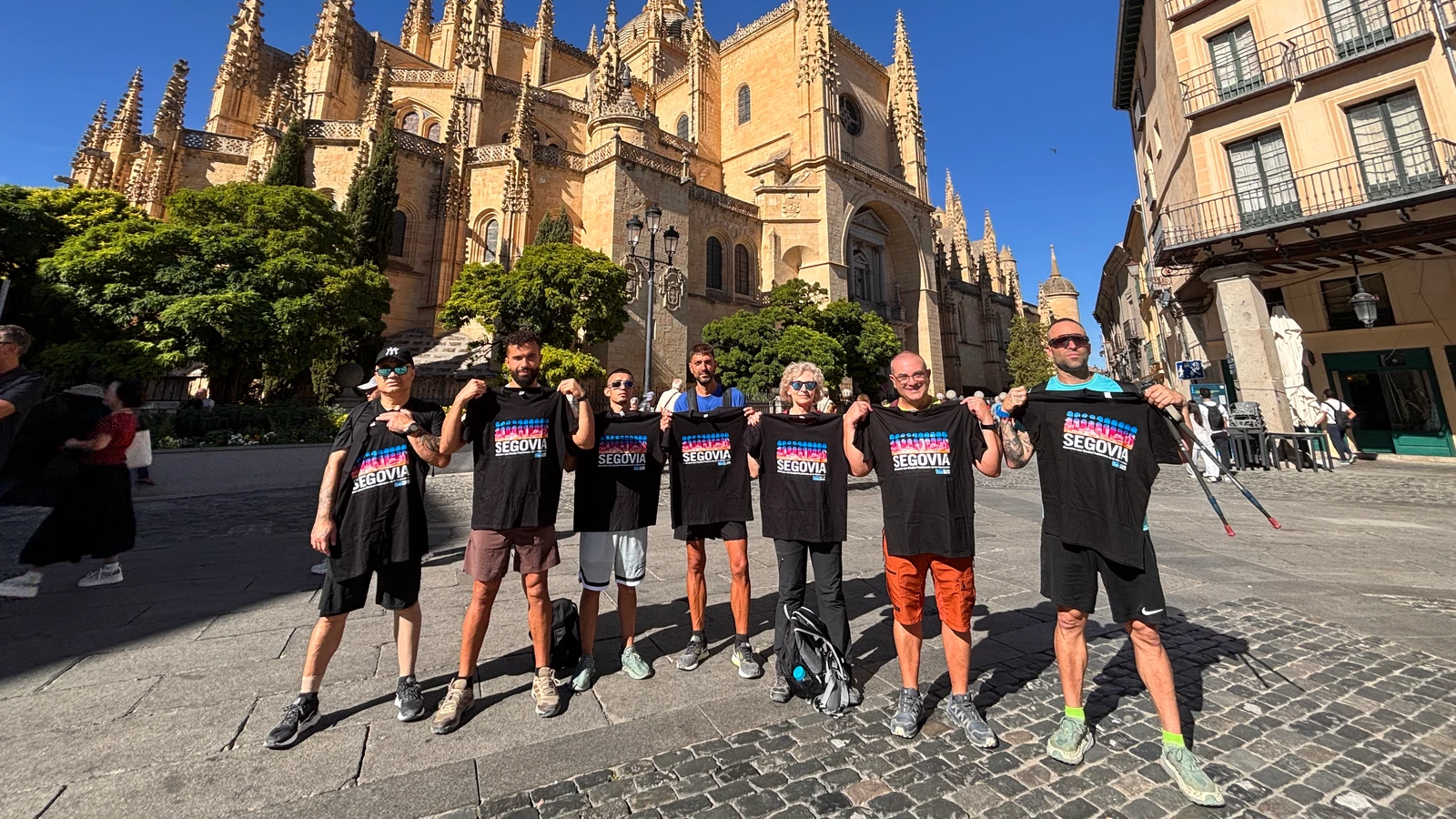
Six inmates from the Segovia prison make the Camino to Santiago
Six inmates from the Segovia Penitentiary Center are participating these days in an experience very different from daily life inside prison: walking the French Way from O Cebreiro to Santiago de Compostela within the “Caminos de Libertad” project.
For a week they will face six stages and about 166 kilometers, passing through Triacastela, Sarria, Portomarín, Palas de Rei and Arzúa before finally arriving in Santiago.
The initiative combines the physical effort of walking with cultural activities, coexistence and moments of personal reflection.
A Way to think about a new stage
The objective of the project goes far beyond completing a Jacobean route.
The experience aims to work on values such as effort, coexistence, responsibility and reflection on the future.
Participants will walk accompanied by professionals and managers of the penitentiary center, on a route also designed as an opportunity to look back, assume mistakes and consider what may come next.
The Camino de Santiago thus becomes an especially powerful symbolic space.
Walking for several days forces you to live together, endure fatigue, help each other and face many hours of silence and thought.
For those who participate in this initiative, each stage can have a different meaning than that of a conventional pilgrim.
It is not just about moving towards Santiago.
Also to ask yourself where you want to move forward in life.
From O Cebreiro to Santiago
The group begins the pilgrimage in O Cebreiro, one of the most emblematic points of the French Way.
From there it will successively travel the sections to Triacastela, Sarria, Portomarín, Palas de Rei and Arzúa, before facing the last day towards Compostela.
The choice of the French Way is not accidental.
It is the best-known and most traveled Jacobean route, but also one of those that concentrates the greatest heritage, pilgrim tradition and international coexistence.
During those days, the inmates will share the road with pilgrims from numerous countries and with very different motivations.
That contact with other people is also part of the experience.
The Camino as a reintegration tool
The “Paths of Freedom” project uses pilgrimage as a tool to work on personal and social processes.
The effort to complete a stage, respect the group's times, live with others and assume small responsibilities during the journey can become a useful experience within a reintegration process.
The initiative is based on a simple idea: a person deprived of liberty continues to have the possibility of learning, changing and rebuilding their future.
And few scenarios are as symbolic to talk about second chances as a path that literally forces us to move forward step by step.
Segovia will also walk with them
The Segovia City Council participates in the initiative by providing t-shirts to pilgrims.
The objective is that the inmates carry the name of Segovia with them during the journey and can also feel like representatives of the city during their Camino.
The gesture has a simple but symbolic dimension.
For a few days, these t-shirts will travel through some of the best-known places on the French Way and will accompany the group to Santiago.
Meeting at Monte do Gozo
One of the most special moments will take place shortly before reaching Compostela.
At Monte do Gozo, participants from the Segovia Penitentiary Center will meet inmates from other penitentiary centers that also participate in the initiative.
From there they will travel the last kilometers together.
They will enter Santiago through the Porta do Camiño and later participate in the Pilgrim's Mass in the Cathedral of Santiago.
It will be the physical end of the pilgrimage.
But it's probably not the most important ending.
A collective experience
The project has the collaboration of different institutions and entities, including the Segovia City Council, the Penitentiary Pastoral of Segovia, Cáritas Diocesana of Segovia, the Spanish Episcopal Conference, Caja Rural de Segovia and the Barrié Foundation.
The participation of so many entities shows that the experience is not considered solely as a sporting or religious activity.
It is also a social project.
The Camino is used here as a meeting space and as a tool to work on values that may be important when the participants return to the penitentiary center and, especially, when they have to face their future outside of it.
Walk to start again
The Camino de Santiago is full of people walking looking for something.
Some are looking for answers.
Others try to close a stage.
Some want to overcome a grief, regain confidence or simply stop the rhythm of their life for a few days.
In this case, six people deprived of liberty will walk towards Santiago with a motivation especially linked to the idea of change.
They will not be able to erase what happened before starting the pilgrimage.
But they can decide what they do next.
And perhaps that is one of the reasons why the Camino continues to have so much meaning more than a thousand years later.
Because each pilgrim arrives with a different story.
And because, regardless of where you come from, everyone shares the same address for a few days.
Santiago.
And then, again, life.

















