📖 PILGRIM-SPANISH DICTIONARY: THE LANGUAGE THAT ONLY UNDERSTAND THOSE WHO HAVE SUFFERED THE ROAD TO SANTIAGO
Because what they tell you on the Camino is one thing... and what it really means is quite another.
PILGRIM HUMOR · RTV CAMINO DE SANTIAGO
The Camino de Santiago has its own customs, traditions, gastronomy and even its way of understanding life. But there is something that is barely spoken about: its language.
Yes, friends. We pilgrims speak a special language. We use seemingly normal words that, once you put on your backpack, take on completely different meanings.
For example, when someone tells you "there's a little bit left," you should never ask how much. Better to sit down, take off your boots and make a will.
After years listening to conversations in hostels, bars, trails and fountains, at RTV Camino de Santiago we have decided to compile the most common expressions in this absolutely unnecessary dictionary, but probably more useful than some maps.
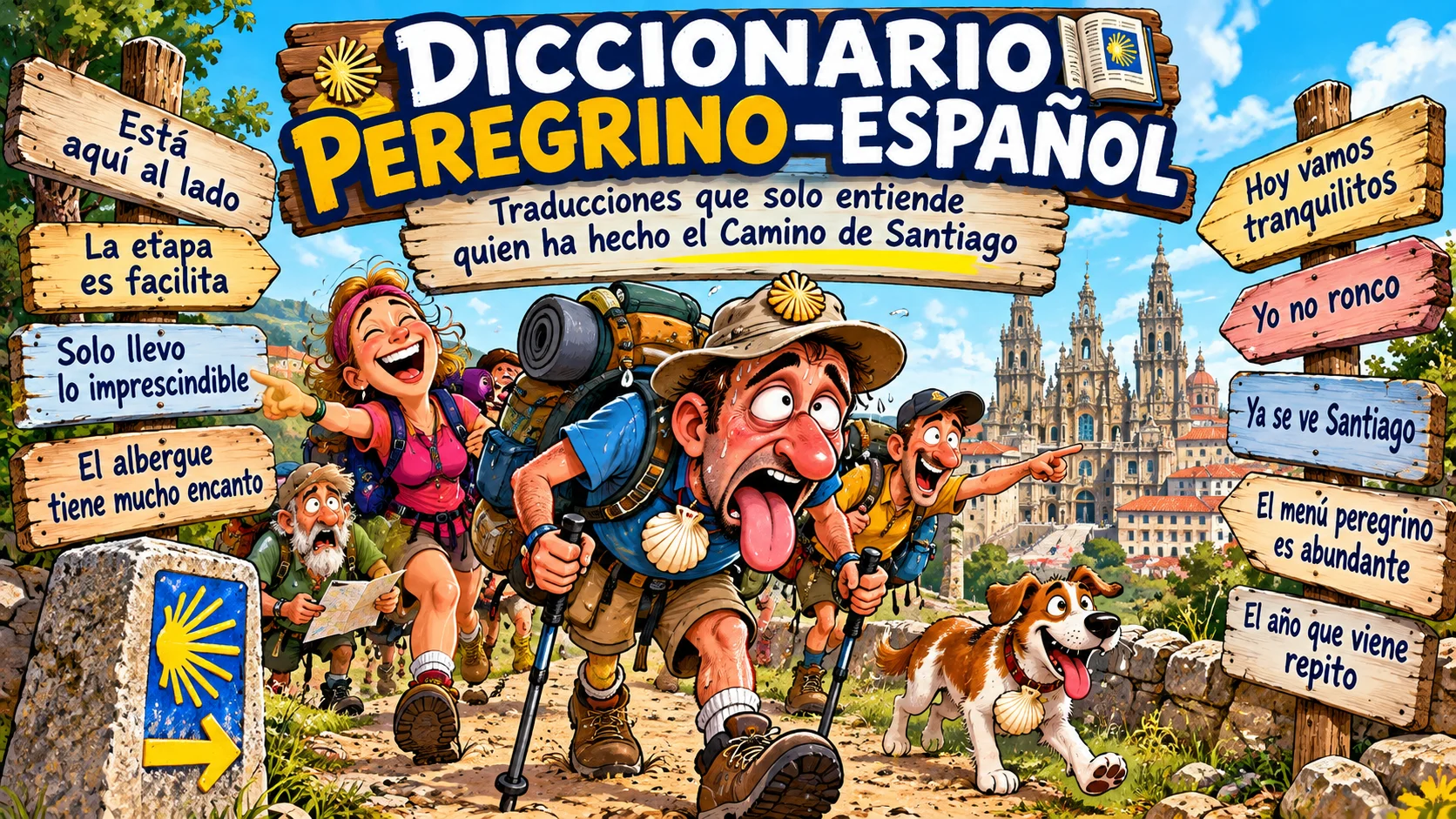
1. "It's here next door"
Official translation: Seven kilometers left, three climbs and a descent designed by someone who hated knees.
It is the favorite phrase of the residents of any town on the Camino. You ask how long it will take to get to the hostel and a man, calmly sitting on a bench since 1987, answers:
—Nothing, man! Here next door!
That man has not walked those seven kilometers since the Seat 600 was invented.

2. «Tomorrow's stage is easy»
Official translation: Call your family and say goodbye just in case.
It is normally said by a veteran pilgrim, one of those who have walked forty Caminos, eat stones for breakfast and consider that going up to O Cebreiro is a pleasant digestive walk.
—Tomorrow it is only twenty-eight kilometers, but it is done very well.
The curious thing is that he always utters this phrase while massaging his knee with a cream whose name sounds like an industrial fuel.
3. "I don't snore"
Official translation: Three Boeings take off from the dormitory tonight.
It is possibly the biggest documented lie in the history of the Jacobean pilgrimage.
The individual arrives at the shelter, delicately places his sleeping bag and assures that he sleeps like a little angel.
At 11:47 p.m., seismic activity begins, forcing the pilgrims in the upper bunks to hold on to the structure.
At 02:15 an Italian shouts "Mamma mia." At 03:30 a German woman starts looking for hotels. And at 05:00 the hospital worker considers calling Civil Protection.
4. "I only carry what is essential"
Official translation: I'm carrying half the house and items I didn't even know I had.
The backpack contains three pants, six T-shirts, four books, two chargers, a complete pharmacy, a cervical pillow, a hair dryer and a mysterious device purchased on the Internet.
The pilgrim weighs 68 kilos. The backpack, approximately the same.
When someone recommends you lose weight, you respond indignantly:
—But I have already removed many things!
Indeed. He left the microwave at home.

5. "Let's leave early to avoid the heat"
Official translation: At four in the morning we will start making noise with plastic bags.
There is a type of pilgrim who considers that five in the morning is a great time to organize his luggage.
He opens zippers, crumples packaging, turns on flashlights, and searches for twenty minutes for a lost sock.
Then he whispers:
—Sorry, I didn't want to wake anyone up.
No, man. If we were all waiting for your concert.
6. “The hostel has a lot of charm”
Official translation: Don't ask about hot water.
Sometimes, "charm" means that the building is four hundred years old, the beds are one hundred and twenty, and the electrical installation looks like it was designed by a medieval monk.
The shower offers two temperatures: glacial and volcanic.
But there is something wonderful: after walking thirty kilometers, a horizontal bed looks like a five-star suite.
Of course, if the bunk moves, it is not an earthquake. It's the German upstairs trying to turn around.
7. «Today we do a short stage»
Official translation: Twenty-four kilometers. Not counting those we will miss.
The word "short" is relative. For a normal person it means going to buy bread.
For a pilgrim it means crossing three municipalities, two provinces and probably an existential crisis.
And someone always appears and comments:
—Well, I still have the strength to do ten more kilometers.
That person should be temporarily expelled from the group for excessive optimism.
8. «The pilgrim menu is abundant»
Official translation: Today you are going to discover how far a serving of macaroni can stretch.
The pilgrim menu is an institution. It has the ability to bring together French, Koreans, Brazilians and Spaniards around a universal question:
—Is wine included?
The waiter assures that the lentils are homemade. Nobody asks which house.
But when a good potato omelet appears, the pilgrim immediately regains faith in humanity.

9. «You can already see Santiago»
Official translation: You still have enough left to rethink all your decisions.
It is one of the most exciting moments of the Camino. Someone points to the horizon and shouts:
—Look, Santiago!
Everyone smiles, some cry and others take out their cell phones.
But then you discover that between you and the Cathedral there are still streets, slopes, traffic lights and a man walking in front taking up the entire sidewalk.
And when you finally arrive at the Plaza del Obradoiro, you sit on the ground and pronounce the most sincere phrase of the entire pilgrimage:
—No one moves me from here!
10. «Next year I repeat»
Official translation: I have learned absolutely nothing.
It is the greatest mystery of modern science.
A person spends fifteen days with blisters, muscle pain, rain, heat, snoring, wet socks and a backpack that seems to be carrying bricks.
He repeatedly swears that he will never do such a barbarity again.
Arrive in Santiago. Hugs his teammates. Cry. Go back home.
And forty-eight hours later he is looking at the stages of the Primitive Way on the Internet.
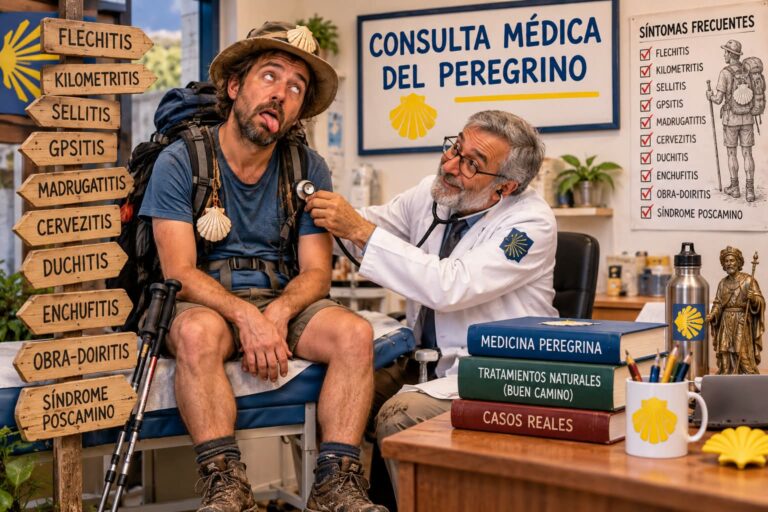
Diagnosis: chronic peregrinitis. It has no known cure. It is only relieved by preparing another Camino.

And the most dangerous expression of all: "Buen Camino!"
It can mean many things: "good luck", "cheer up, mate", "see you in Santiago" or "I have no idea how much longer, but I'd rather not tell you."
It can also mean: "I'm going downhill and you're going uphill. "I don't want to discourage you."
Because the Camino has that extraordinary capacity to turn suffering into wonderful memories, misfortunes into anecdotes, and complete strangers into friends for life.
And although each pilgrim speaks their own language, we all end up understanding the same expression.
Good Way!
And if someone tells you that what's coming is all plain... be suspicious.
Now it's your turn, pilgrim. What phrase have they told you on the Camino that later turned out to be a monumental lie? Tell us in the comments. We want to expand this dictionary with your best experiences!