




Logroño puts an end to seven months of controversy by removing the Jacobean monolith installed next to La Redonda: it was intended to mark the Camino de Santiago, but the official route does not even pass through there
LOGROÑO. — There are signs on the Camino de Santiago that have been guiding pilgrims for centuries. Yellow arrows painted on stones, scallops, cairns and small indicators that have a very simple mission: tell the walker where they should continue towards Santiago.
And then there was the Logroño landmark.
It was inaugurated with an institutional character, placed in one of the best-known places in the historic center and presented as an element destined to reinforce the Jacobean signage for the next Xacobeo Year 2027.
There was just one small problem.
The Camino de Santiago did not pass through there.
Seven months after its installation, the controversial monolith placed next to the co-cathedral of Santa María de La Redonda, on Portales Street, has finally been removed.
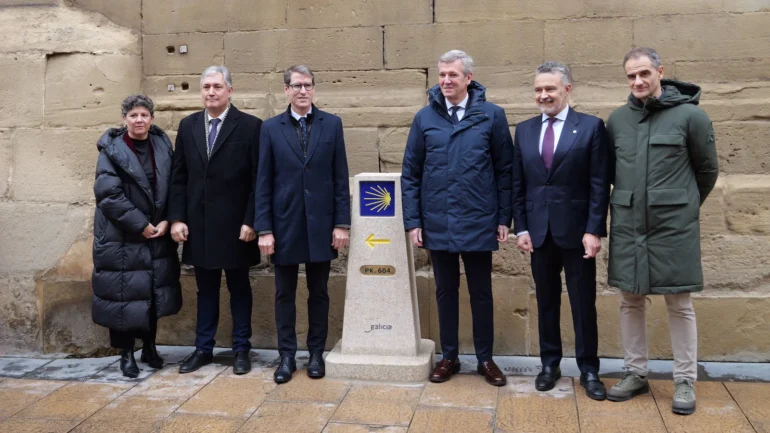
A milestone on the Camino… outside the Camino
The story began last January 16, when the monument was inaugurated in the presence, among other authorities, of the president of the Xunta de Galicia, Alfonso Rueda.
The objective seemed perfectly reasonable: to reinforce the presence and signage of the Camino de Santiago in a city deeply linked to the French Way.
The chosen location, however, soon began to raise questions.
The official route that pilgrims follow as they pass through Logroño runs through other streets. Therefore, a walker who correctly followed the directions of the Camino would hardly find that new landmark.
And there the controversy began.
A sign for pilgrims or a tourist element?
The criticisms did not take long to appear.
The councilor of the Riojano Party Ruben Antoñanzas He questioned the usefulness of placing the indicator outside the route and argued that it would be much more practical to improve the signage precisely in the places where pilgrims actually pass.
Also the association Rioxa Nostra, dedicated to the defense of heritage, expressed its doubts about the location.
His argument was difficult to ignore: if an element is intended to signal a route, the logical thing would be to place it on that route.
The association considered that the monolith ended up functioning more as a tourist element on Portales Street than as a true reference for walkers.
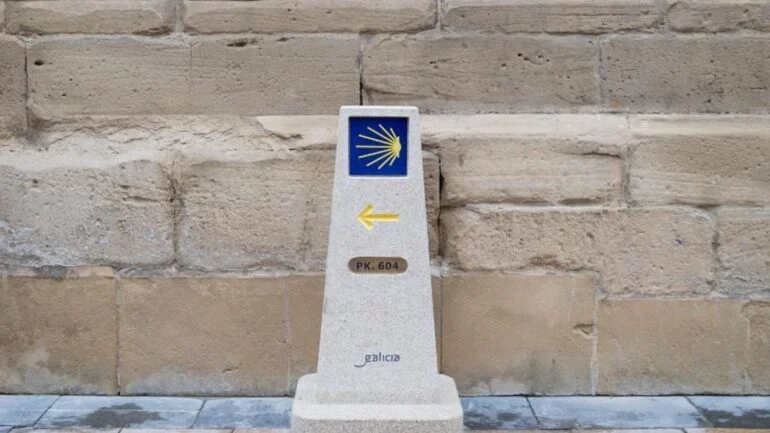
And another problem appeared: the license
But the location was not the only controversy.
The Riojano Party later denounced that the monolith had been installed without the corresponding municipal license, demanding its withdrawal and its possible relocation to a point through which the Camino de Santiago actually passed.
The situation acquired even greater relevance because it was located next to the co-cathedral of Santa María de La Redonda, declared Asset of Cultural Interest.
The doubts ended up reaching the area of Culture, which was asked to study the legality of the installation and the permits with which the action had been carried out.
Seven months later, the landmark disappears
This Thursday the story has taken a new turn.
The monolith It is no longer on Portales Street.
It has been withdrawn seven months after that inauguration and after a controversy that probably would never have existed if a point located within the Jacobean route had been chosen from the beginning.
The paradox is evident.
A sign created to indicate the Camino ended up being known precisely because was out of the way.
Logroño does not need to invent the Camino
And here a question appears that goes far beyond this milestone.
Logroño is one of the great historical cities of the French Way.
Thousands of pilgrims cross the Riojan capital on their way to Nájera, Santo Domingo de la Calzada and, many kilometers later, Santiago de Compostela.
The city does not need to fabricate an artificial relationship with the pilgrimage.
The Camino already passes through Logroño.
It is part of its history, its streets and its heritage.
That is why it is especially striking that a new Jacobean element ended up placed outside the itinerary itself.
Good signage matters
To those who observe the Camino from the outside, a cairn may simply seem like a decorative element.
For a pilgrim tired after twenty or thirty kilometers, it is not.
One wrong arrow can mean walking several extra miles.
An unclear signal can cause doubts.
And an indicator located outside the layout can cause confusion among precisely the people it is supposed to help.
The signage of the Camino has a practical function rather than an aesthetic one.
It must guide.
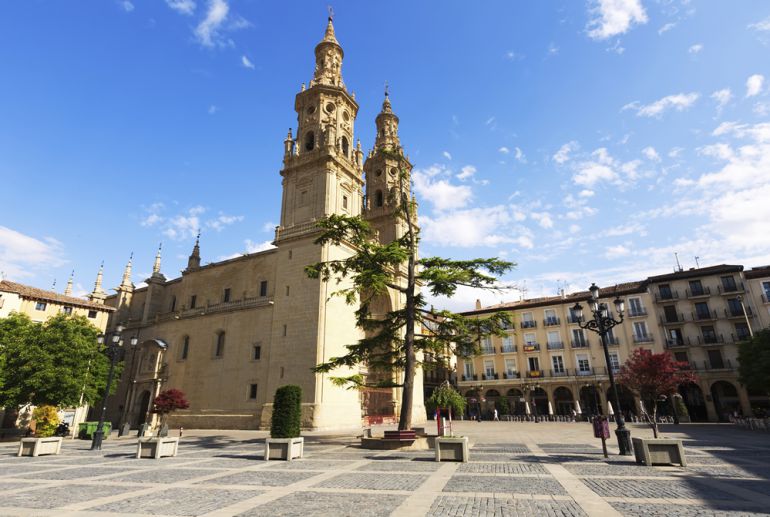
Xacobeo 2027 is getting closer
The case also acquires special interest because the monolith was raised in the context of the preparation of the next Holy Year Xacobeo 2027.
During the coming months, numerous cities, municipalities and autonomous communities will promote actions related to the Camino de Santiago.
There will be promotion.
New infrastructures.
Signaling.
Tourist campaigns.
Events.
And probably important investments.
But perhaps this little episode from Logroño leaves a fairly simple lesson:
Before placing a Camino sign, it is a good idea to check where the Camino passes.
A controversy that ends with a question
The monolith has disappeared from its initial location.
Now it remains to be known what its final destiny will be and if it will end up being relocated somewhere where it can truly fulfill the function for which it was conceived.
Because no one disputes that Logroño should value its enormous Jacobean heritage.
The question is how to do it.
The Camino de Santiago has more than a thousand years of history and one of the most recognizable symbol systems in the world.
It doesn't need too many complications.
A scallop.
A yellow arrow.
A cairn.
And a rather important condition:
that points out where the pilgrims really have to walk.

















