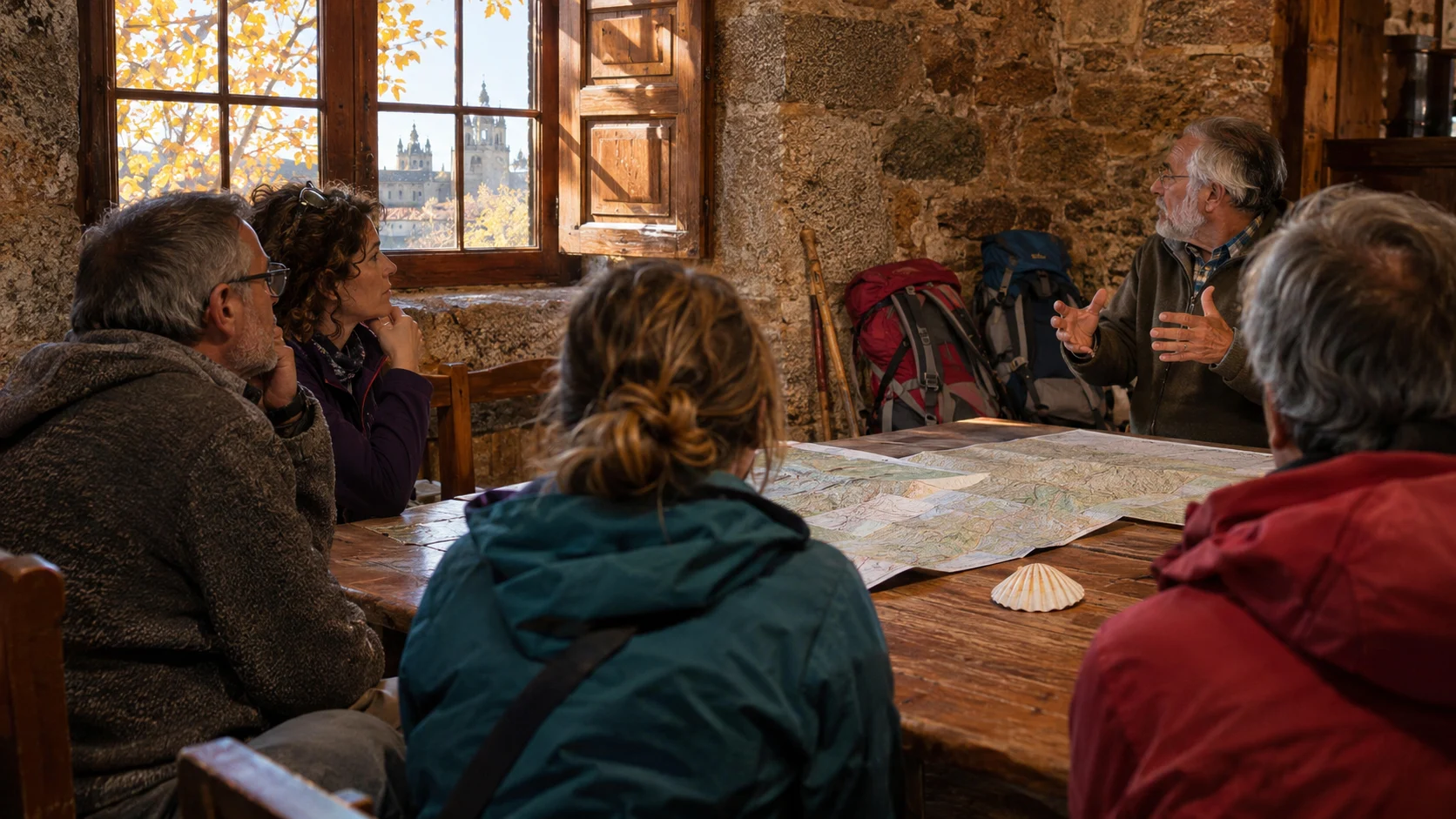
What does the Vía de la Plata need to continue being a recognizable and safe Camino? Astorga will open this Friday, November 6, at 7:00 p.m., a space for conversation about the present and future of this Jacobean route. The second session of the Filandones de la Vía de la Plata will take place at the Siervas de María Pilgrims' Hostel and will bring together perspectives from Extremadura and Castilla y León.
The call, organized by the Association of Friends of the Camino de Santiago de Astorga, seeks to bring to the neighbors and people linked to the Camino a reality that goes beyond promotion: the state of the routes, the orientation of pilgrims and the collaboration necessary to preserve them.
The day is open to the public and will end with a small aperitif that will allow the exchange of experiences between attendees to continue.
From Mérida to Astorga: two voices for the same route
One of the guests is Luis María González, president of the Association of the Camino de Santiago de Mérida, Mozarabic Way – Via de la Plata. His intervention will bring closer the situation of the itinerary from Extremadura, an essential territory to understand the continuity of this pilgrimage towards the north.
Next to him will be José Manuel Rodríguez Montañés, historian and member of the Astorgana association, who will address the signage and diagnosis of the route. These are issues of enormous interest to the walker: an unclear fork or a damaged sign can complicate a stage and raise doubts about the correct route.
The participation of representatives from different points of the itinerary raises a fundamental issue. A long-distance route cannot be cared for by isolated fragments: it needs coherent references when it crosses municipalities, provinces and autonomous communities.
The signaling of the Vía de la Plata, at the center of the debate
According to the information released about the meeting, in 2025 the Astorga association carried out the first comprehensive diagnosis of the signaling of the Vía de la Plata in Castilla y León. The work was conceived as a starting point to promote coordination between Jacobean associations and public administrations.
The results and needs of the route will take center stage in this second quest. It is not just about placing new arrows: it is important to know what route is being indicated, where doubts arise and who can be responsible for its maintenance.
Signage also influences safety. For a person who walks for several days, identifying the intersections well and having continuity in the directions can make the difference between a calm stage and a day of disorientation.
At RTV Camino de Santiago we have already reported actions to improve the Vía de la Plata in Zamora. Those who are preparing the route can also consult our guide to the Vía de la Plata to make a wise pilgrimage.
The Philandones recover the Jacobean conversation
The name of the Philandones refers to the tradition of meeting to talk and share knowledge. The Astorgana association recovers that spirit to give a voice to people who know the route and work on its conservation.
The cycle had planned a first session on October 16 and this second on November 6. Its interest is in bringing to the public problems that are usually discussed in technical meetings, but that directly affect pilgrims, hospital workers and inhabitants of the towns along the Camino.
Astorga It is a significant setting for that dialogue. The Vía de la Plata and the Camino Frances converge in the city, and its welcoming tradition allows us to observe the relationship between different Jacobean itineraries.
The debate also connects with the shared work of entities from different territories, as shown by the recent meeting of the Jacobean world in Mérida.
Time and place of the meeting in Astorga
The Filandones of the Vía de la Plata will be held on Friday, November 6, 2026, at 7:00 p.m., in it Siervas de María de Astorga Pilgrims Hostel. Luis María González and José Manuel Rodríguez Montañés will participate.
The activity is organized by the Association of Friends of the Camino de Santiago de Astorga, with the collaboration of the Xunta de Galicia and Xacobeo 2027. All people interested in the Camino and its heritage can attend.
The future of the Vía de la Plata is also decided on very specific issues: knowing where to walk, conserving what exists and listening to those who know each section.
Sources: Astorga Digital y The New Chronicle.