



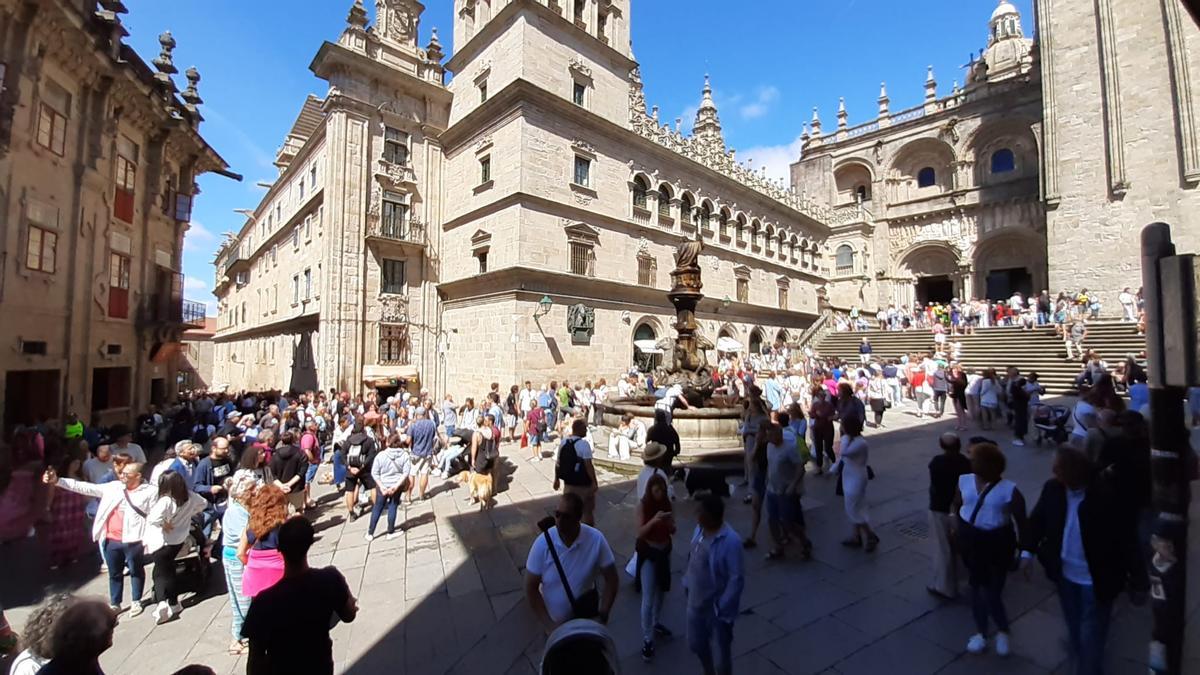
The massive arrival of pilgrims and tourists in the middle of August causes long waits in Praterías and reopens the debate on how to manage the enormous influx of visitors
SANTIAGO DE COMPOSTELA – Arriving at the Plaza del Obradoiro after hundreds of kilometers walking does not mean being able to immediately enter the Santiago Cathedral. In the middle of the high season, pilgrims and tourists are meeting these days with queues that can reach an hour to access the Compostela temple.
The situation is especially concentrated in the access of the Praterías Square, where at mid-morning the lines extend through the nearby streets of the historic center. Some visitors take turns resting, others take the opportunity to take photographs and many wait patiently until they can enter.
The enormous influx once again puts on the table one of the great challenges of the Camino de Santiago: how to manage the success of a pilgrimage that attracts hundreds of thousands of people every year.
Worst time: around noon
There is a particularly complicated hour.
The longest waits occur around 12:00, coinciding with the celebration of the Pilgrim's Mass. During certain times the entry of new visitors is temporarily interrupted due to capacity reasons.
The result is that the queue continues to grow outside and some people may wait for a long time to finally discover that the temple has reached its maximum capacity.
For many pilgrims, this situation is especially frustrating.
After days or weeks of walking, entering the Cathedral is one of the most anticipated moments of the entire pilgrimage.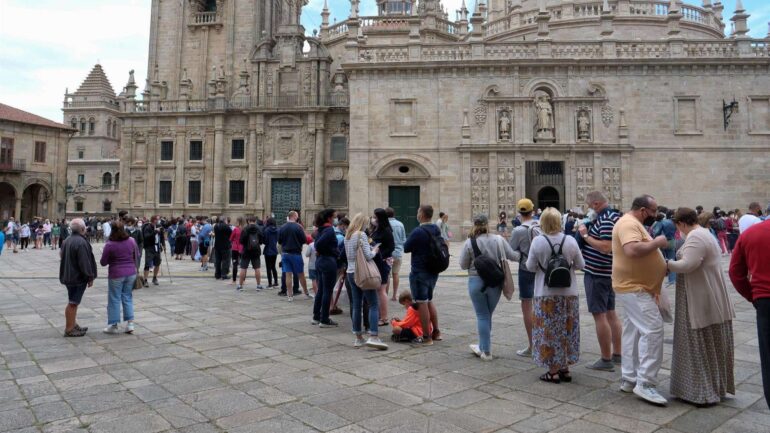
Concern for the elderly
Among the criticisms that some visitors are making, the situation of the elderly or those who have difficulty standing for long periods of time stands out.
Some demand a different organization and more access to distribute the flow of visitors and avoid such long waits.
One of the complaints collected these days in Santiago sums it up clearly: "It is not possible to have older people waiting in those conditions".
The situation also opens a debate on accessibility. The Camino welcomes pilgrims of all ages and more and more people with reduced mobility or special needs manage to reach Compostela.
Properly managing your arrival should therefore become a priority.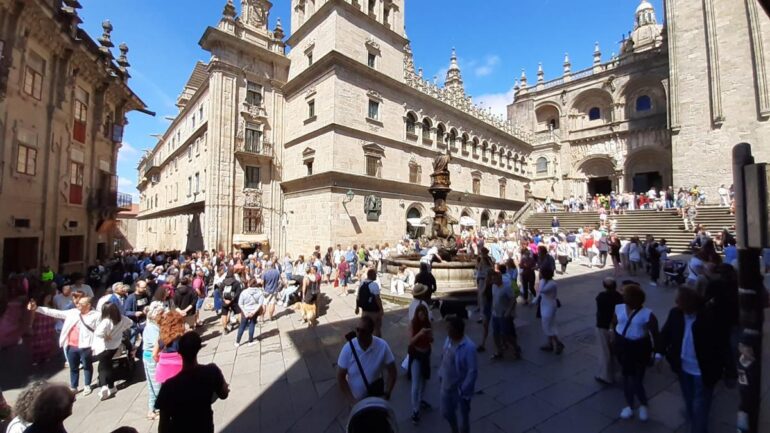
The Puerta de Abades, the alternative that many are unaware of
There is a possibility that a significant portion of visitors still do not know about.
To try to alleviate the saturation, the cathedral complex has temporarily enabled access through the Abades Gate, located in the Plaza de la Quintana area.
The goal is to better distribute visitors and reduce pressure on Praterías. However, this alternative entrance is used after the end of the Pilgrim's Mass and the works on the Clock Tower currently complicate traffic to that area.
The lack of knowledge about this access causes a good part of the visitors to continue heading directly towards Praterías.
Better information could help distribute tickets and reduce waits.
The Botafumeiro also generates confusion
Another of the great wishes of many pilgrims is to contemplate the Botafumeiro in operation.
But there is a frequent confusion: arriving in Santiago or attending a Pilgrim's Mass does not guarantee seeing it fly through the Cathedral.
The famous censer is used in certain liturgical celebrations and specific occasions, so some visitors who hope to see it end up being disappointed.
Knowing the schedules and celebrations in advance can avoid false expectations.
August tests Santiago
The situation that is being experienced these days is not completely unexpected either.
August is one of the months with the greatest presence of pilgrims and tourists in Santiago de Compostela. Hotels, restaurants, terraces, streets of the historic center and services linked to the Camino register extraordinary activity.
Many regular visitors to the city accept the crowds with resignation. One of them summed up the situation with a simple phrase: «Whoever comes to Santiago knows that there will be people».
However, the popularity of the Camino poses a growing challenge.
The objective should be to ensure that the growth in the number of pilgrims is compatible with the conservation of heritage, the daily life of the inhabitants of Santiago and a dignified experience for those who arrive after traveling hundreds of kilometers.
Because after overcoming mountains, rain, heat, blisters and long stages, maybe The last test of the Camino should not be waiting an hour in front of the Cathedral.

















