



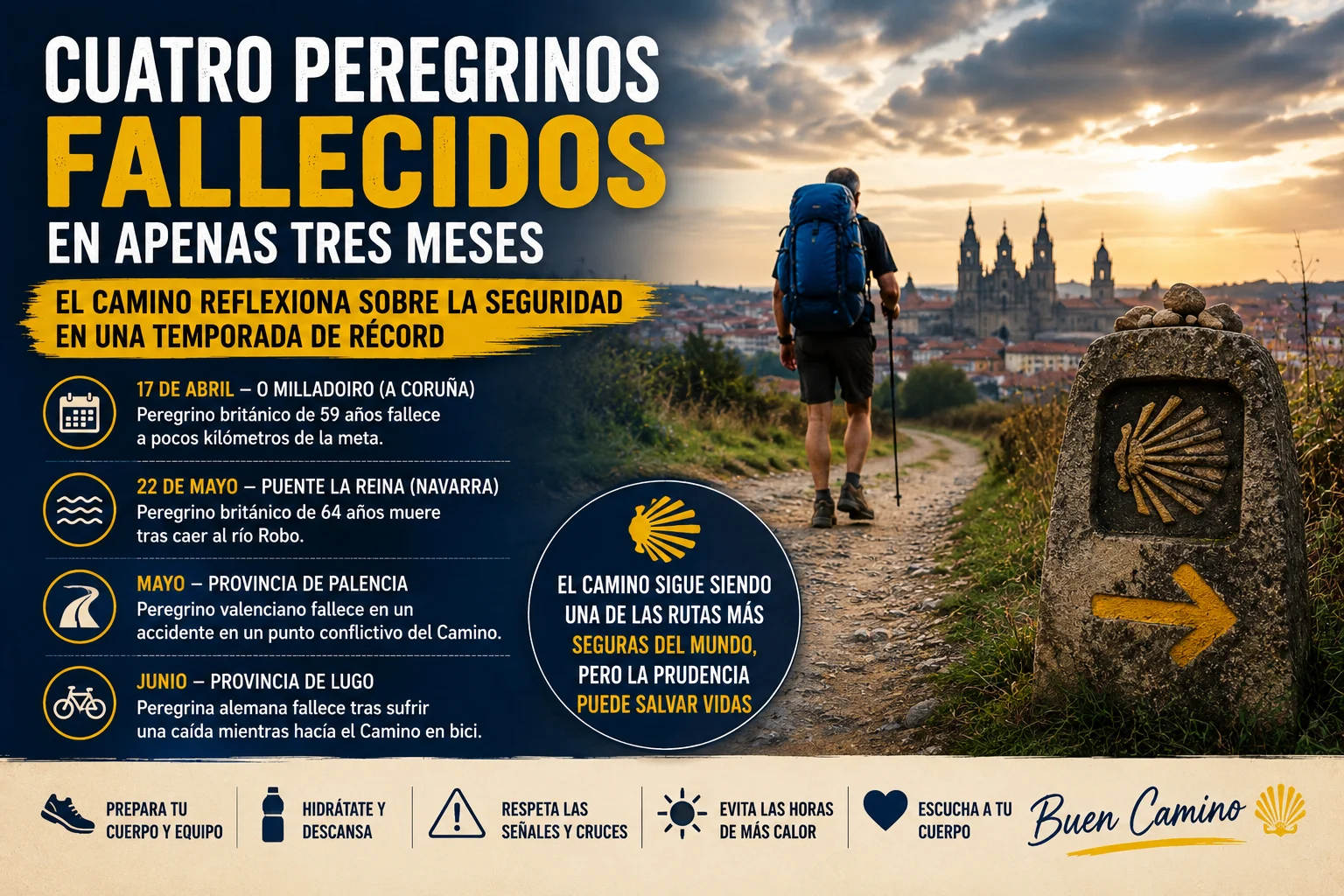
A series of tragedies reopens the debate over safety on one of the world's busiest pilgrimage routes
The Camino de Santiago is experiencing a historic moment. Thousands of pilgrims travel the different Jacobean routes every week, attracted by a unique experience that combines sport, spirituality, nature, culture and personal improvement.
However, the last few months have also left painful news for the pilgrim community. Between April and June 2026, several deaths that occurred at different points along the Camino have generated deep shock among pilgrims, hospitaliers, Jacobean associations and residents of the towns through which the route passes.
One of the most shocking cases was that of a 59-year-old British pilgrim who suffered an illness when he was a few kilometers from the Cathedral of Santiago, in the town of O Milladoiro. After traveling hundreds of kilometers, the pilgrim collapsed during the last stages of his trip and the emergency services were unable to save his life.
Weeks later, another 64-year-old British pilgrim died in Navarra after falling into the Robo River, near Puente la Reina-Gares. The first investigations pointed to a possible loss of balance while trying to cross an improvised structure near the riverbed. The event caused a great commotion among the walkers and once again put on the table the need to take extreme caution in certain areas of the route.
Added to these cases was the death of a Valencian pilgrim at a conflict point on the Camino in the province of Palencia. The accident generated numerous criticisms from Jacobean groups and local representatives, who demanded urgent improvements in the safety of some crossings used daily by walkers and cyclists.
Although the number of deaths is still very small compared to the hundreds of thousands of pilgrims who travel the Caminos de Santiago each year, these tragedies remind us that the pilgrimage also requires responsibility and physical preparation. Long stages, heat, dehydration, accumulated fatigue or certain previous pathologies can increase the risks during the route.
Jacobean associations and health professionals insist on basic recommendations: maintain proper hydration, respect breaks, avoid peak heat hours, carry out adequate prior preparation and not take unnecessary risks on roads, intersections or complicated areas of the route.
Despite these events, the Camino de Santiago continues to be one of the safest pilgrimage routes in the world. Every year hundreds of thousands of people arrive in Compostela without suffering serious incidents, demonstrating that prudence and common sense continue to be the best travel companions.
Behind each of these deaths there are personal stories, families and dreams that were interrupted during the pilgrimage. The Jacobean community has responded once again with solidarity and support, remembering that the Camino is much more than a route: it is a large international family united by the experience of walking towards Santiago.
Because getting to Compostela is important.
But returning home to tell the experience is even more so.

















