Survival Guide for Volunteer Hospitallers: Don't Die Trying (and Keep Your Sanity)!
Ah, the Camino de Santiago! That ancient path of self-discovery, sweat, blisters and, for some brave people, the opportunity to become a Volunteer Hospitaller. If you are thinking of joining this noble cause, get ready, because life at the hostel is a mix of Zen, chaos and a humor that can only be understood at 6 in the morning, with the smell of damp socks and the promise of coffee.
Chapter 1: The Call of the Hostel (and the 5 AM Wake Up)
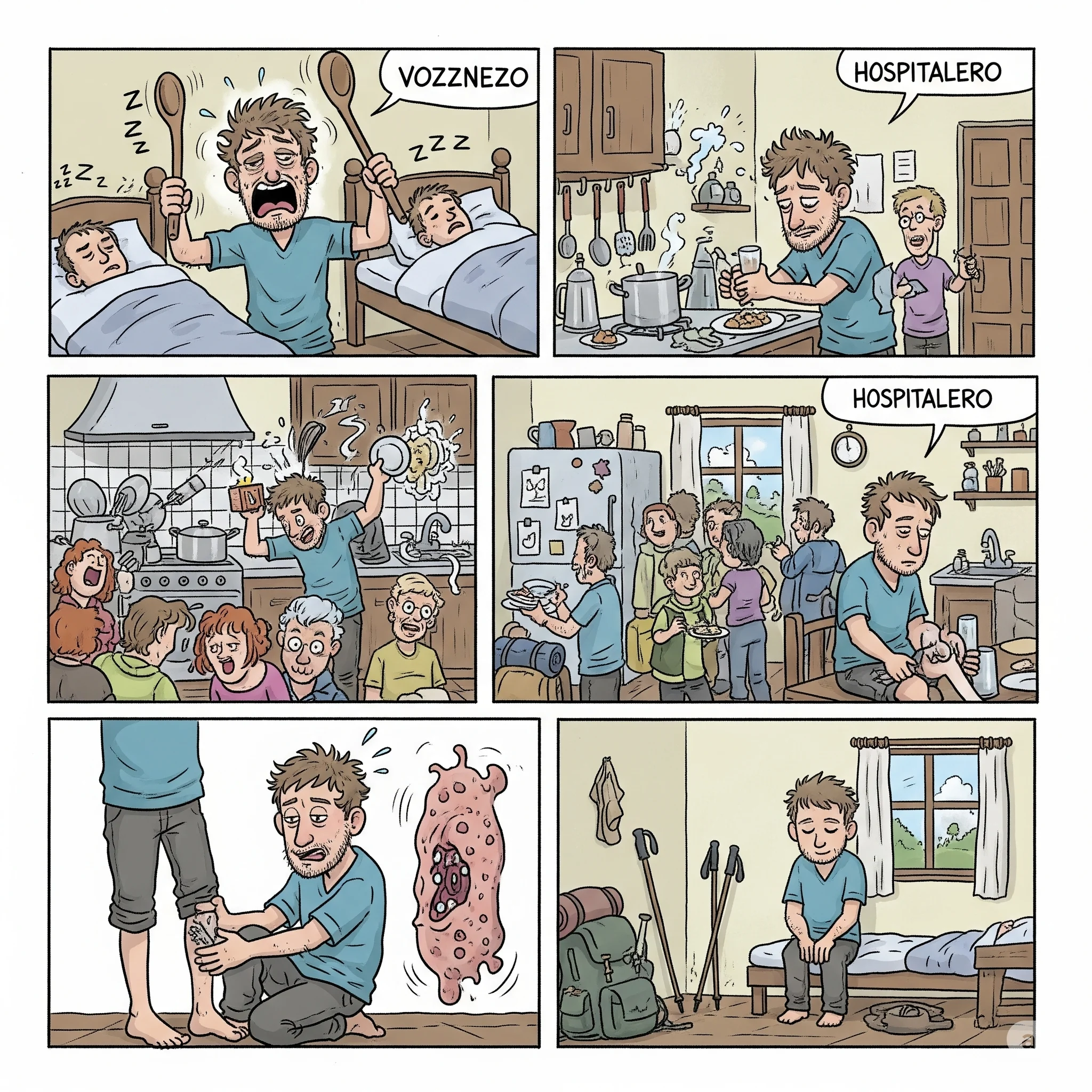
It all begins with a revelation: "I want to give back to the Camino how much it gave me." How beautiful! How idealistic. Then you discover that “giving back” means getting up before the chickens, cleaning toilets with the devotion of a Zen monk, and listening to stories of blisters that would make a fakir cry. Your first lesson: the alarm clock is your new archenemy. And silence, a luxury that only exists in your dreams (or in the midday nap, if you manage one).
Chapter 2: The Art of Welcoming (and Crowd Management)
The first pilgrim arrives. Smiling, grateful. "How beautiful this is!" you think. Then twenty more arrive. And thirty others. And suddenly, the hostel looks like a branch of the Central Bus Station during rush hour. You will learn to say “Quiet, please!” in five languages, to discern between a normal snore and a human chainsaw, and to convince a group of Germans that yes, dinner is at eight, not six. Your superpower: infinite patience. Your nemesis: the pilgrim who asks if there is Wi-Fi before saying "hello."
Chapter 3: The Kitchen of Love (and the Mystery of the Lost Tupperware)
The community dinner. Summit moment! Cooking for 50 people with three burners and a dull knife becomes an extreme MasterChef test. You will learn to improvise, to stretch the rice as if it were chewing gum, since garlic and onion are the basis of happiness (and the camouflage of any culinary error). But the real challenge is the next morning: where are the tupperware? Who took the wooden spoon? The hostel is a black hole for kitchen utensils.
Chapter 4: The Universal Language of the Camino (and the Pampering of the Pilgrim)
It doesn't matter if you speak Mandarin Chinese or Klingon. At the shelter, the official language is empathy. A "hello", a smile, a "buen Camino" said from the heart, are worth more than a thousand dictionaries. You will become an improvised nurse (the blisters!), a part-time psychologist (the existential crises!), and a spiritual advisor (the doubts about life!). But the most gratifying thing is to see the relief on an exhausted pilgrim's face when he finds a clean bed and a kind word.
Chapter 5: The Farewell (and the Promise to Return)
After two weeks of blessed madness, it's time to say goodbye. You will see your pilgrim "children" leave, some with tears in their eyes, others with the Compostela in their hands and a smile from ear to ear. You will feel tired, yes, but with a full heart. And then, without realizing it, the phrase that brought you here will return to your mind: "I want to give back to the Camino how much it gave me." And you will know that, despite the snoring, the lost tupperware and the endless lines, you will come back! Because being a hospitalist is not a job, it is a way of life… and of humor.