



The origin of the Compostela, the certificate that accredits the pilgrimage to Santiago, dates back to the Middle Ages and it is directly related to the need to verify the authenticity of the pilgrims who arrived at the Apostle's tomb.
Here you have the process of its historical evolution:
1. The Precursor: The Scallop (Early Middle Ages)
In the first centuries of the pilgrimage, the proof of having completed the Camino was not a document, but the Scallop Shell (Pecten maximus).
- Symbol and Test: The pilgrims who arrived in Santiago collected the shell on the coast of Galicia or bought it. It was the most recognized symbol of the pilgrim and served as proof to his community that he had fulfilled his vow.
2. The Problem of Counterfeiting (13th Century)
With the growing popularity of the Camino, counterfeiting also grew. Unscrupulous sellers sold fake shells or obtained them without having done the Camino, devaluing the effort of the pilgrimage.
- Church reaction: Due to the ease with which the shells (the "veneras") were counterfeited, the ecclesiastical authorities of Santiago had to look for a more secure accreditation system.
3. The Birth of the Document: The Evidence Letters
From 13th century, the Church replaced the shell insignia with a written document, the direct antecedent of the Compostela:
- Evidence Letter (Testimonium): This was a written certificate, more difficult to copy, showing that the bearer had reached the tomb of Santiago. This document, sealed by the Cathedral Chapter, guaranteed the legitimacy of the pilgrims.
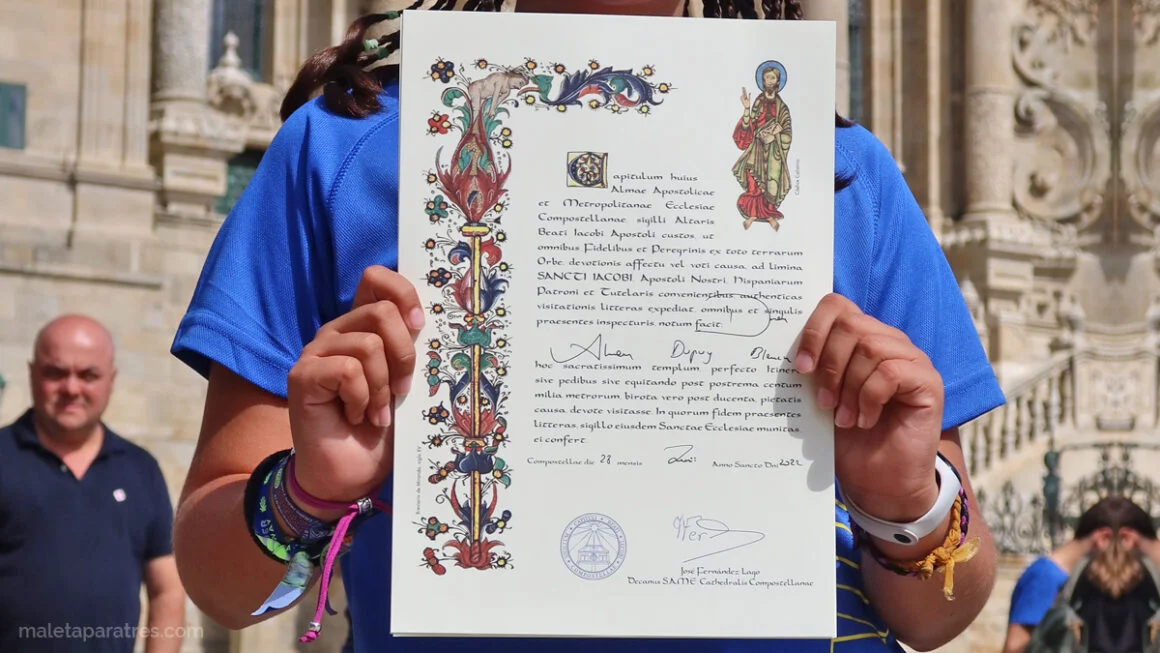
4. Modern Compostela (16th Century and Resurgence)
The name of Compostela (Compostela document) was consolidated during the 16th century. A fact that drove its importance was the role of the Catholic Monarchs:
- Royal Hospitality: In the 16th century, the Catholic Monarchs founded the Royal Hospital (current Parador de los Reyes Católicos) in the Plaza del Obradoiro. Only pilgrims carrying the Compostela had the right to be hosted and cared for free of charge there for three days, raising the value and need for the certificate.
- Renaissance: After centuries of decline in the pilgrimage, the delivery of the Compostela reemerged strongly at the end of the 20th century (especially after the Holy Year of 1993), consolidating itself with the requirements and format that we know today.
Who grants it and for what purpose?
Currently, the Compostela is issued by the
of the Cathedral of Santiago. It is given exclusively to those who prove to have made the pilgrimage with "Christian sense" (devotionis affectu, voti vel pietatis), having traveled at least 100 km on foot or on horseback, o 200 km by bike, which is proven by the seals on the Pilgrim's Credential.

















