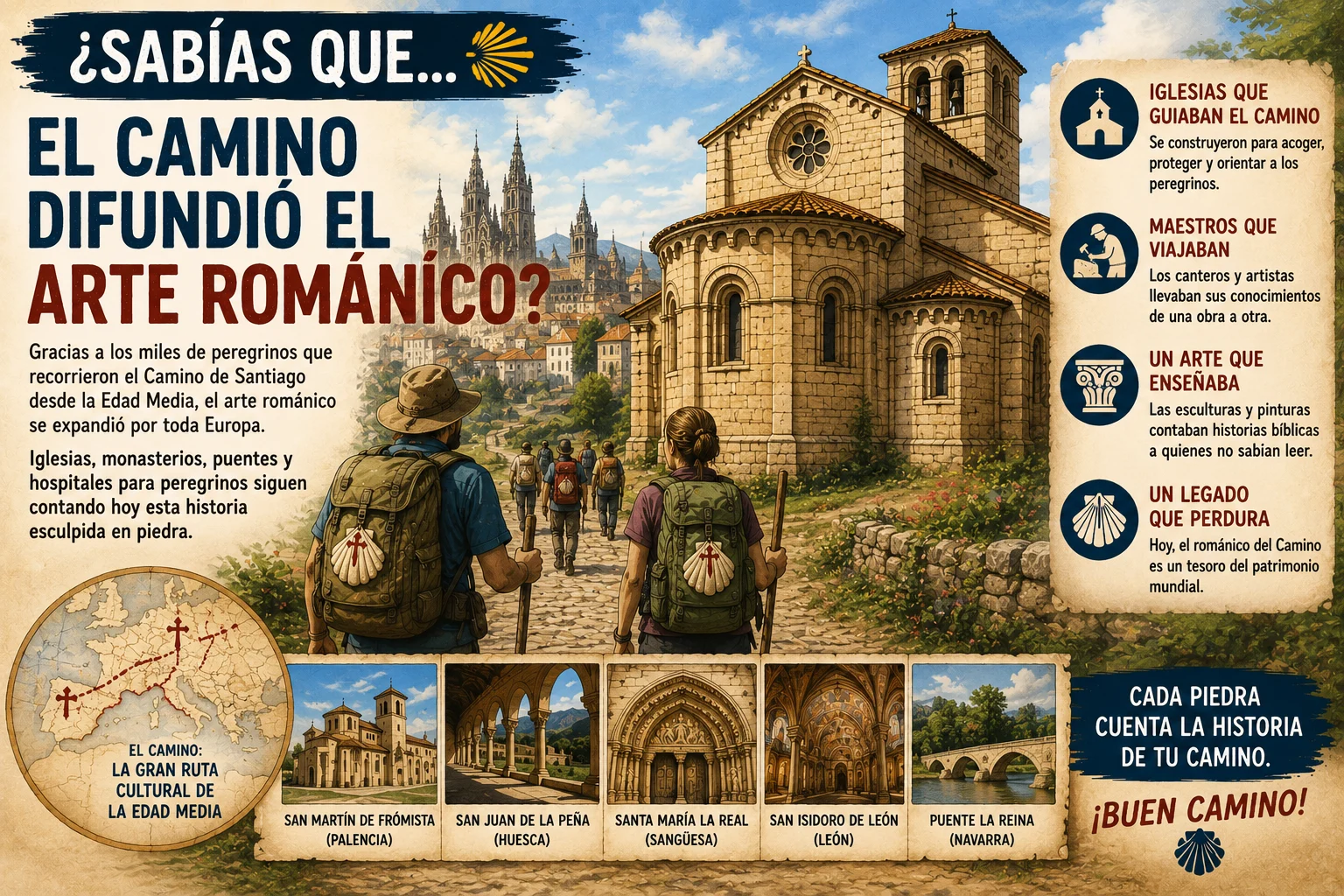
For centuries, thousands of pilgrims not only carried their faith from one place to another. Without knowing it, they also contributed to spreading one of the most important artistic styles of the Middle Ages: Romanesque art.
When we think of the Camino de Santiago, we usually imagine pilgrims with backpack, cane and scallop walking towards Santiago de Compostela. However, almost a thousand years ago, the Camino was much more than a pilgrimage route. It was the Europe's great cultural highway.
Since the 11th century, thousands of people from France, Italy, Germany, England and other European territories crossed mountains, rivers and forests to reach the tomb of the Apostle Santiago. With them traveled ideas, knowledge, construction techniques, sculptors, stonemasons, painters and craftsmen who would end up transforming the landscape of the Iberian Peninsula.
Thus was born one of the great legacies of the Camino: the extraordinary expansion of the Romanesque art.
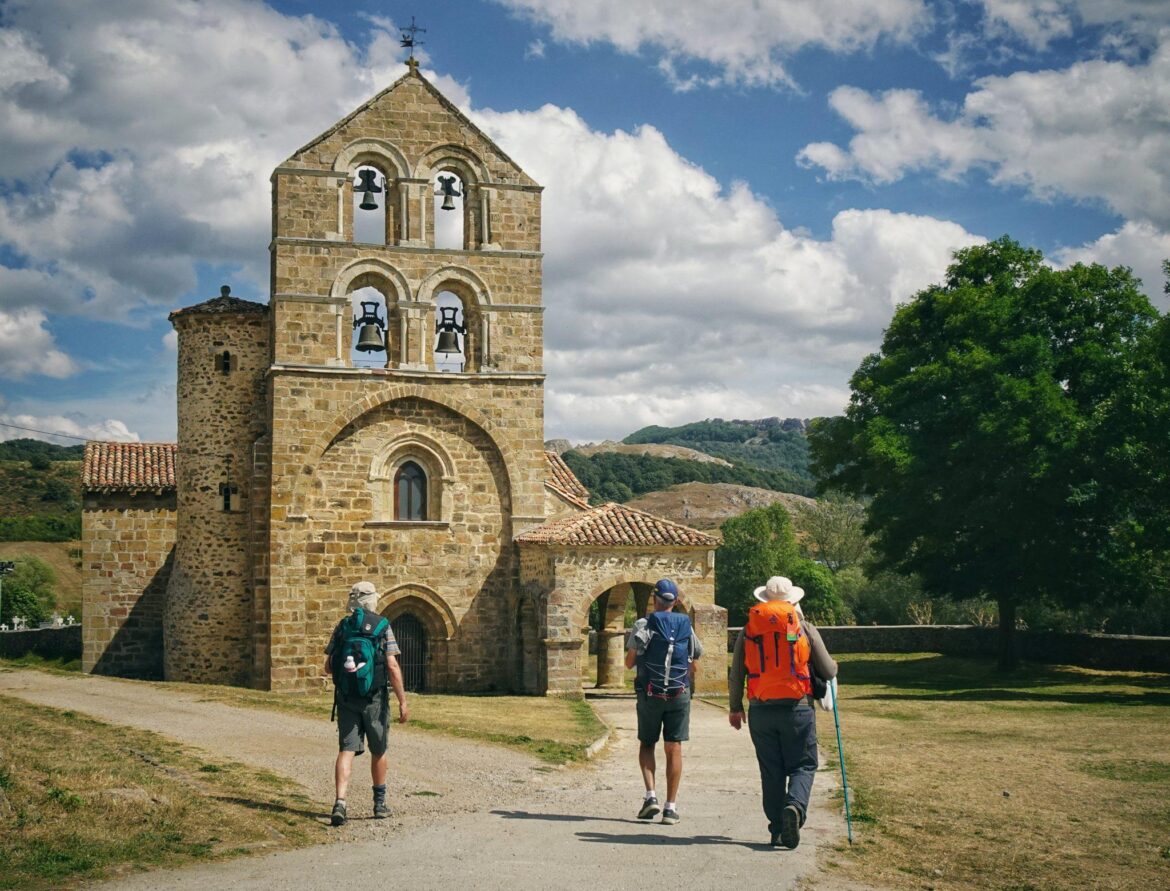
An open air museum
Long before museums existed, the Camino de Santiago was already an authentic art gallery.
Throughout hundreds of kilometers, churches, monasteries, pilgrim hospitals, bridges and castles began to rise following the same architectural language: robust walls, semicircular arches, small windows, thick pillars and spectacular capitals sculpted with biblical scenes, fantastic animals and mythological creatures.
Each new construction also served to teach the faith to a population that, for the most part, did not know how to read.
The stones spoke.
The "social network" of the Middle Ages
Today we share information online.
A thousand years ago, that function was fulfilled by the Camino de Santiago.
Pilgrims exchanged news, customs, songs, recipes, languages and even ways of building churches.
The master stonemasons traveled from construction site to construction site, leaving their mark throughout Europe.
Thanks to them, authentic Romanesque gems emerged such as:
- San Martin de Frómista (Palencia), considered one of the most perfect Romanesque churches in Europe.
- Santa María la Real de Sangüesa (Navarra), famous for its impressive sculptural doorway.
- Saint Isidore of Leon, known as the "Sistine Chapel of the Romanesque" for its medieval paintings.
- The Monastery of San Juan de la Peña (Huesca), one of the most mysterious places on the Aragonese Way.
Each of these constructions was a mandatory stop for medieval pilgrims.
An art designed to excite
The Romanesque did not seek to impress with its height, but with its symbolism.
The sculptures on the doors represented heaven, hell, saints, apostles and scenes from the Apocalypse.
For many pilgrims, crossing those doors was a reminder that the journey was also a spiritual path.
Each capital hid a message.
Each stone had a meaning.
The Portico of Glory changed history
When Master Mateo finished the Porch of Glory in the Cathedral of Santiago, around the year 1188, marked a before and after in medieval sculpture.
Thousands of pilgrims were amazed when contemplating that masterpiece.
Many returned to their countries telling what they had seen.
In this way, the Camino became the great artistic showcase of medieval Europe.
More than a thousand Romanesque churches
Historians estimate that the Camino de Santiago preserves hundreds of Romanesque buildings of enormous historical value.
Each one tells a part of the pilgrim's story.
Each church was built to offer shelter, prayer or rest.
And all together they form one of the most important heritage sites in the world.
A legacy that lives on
Today, almost a thousand years later, millions of pilgrims continue to walk alongside those same churches, monasteries and bridges.
Many photograph them without knowing that they are contemplating some of the masterpieces of medieval European art.
The Camino de Santiago not only changed the lives of those who walked it.
It also transformed the architecture, art and culture of an entire continent.
The next time you pass a small Romanesque church, stop for a few minutes.
Maybe it's not just a church.
Perhaps you are contemplating one of the stones that helped build the history of Europe.