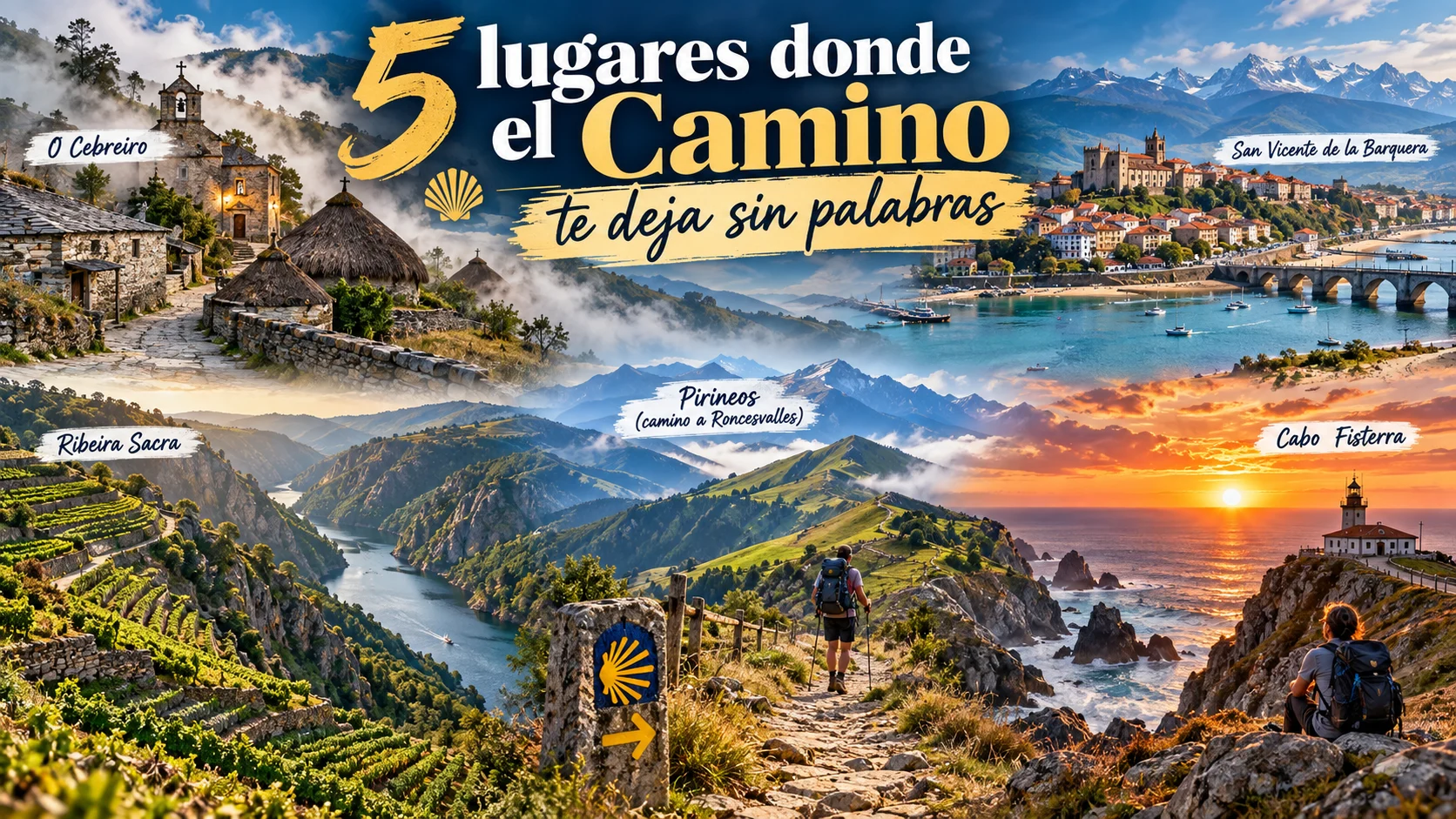
There are places on the Camino de Santiago that do not need explanation. You arrive, stop walking and just look. Mountains, fog, sea, vineyards and horizons that make you forget the kilometers, the fatigue and even the backpack for a few seconds.
The Camino de Santiago is full of monuments, historic towns and memorable landscapes, but there are certain places that provoke something different.
They are not necessarily the most famous or the most photographed.
They are those points where the pilgrim slows down without realizing it.
Look.
Breathe.
And for a few moments he doesn't need to say anything.
Choosing only five is almost impossible. Each Camino has its own special places and each pilgrim keeps his or her own.
But these five represent five very different ways of being speechless.
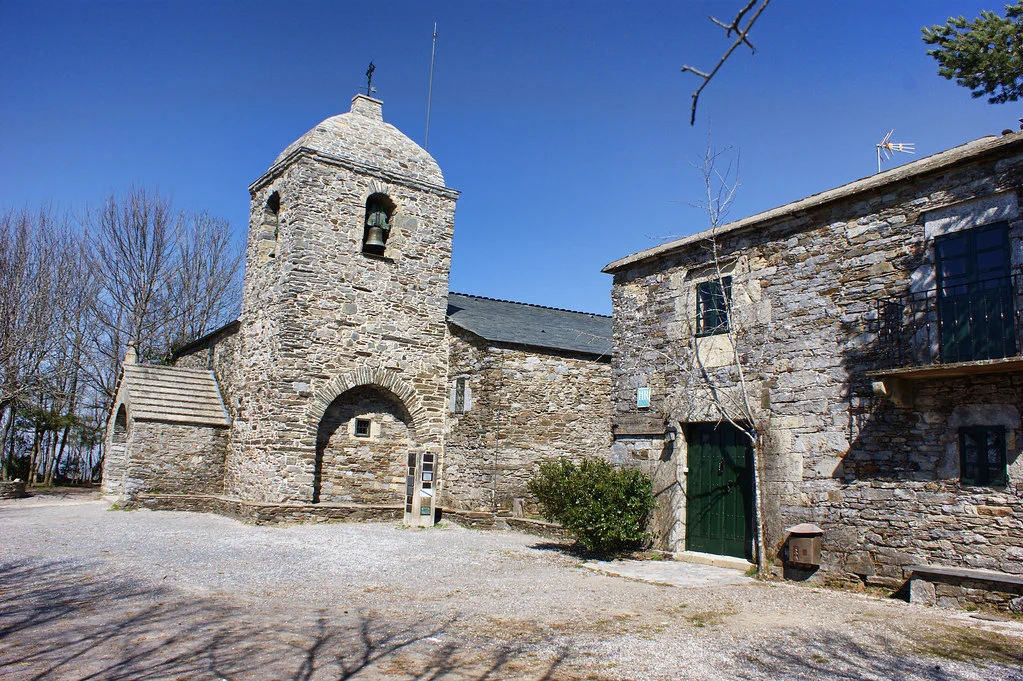
1. O Cebreiro: entering Galicia between mountains and fog
There are places that one remembers by what one sees.
O Cebreiro is also remembered for what he feels.
After a demanding climb, the pilgrim reaches this small mountain center located at the entrance to Galicia on the French Way.
Stone, dark roofs, pallozas, fog and mountains create an atmosphere that is difficult to find anywhere else on the route.
On clear days, the views stretch over the valleys.
On foggy days, almost the opposite happens.
Everything disappears.
The houses seem to emerge from the clouds and the Camino takes on an almost medieval feel.
Many pilgrims arrive tired. Some come thinking only of resting.
But you only have to look up to understand why O Cebreiro has become one of those places that remain in your memory long after returning home.
The moment: Get there early, when the fog still covers part of the valley.
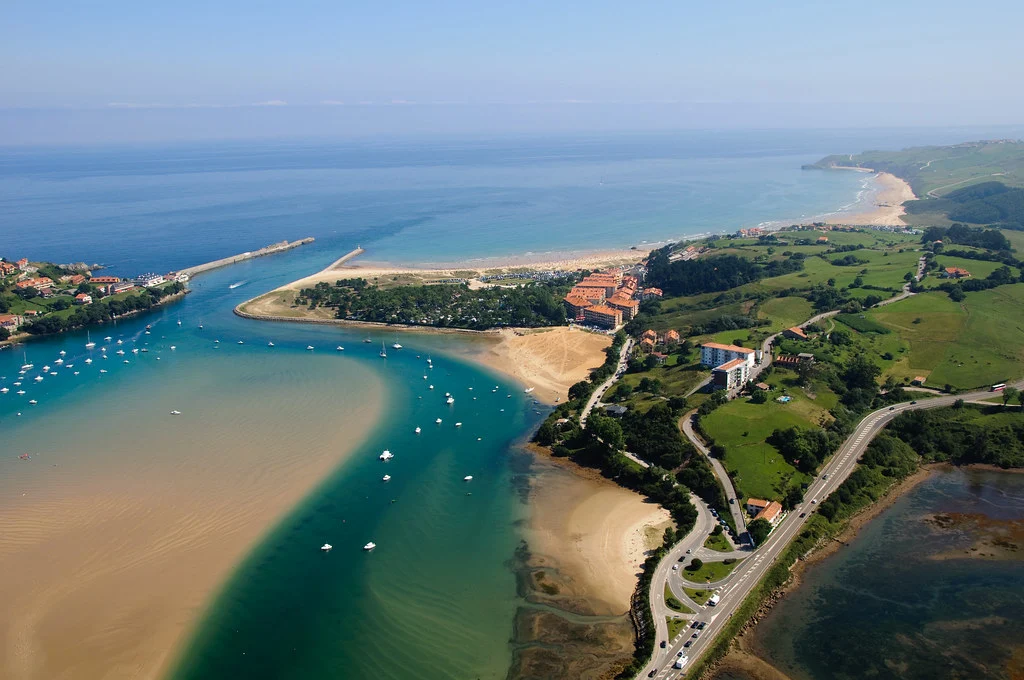
2. San Vicente de la Barquera: when the Camino meets the sea
The Camino del Norte has a characteristic that makes it completely different: the sea appears and disappears during a good part of the route.
But there are places where that relationship reaches another dimension.
San Vicente de la Barquera is one of them.
The pilgrim finds a fishing village surrounded by water, beaches and mountains.
When the day is clear, the Picos de Europa can appear in the background, creating an extraordinary image: the Cantabrian Sea in front and the mountains behind.
It is difficult to think of many places on the Camino where two such different landscapes can be seen practically at the same time.
Here the Camino smells of salt.
There are boats, estuaries, bridges and an open horizon that invites you to stop.
For those who have been walking for days along the coast, San Vicente may seem like a reward.
And for those who continue towards Asturias, it also works as a spectacular farewell to Cantabria.
The moment: look towards the town with the Picos de Europa visible in the background.
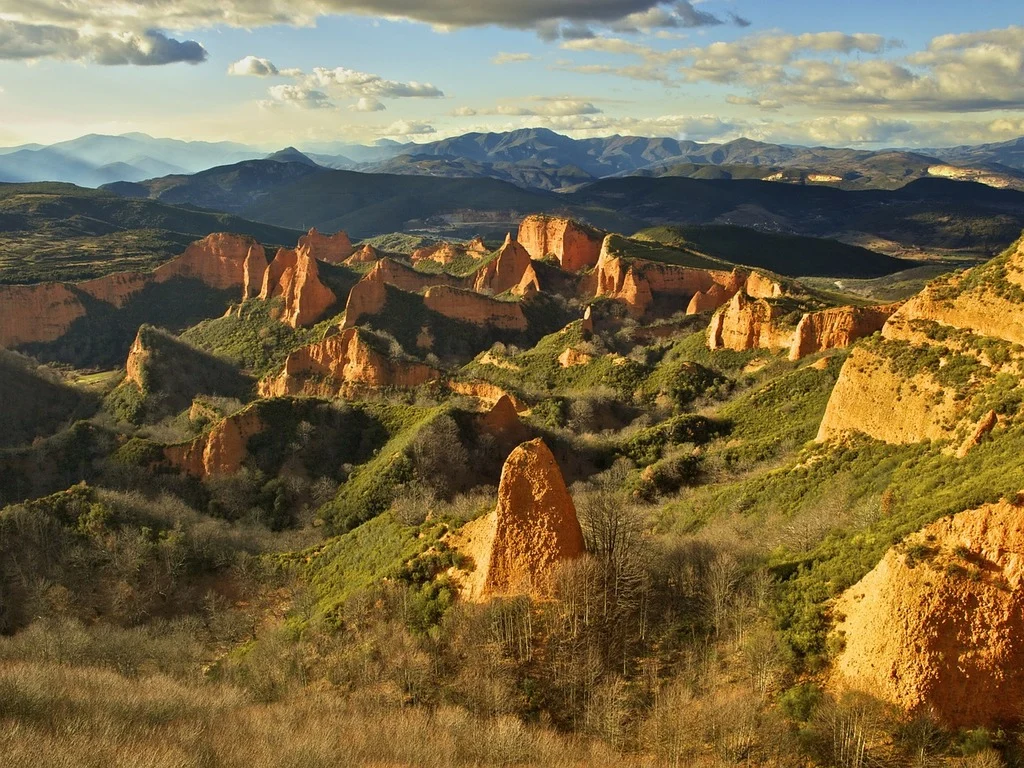
3. Ribeira Sacra: walking among impossible vineyards
The Winter Road preserves some of the least known landscapes of the Jacobean universe.
And among them the Ribeira Sacra stands out.
Here the pilgrim finds vineyards that seem to defy gravity, planted on slopes that descend towards the great Galician rivers.
The landscape has a different scale.
Mountains, agricultural terraces, small villages and forests form a scene that constantly changes as you walk.
It's not just beauty.
It is also the sensation of crossing a territory built over centuries by people who learned to farm in places where it seemed impossible to do so.
For many international pilgrims, this part of the Camino is a surprise.
They arrive looking for Santiago and end up discovering one of the most unique territories in Galicia.
And perhaps therein lies one of the great virtues of the Winter Trail.
It still retains the ability to surprise.
The moment: walking at dawn when the fog remains over the valleys and the first lights illuminate the vineyards.
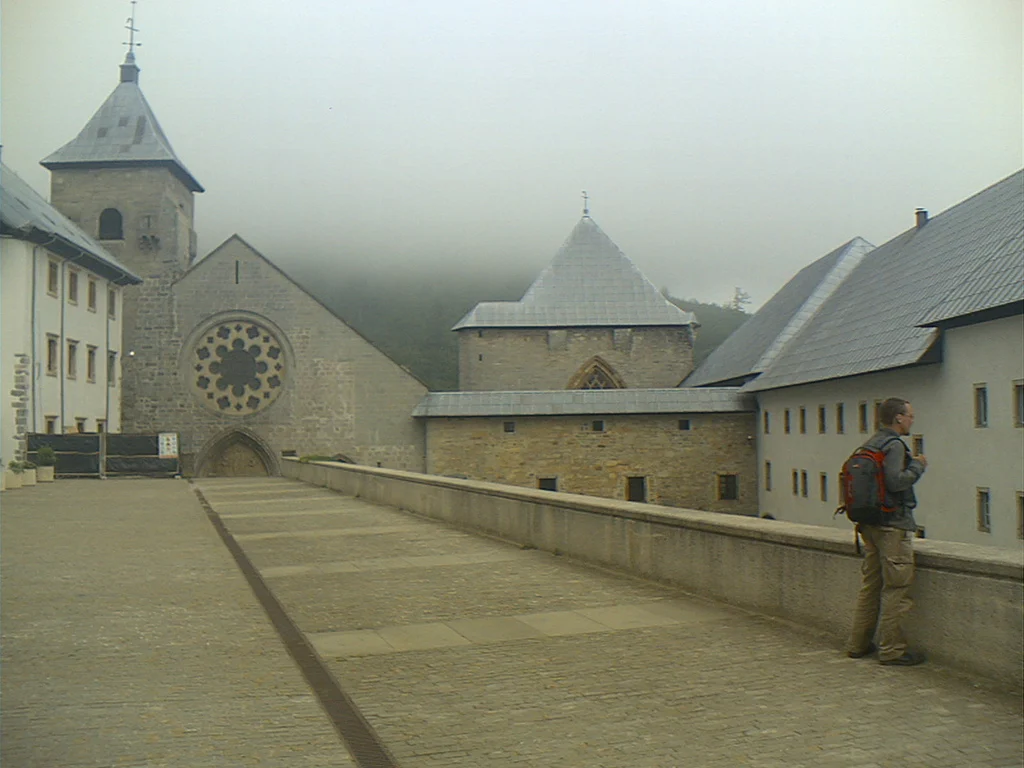
4. The Pyrenees: the day it all begins
For many pilgrims on the French Way, the Pyrenees represent more than just a stage.
They represent the beginning.
There are nerves.
The backpack still seems too heavy.
The legs still don't know exactly what awaits them.
And ahead appears the mountain.
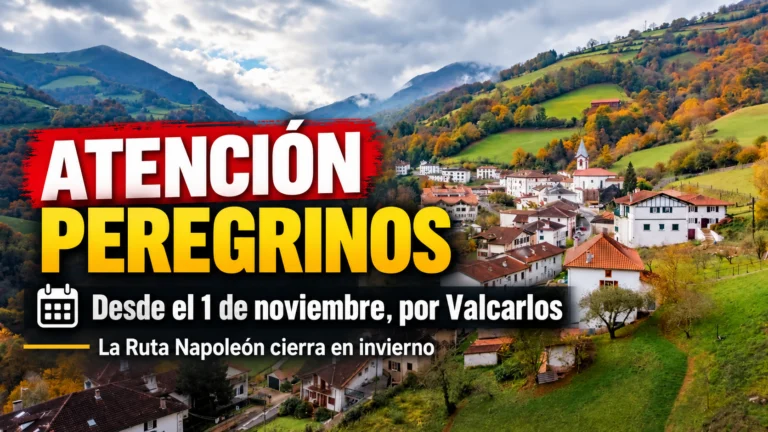
The landscape between Saint-Jean-Pied-de-Port and Roncesvalles can be spectacular, but also changing and demanding.
There are meadows, forests, fog, wind and wide open spaces.
At some moments the pilgrim may look back and discover that the town from which he left has been very far away.
That moment usually marks a before and after.
Because for the first time a very specific sensation appears:
“I am already really on the Camino.”
Then there will be hundreds of kilometers.
But many pilgrims never forget that first big climb.
The moment: Stop for a few minutes at altitude and look towards the valleys before continuing towards Roncesvalles.
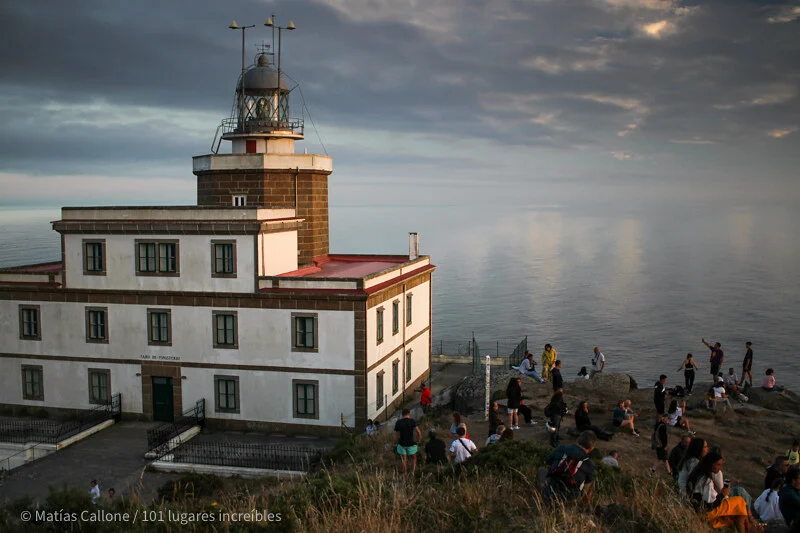
5. Fisterra: when there is no land left ahead
Santiago is the traditional destination of the pilgrim.
But some decide to continue.
They walk west until there comes a time when the Path seems unable to continue.
Ahead is the Atlantic.
Fisterra has been surrounded by stories, legends and symbolism for centuries.
For the modern pilgrim, getting there after having reached Santiago can have a force that is difficult to explain.
There is no longer a cathedral waiting.
There is no big plaza.
There is sea.
Wind.
Rocks.
And a horizon that seems to never end.
Many pilgrims sit for long minutes looking at the ocean.
They don't take pictures immediately.
They don't speak.
They just stay there.
Maybe because after walking so many kilometers it is not easy to accept that the trip is ending.
The moment: the evening, when the sun descends over the Atlantic.
The most beautiful place will always be another
We could add many more.
Arrival in Santiago through Monte do Gozo.
The forests of the Camino Primitivo.
The Asturian coast.
The plains of Castile.
The Ferro Cross.
The beaches of the Portuguese Way.
The monasteries hidden between mountains.
And precisely that is one of the great wonders of the Camino de Santiago.
There is no single landscape.
Every few days the architecture, vegetation, food, climate and even the way of walking changes.
That is why there is no place that is objectively the most beautiful.
He who leaves one pilgrim speechless may go almost unnoticed by another.
Sometimes it's not even much of a landscape.
It can be a small open church at the end of a stage.
A fountain in the middle of the forest.
A bench from which you can see a valley.
Or a curve in the Camino that appears at just the right moment.
Walking also means learning to look
Perhaps the problem of our time is precisely that.
We want to arrive.
We complete stages.
We look at kilometers.
We consult schedules.
We quickly photograph a landscape and continue walking.
But the Camino has been teaching something much simpler for centuries.
Sometimes you have to stop.
Put away the phone.
Take off your backpack.
Feel.
And watch for five minutes doing absolutely nothing.
Because there are places that do not need an explanation.
The Camino simply puts them in front of you.