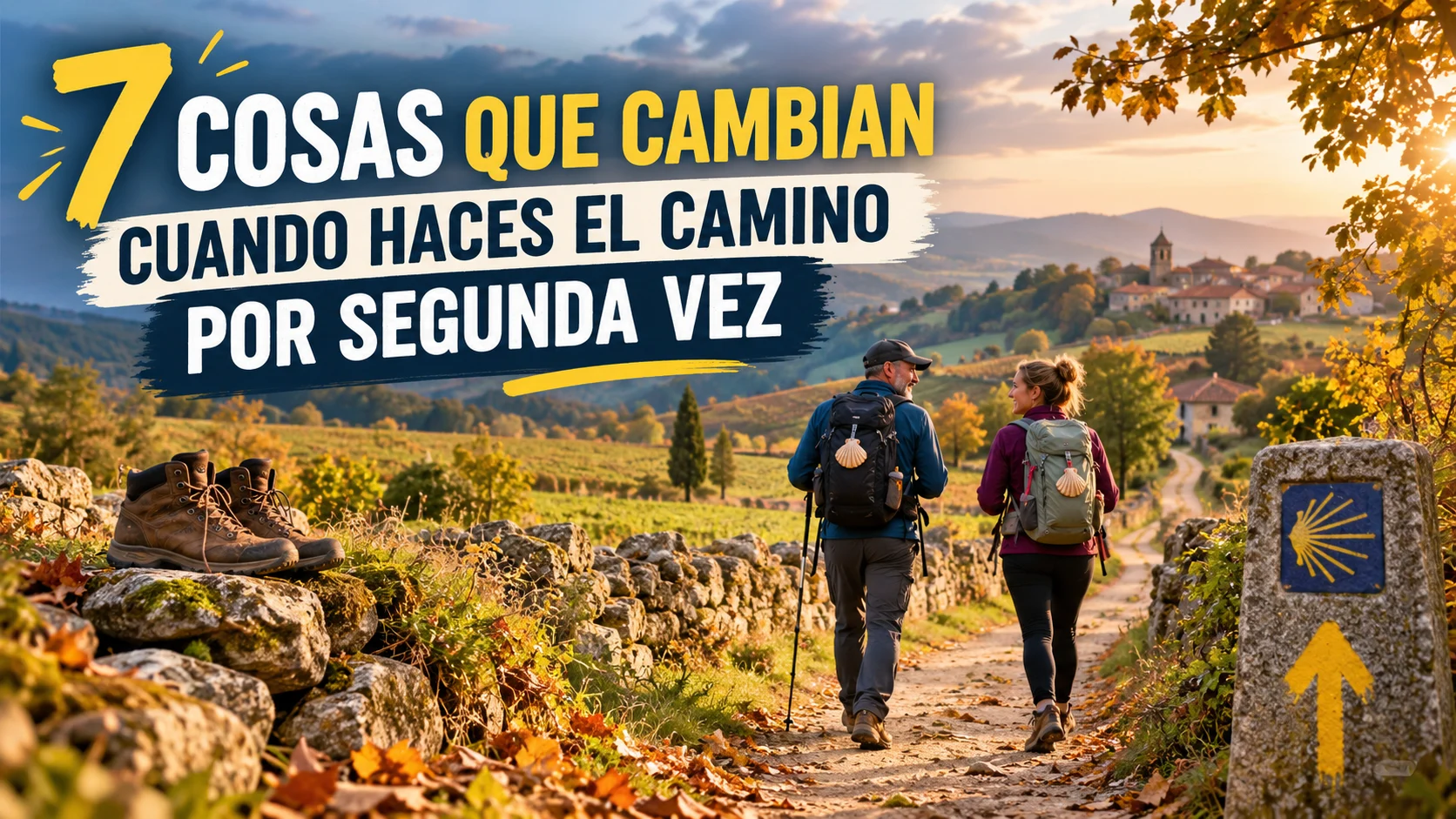
The first time you do the Camino de Santiago everything surprises. The second, surprisingly, changes almost everything. You no longer walk the same way, you don't look at the kilometers the same way and you begin to understand that returning to the Camino does not mean repeating it. It means living it differently.
The first time a person does the Camino de Santiago they usually have many questions in their backpack.
How much is left?
Will I arrive?
Will it be too hard?
Will I find accommodation?
Do I really need everything I carry?
Each stage seems like a test and each yellow sign confirms that one continues moving towards a destination that still seems very far away.
But then Santiago arrives.
You come home.
A few weeks pass.
Sometimes a few months.
And something curious happens.
You start to think about going back.
When you finally do, you discover that the second Path is not as similar to the first as you imagined.
The landscape may be similar.
The arrows they are still there.
But you have changed.
1. You no longer need to prove that you can do it
The first Camino usually has a very specific goal: to arrive.
Every stage counts.
Every kilometer seems important.
There is even some concern about fulfilling the plan we had prepared before leaving.
In the second Path this tension usually decreases.
You already know you can walk.
You already know there will be bad days.
You also know that a difficult day ends.
This allows you to walk with less pressure.
If you need to stop, you stop.
If a stage has to be shorter, you accept it.
And if you discover a place that deserves an hour of rest, you begin to understand that perhaps that hour is also part of the Camino.
2. The backpack weighs less, even if you carry almost the same amount
Whoever returns to the Camino has usually learned one of his first great lessons:
We almost always carry too much.
In the first pilgrimage the famous “just in case” appear.
A t-shirt in case it's cold.
Another one in case it's hot.
A third pants.
A complete pharmacy.
Objects that we will probably never use.
The second time the backpack begins to look more like what is really necessary.
But there is another change.
Although the physical weight is similar, psychologically it weighs less.
You already know how to place it.
You know when to tighten the straps.
You know when to rest.
And, above all, you have learned that almost any problem has a solution in the next town.
3. You stop continually looking at the kilometers
During the first Camino, many conversations begin with a question:
—How many kilometers left?
The phone appears constantly.
The distance is consulted.
You look at the profile.
Arrival is calculated.
In the second Path something different happens.
You begin to measure the stages in a different way.
A fountain.
A coffee.
A church.
A forest.
A conversation.
Distance is still important, but it stops completely ruling the day.
Some of the best moments occur precisely when you stop looking at how much is left.
4. You talk to people more
In the first Path one is usually very aware of one's own body.
The feet.
The backpack.
The tiredness.
The next accommodation.
In the second there is more space to look around.
And that completely changes the experience.
You start talking to the hospitalero.
You ask the villager.
You sit with someone who walks more slowly.
You hear stories.
The Camino is still a physical journey, but it is beginning to look much more like a succession of encounters.
And many times those encounters end up being what you really remember years later.
5. Blisters are no longer a tragedy
The first pain can seem like the end of the world.
A blister.
A knee that protests.
A rainy day.
An accommodation that was not as we expected.
It all seems huge because we still don't know how to respond.
The second time the same problems appear.
But it changes our reaction.
We know how to treat a small blister before it gets worse.
We know that a day of rain ends.
We know that after a rise there will always be a fall.
Experience does not eliminate difficulties.
It simply makes them stop dominating the Way.
6. Santiago is no longer the only objective
The first time, Santiago exerts enormous force.
Each sign with the remaining kilometers constantly reminds you of the goal.
Plaza del Obradoiro seems like the end of everything.
But when you return, you begin to discover something strange.
Santiago is still important.
But it is no longer the only thing.
Maybe you expect more from that small town.
A hostel you remember.
A conversation at dusk.
A stretch of forest.
A beer after a long stage.
Sometimes you even begin to feel a certain sadness when the kilometers to Santiago decrease.
Because you already know what it means to arrive.
You also know what it means to finish.
7. You discover that you never do the same Camino
This is probably the big surprise.
You can travel the exact same route.
Sleep in the same towns.
Cross the same squares.
And yet, experience something completely different.
People have changed.
Time has changed.
The landscape has changed.
And you have changed.
That is why there are pilgrims who return again and again.
They are not necessarily looking to discover a new route.
Sometimes they want to check what they find on a route they already know.
Because the Camino has a peculiarity that is difficult to explain to those who have never walked it:
The place may be the same, but the experience never is.
The second time you start to understand some things
Perhaps during the first Camino we still thought too much about completing an experience.
We want to do it well.
We want to arrive.
We want to get Compostela.
We want to take photographs.
The second time many of those things still matter.
But others appear.
Walk without haste.
Hear.
Sleep tired.
Wake up early.
Sitting in front of a closed church without having to enter.
Sharing food with someone whose last name we will probably forget.
The Camino becomes less extraordinary and, curiously, much deeper.
And the third time?
That's where another problem begins.
Because after the second Camino one already knows perfectly well what happens.
He says it will be the last.
Come back home.
Put away the backpack.
Place the credential in a drawer.
And a few months later he opens a map.
Just to look.
That's what he says.
But we all know how that story ends.
The Camino doesn't always make you want to arrive. Sometimes it achieves something much more dangerous: making you want to come back.