If doing the Camino de Santiago with a ten kilo backpack already causes serious arguments between yourself and your knees, imagine doing it carrying between 20 and 25 kilos, dressed like a Roman legionary and with sandals designed long before the existence of the gore-tex.
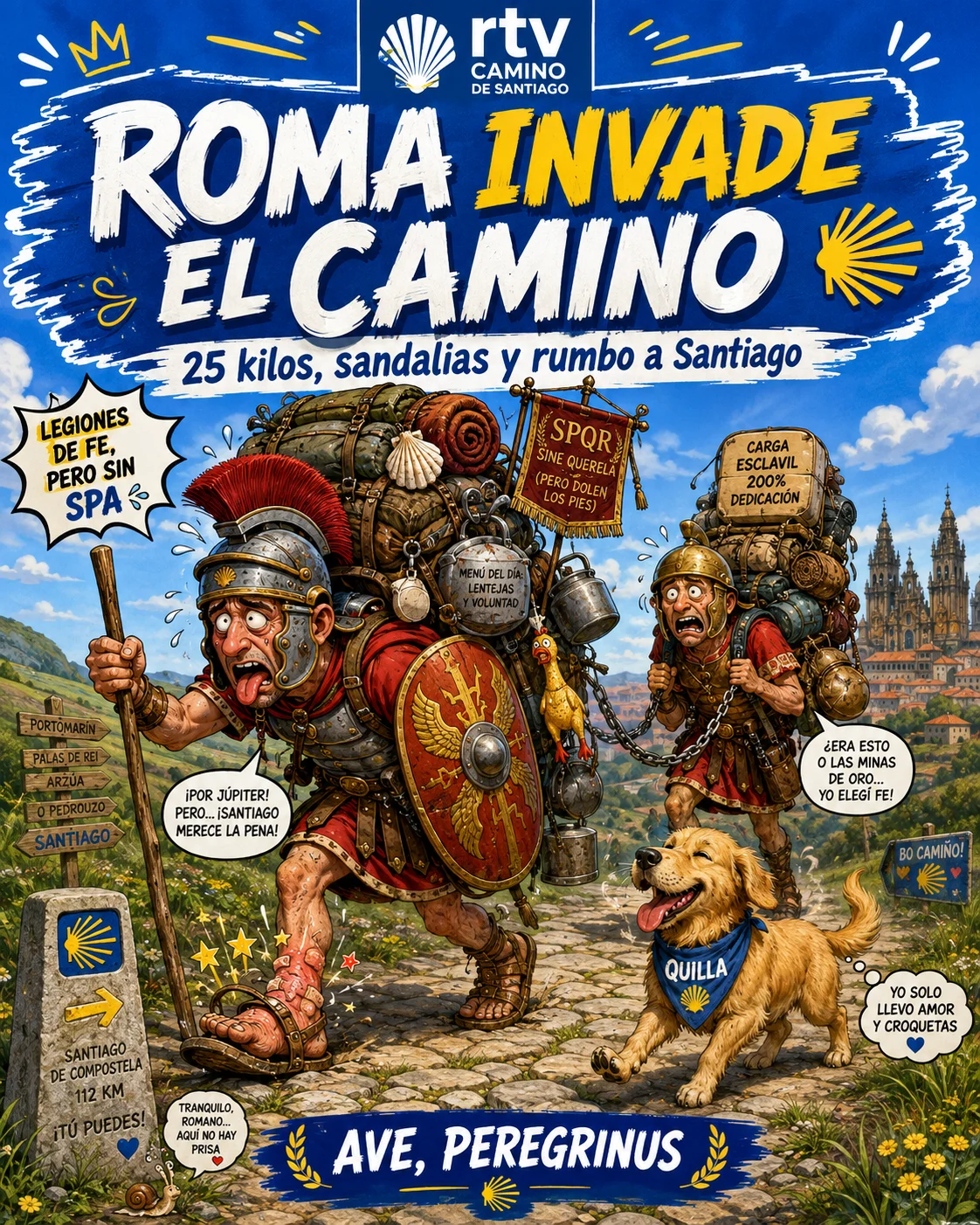
Well, that is exactly what Miquel Fornera is going to try between the September 5 and 11, traveling through the six stages that separate Sarria from Santiago de Compostela.
And he won't go alone.
They will accompany you another Roman legionary, a slave and a dog named Quilla.
Rome has not returned.
But he is on his way to Galicia.
The idea is not to put on a carnival robe and take four photos for Instagram. The challenge aims to truly test how the body responds using reproductions of the clothing and equipment of Roman soldiers during several consecutive days of marching.
That is to say: heat, hills, stones, sweat, kilometers and probably some blister capable of becoming independent and asking for your own Compostela.
Fornera will carry between 20 and 25 kilos in weight.
To understand each other: while many pilgrims spend half the afternoon deciding whether to leave the second pair of pants at home to save 300 grams, this man has decided to go out practically with half a legion on his back.
But curiously weight is not what worries him the most.
The great enemy could be at the feet.
The famous caligae, the sandals used by the Roman legionaries, will have to demonstrate if they were really useful to conquer half the world or if the Romans simply had feet made of reinforced concrete.
Because there is a truth that unites the pilgrims of the 21st century with the soldiers of two thousand years ago:
If the feet say enough, the Empire is over.
The expedition will be difficult to confuse with any organized group.
Two legionaries, a slave and a dog advancing along the French Way.
More than one pilgrim will leave the hostel half asleep, see them appear around a bend and think that last night's dinner was stronger than it seemed.
Quilla, by the way, is probably the member of the expedition with the best chance of arriving fresh in Santiago.
She will also probably be the only one wondering why her companions have not yet discovered the ultralight backpack.
Some of the clothing has been made following historical patterns and using materials such as linen, with the intention of making the experiment as faithful as possible.
Therefore, during those six days we will see if Roman technology passes some of the toughest tests of our time:
the Galician climbs, the humidity, the stones, the long stages and finding a place to have breakfast when everyone has left the hostel at the same time.
If everything goes as planned, the September 11 The peculiar delegation will arrive in Santiago de Compostela.
And then we will have answers to some fundamental questions for the history of humanity:
Will the sandals hold up?
Will the full 25 kilos arrive?
Will the slave end up overtaking the legionaries?
Will Quilla be the first to enter Praza do Obradoiro?
Where does a Roman legionary keep his credentials?
And what face will the hospitalkeeper make when they ask him for room for two soldiers of the Empire, a slave and a dog?
The only thing that seems clear is that going unnoticed is not going to happen.
The Camino de Santiago has seen pilgrims walking, running, cycling, riding horses, barefoot and carrying practically anything imaginable.
But it still manages to surprise us.
So, if at the beginning of September you are doing the French Way and you see a Roman legion appear behind you, don't worry.
There is no need to notify the authorities.
They probably just want to get to Santiago.
Bird, peregrinus. Ultreia.