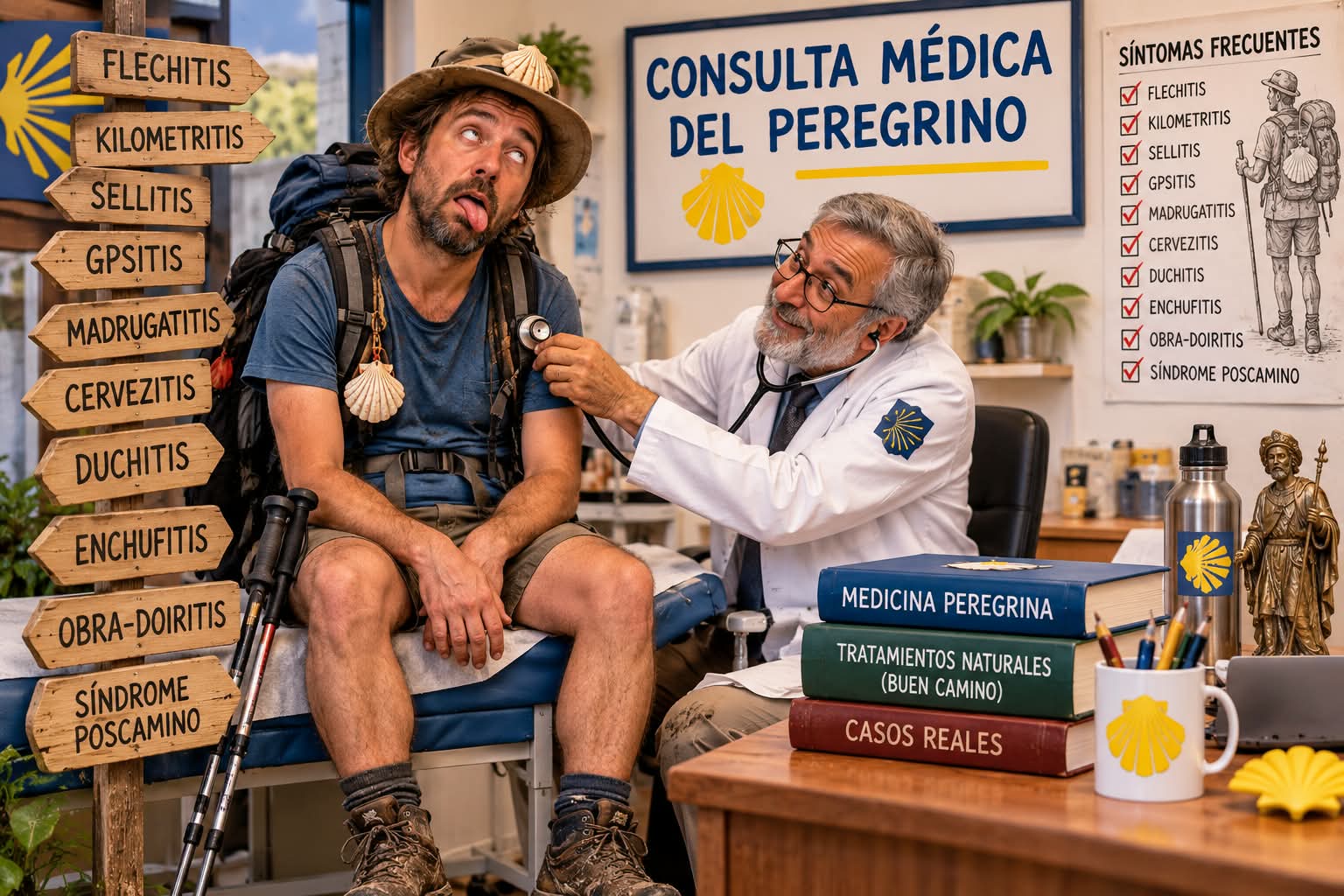
The Camino de Santiago has its own ailments. Some affect the feet, others the head and a few appear when one has been following yellow arrows for too many days. They do not appear in any medical manual, but any veteran pilgrim will recognize more than one.
There are people who begin the Camino worried about blisters, tendonitis or knee pain.
But no one warns them about other diseases.
The truly pilgrims.
Those that appear little by little and that are not cured with ibuprofen, compeed or a good night's rest.
At RTV Camino de Santiago we have put together some of the most frequent.
Phlechitis
Symptoms: inability to walk a hundred meters without looking for a yellow arrow.
The affected pilgrim begins by looking at the facades, the streetlights, the trees and even the garbage containers in case a sign appears.
When he returns home, the problem continues.
You see a yellow arrow in a parking lot and automatically think:
“Over there.”
Treatment: complicated. In serious cases, return to the Camino.
Kilometritis
Milemetritis usually appears after several days of walking.
The pilgrim stops measuring the world in hours and begins to measure it in kilometers.
He no longer asks how long it takes to the next town.
Ask:
“How many kilometers left?”
When he returns home, someone tells him that the supermarket is a fifteen-minute walk away and he responds:
“That will be 1.2 kilometers.”
Treatment: Avoid looking at staging apps for at least a week.
Sellitis
It starts innocently.
A stamp on the credential.
Then another.
And another.
Until the pilgrim discovers that there is free space between two seals and feels an inexplicable need to fill it.
The most advanced cases enter bars, churches, town halls and businesses asking:
“Excuse me, do you have a seal?”
Even if they don't want to buy anything at all.
Treatment: difficult. Some affected people continue collecting stamps even after arriving in Santiago.
GPSitis
It appears mainly among those who do not completely trust the yellow arrow.
The pilgrim checks the GPS every five minutes.
Even if he has thirty pilgrims ahead.
Even though there is a huge arrow painted on the ground.
Although the bell tower of the next town is perfectly visible.
You need to confirm that you are really on the Camino.
Treatment: walk ten minutes behind a veteran pilgrim who doesn't carry a phone.
Early risetitis
It is an especially contagious disease in shelters.
It all starts when a pilgrim sets the alarm clock for six.
The next one decides to get up at five forty-five.
Another thinks that this way he will avoid the heat and sets the alarm for five thirty.
In the end, at four fifty in the morning there are twenty people putting sleeping bags inside plastic bags.
Main symptom: believing that leaving before dawn guarantees getting everywhere first.
Treatment: private room for one night.
Cervezitis
It usually appears at the end of the stage.
The pilgrim arrives completely exhausted and assures:
“I just want water.”
Ten minutes later he appears sitting on a terrace with a beer saying that he has earned it.
In advanced cases, it begins to calculate the distances between locations according to the number of terraces available.
Treatment: is not known.
Duchitis
Duchitis has two variants.
The first is to think only about a hot shower for the last five kilometers.
The second appears when the pilgrim arrives at the hostel and discovers that the hot water has run out.
At that moment you may experience disbelief, denial, anger and finally acceptance.
All this in approximately forty seconds.
Treatment: shower. Preferably hot.
Enchufitis
Very common among pilgrims of the 21st century.
The affected person enters a shelter and before even asking where his bed is, he locates all the available plugs.
It then performs complex strategic calculations to determine which is closest.
The disease worsens when you need to charge phone, watch, power bank, headphones and camera at the same time.
Definitive symptom: Carry an electric thief in your backpack and automatically become the most popular person in the dorm.
Obra-doiritis
It normally appears during the last kilometers before Santiago.
The pilgrim begins to imagine what his entry into the Plaza del Obradoiro will be like.
He thinks he will cry.
Who will hug his companions.
He will remain for several minutes contemplating the Cathedral in silence.
Then he arrives and spends the first fifteen minutes taking photographs from twenty-seven different positions.
Treatment: Sit on the floor of the square and put the phone away for five minutes.
Post-road syndrome
It is probably the most serious disease of all.
It appears when the pilgrim returns home.
During the first days you feel something strange.
The bed is too comfortable.
The backpack is no longer ready by the door.
Nobody asks where it comes from.
Nobody wishes him “Buen Camino”.
And, worst of all, after breakfast you don't have to walk twenty kilometers.
Then start looking at pictures.
Then videos.
Then old tracks.
And finally the inevitable happens.
Open the calendar.
Search dates.
And think:
“What if next year I do the Primitivo?”
At that moment the diagnosis is confirmed.
Final diagnosis
Most of these diseases are not dangerous.
Some even improve mood.
But there is a common characteristic: once they appear, they can accompany the pilgrim for many years.
So if you recognize three or more of these symptoms, don't worry.
You do not need a medical appointment.
No prescription needed.
And it probably doesn't have a cure either.
He is a pilgrim.