It doesn't matter if you are in Galicia, Castilla y León, Asturias, Portugal, Navarra or France. Anyone who has done several stages of the Camino de Santiago knows that the hostels change, the beds change, the towns change and even the daily menu changes. But there is something that is repeated with almost scientific precision: the characters.
Every night, after walking for hours, the same profiles appear again. Sometimes they change their nationality, other times their age, but their behavior is suspiciously similar. And if you've ever slept in a pilgrim hostel, you'll probably recognize more than one.
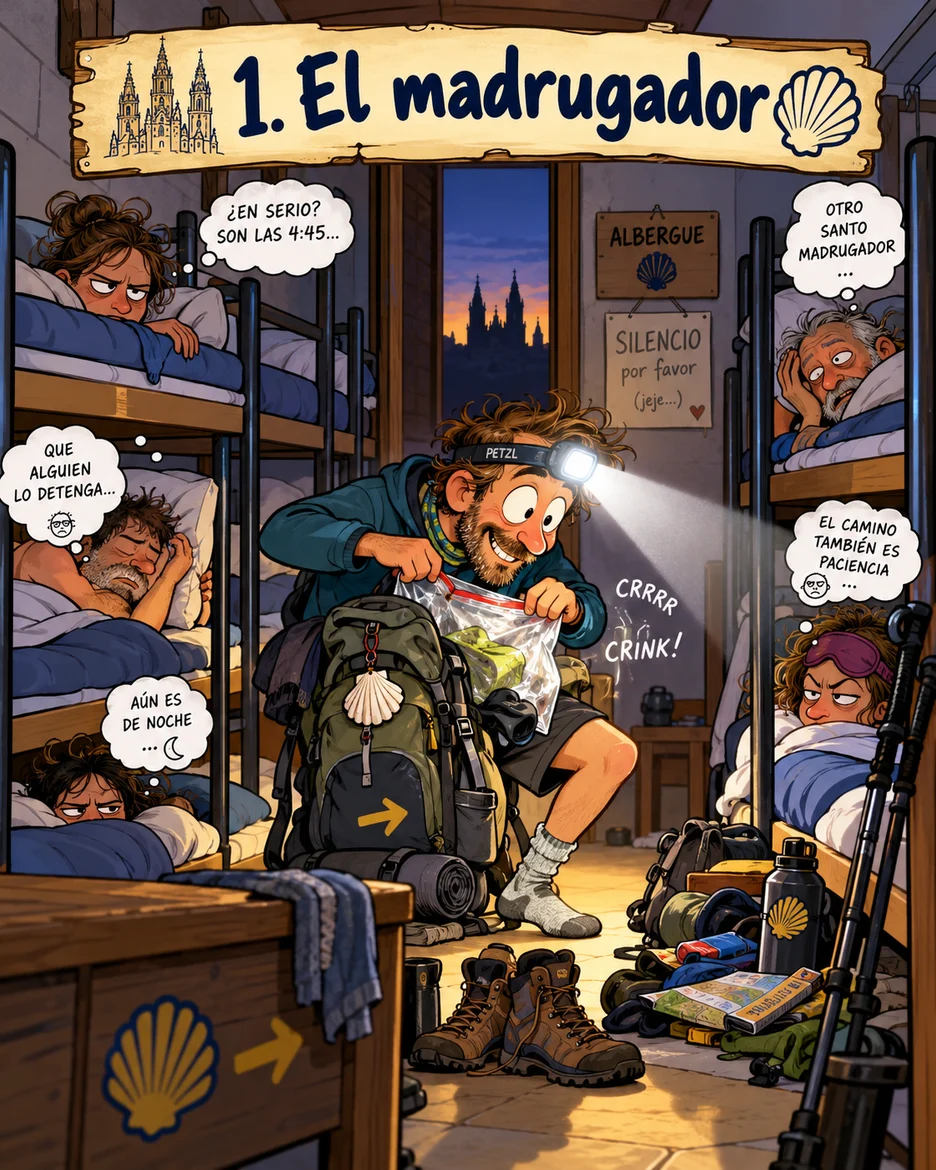
1. The 4:45 Early Bird
It is a species perfectly adapted to darkness.
No one knows exactly why he is in such a hurry. The next town is twelve kilometers away, breakfast doesn't open until seven and it's cold outside. But he considers that 4:45 in the morning is a reasonable time to start preparing the backpack.
First open a plastic bag.
Then another.
Then he discovers that he has kept the sock he needs at the bottom of his backpack and begins an archaeological excavation among t-shirts, chargers, bottles, fruit and objects that no one understands why he has taken to the Camino.
Finally he turns on a headlamp capable of illuminating an airport.
In less than five minutes he has woken up the entire room.
When he leaves the hostel, he closes the door very carefully and leaves convinced of one thing: no one has noticed.
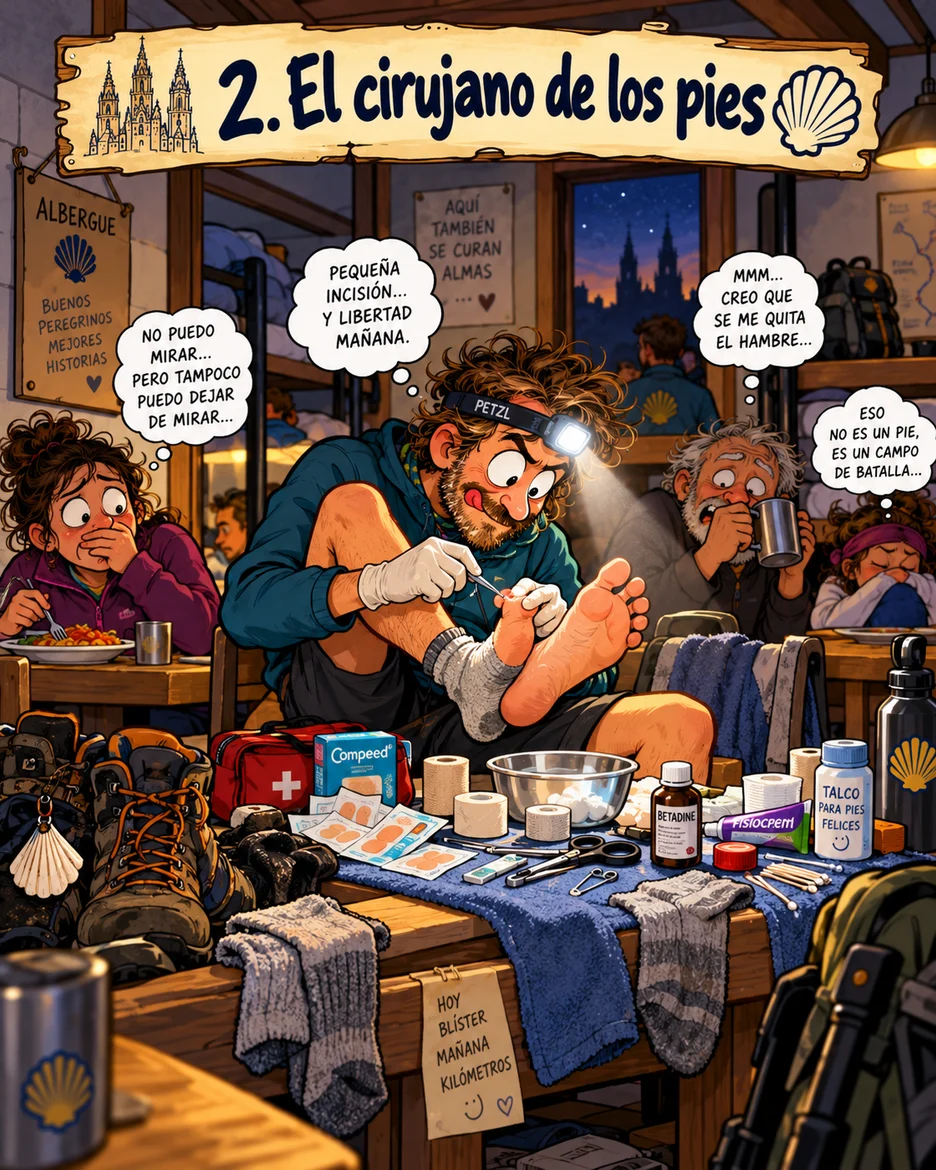
2. The foot surgeon
After the shower the operation begins.
Place bandages, needles, thread, Compeed, tape, cream, Vaseline, scissors and products whose existence you did not know until that moment on the table.
He sits down, lifts one foot and observes it with the same concentration as a specialist before a complicated intervention.
—I have a small blister.
The “little blister” seems to have its own zip code.
The other pilgrims try not to look, especially those who are having dinner.
But it's impossible.
The foot surgeon cleans, punctures, protects, bandages and analyzes each toe while calmly explaining what happened in the previous stage.
Then he puts away all his material and says:
—Tomorrow, like new.
Nobody is completely safe.
3. The technological pilgrim
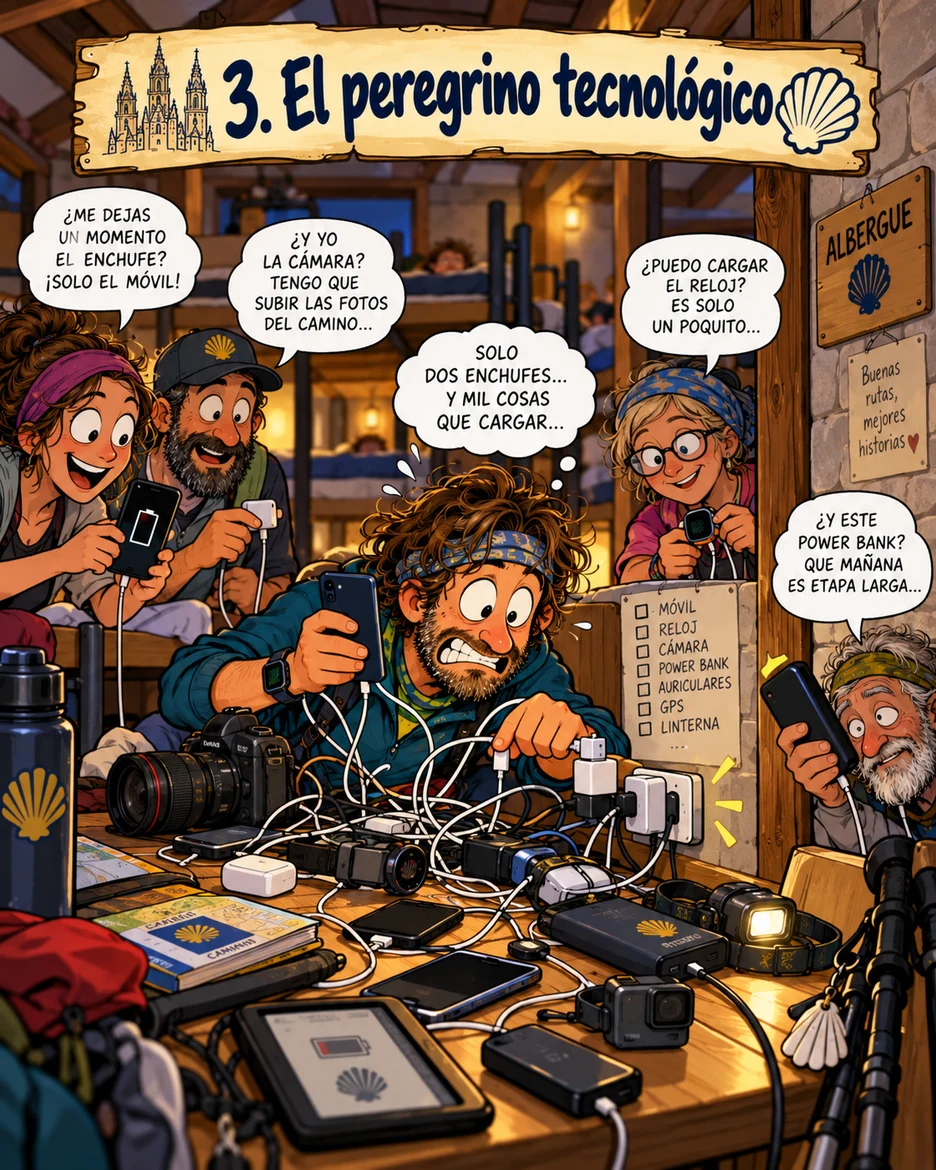
Your main concern is not blisters.
Neither does the rain.
Not even the slopes.
Your real enemy is a phrase:
—We only have two plugs.
It carries a mobile phone, GPS watch, headphones, action camera, another camera, external battery, a second external battery in case the first one fails, and several cables that look like they belong to a space station.
As soon as you arrive at the hostel, inspect the walls.
He's not looking for a bed.
Look for electricity.
Five minutes later he has turned a small table into a technological operations center.
While the others ask where they can wash their clothes, he asks:
—Does the Wi-Fi work well here?
The Camino may have been walked for a thousand years without mobile phones, but he is not willing to risk doing a stage without recording every meter.
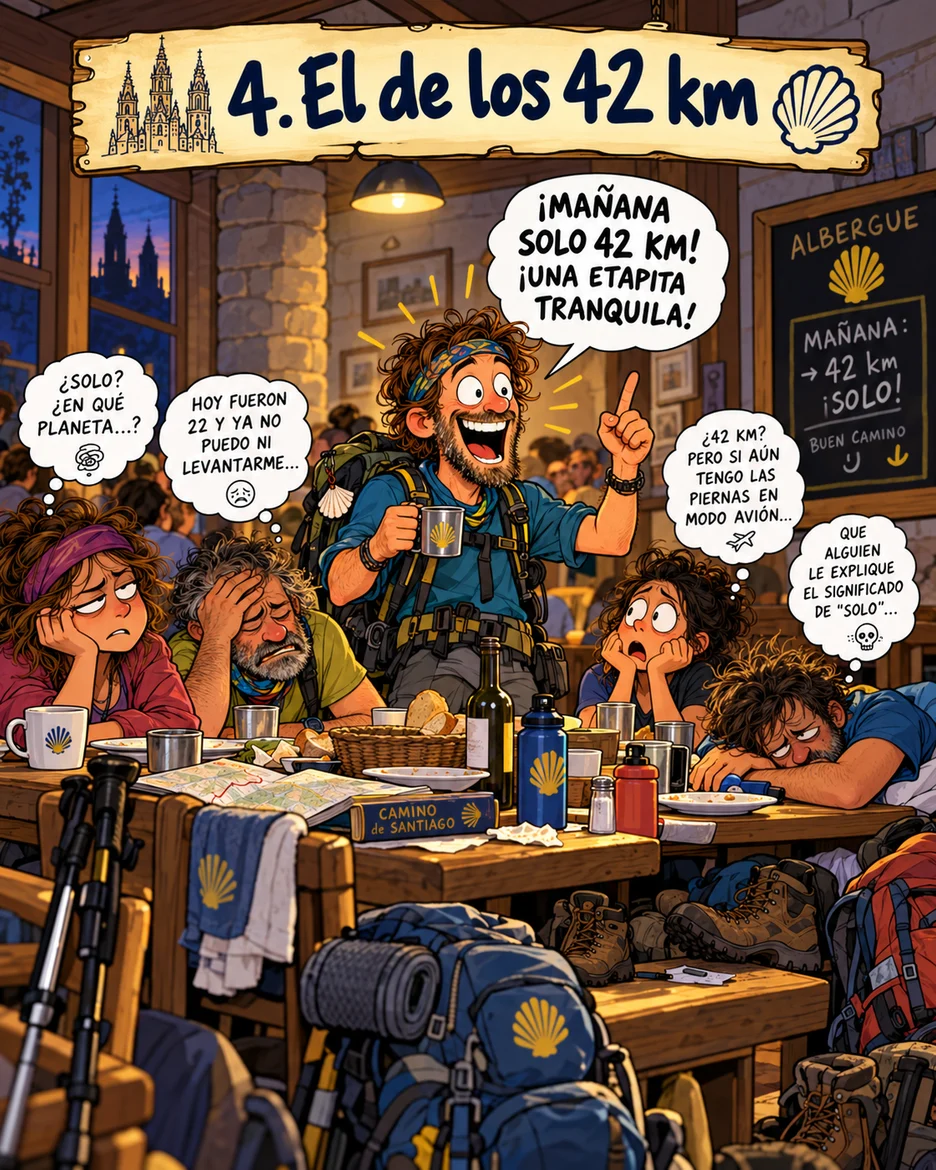
4. The one who will do “only 42 kilometers” tomorrow
This character is especially difficult to understand when you have just completed a 23 kilometer stage and need to lean on the walls to climb the stairs.
He is sitting quietly having a beer.
Someone asks:
—Where are you going tomorrow?
And answers:
-Not much. Only 42 kilometers.
Silence.
Someone drops their fork.
Another pilgrim looks at the map trying to figure out if there are any errors.
But not.
It's 42 kilometers.
The most worrying thing is that he seems happy.
He explains that he normally does 35 or 40, that he has a “good pace” and that he will probably arrive before eating.
The next morning you start walking with your legs still negotiating with you.
He has already traveled twenty kilometers.
5. The pilgrim who brings everything
Your backpack is too heavy.
Everyone has told him so.
But when it's time for dinner you start to understand why.
He opens a zipper and bread appears.
Another zipper: cheese.
Then ham.
Chocolate.
Fruit.
Dried fruits.
A small bottle of wine.
Something his mother prepared.
And possibly some can that has been traveling from Saint-Jean-Pied-de-Port.
In five minutes there are six pilgrims around his table.
In ten minutes, twelve.
After fifteen minutes, no one remembers which country everyone is from.
The official language becomes bread with cheese.
He is probably one of the most beloved characters in any hostel.
Because on the Camino, sharing food has an extraordinary capacity to turn strangers into companions.

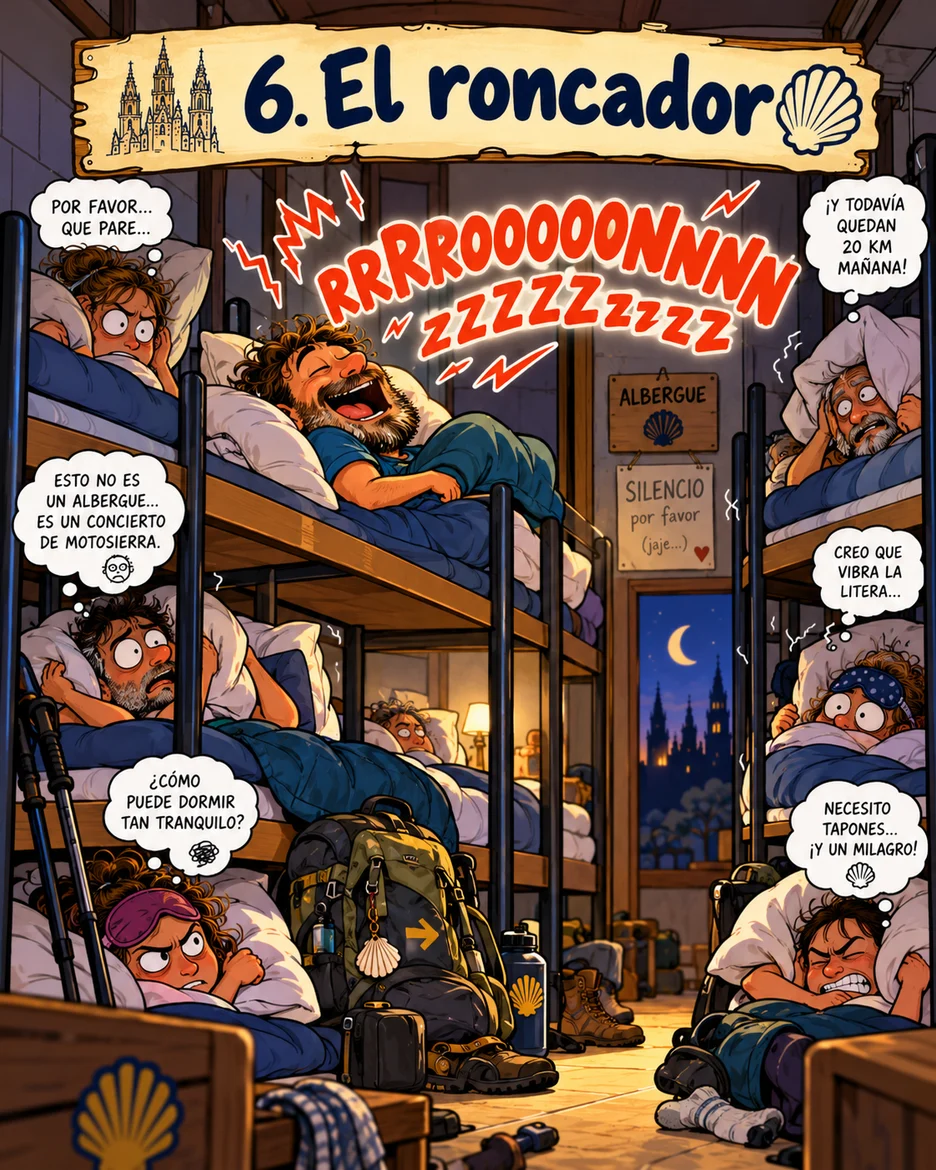
6. The snorer
There is a common characteristic in practically all heavy snorers:
They claim they don't snore.
—My wife says that sometimes I make a little noise.
That night you discover that his wife is an extraordinarily prudent person.
At eleven it begins softly.
At twelve it already looks like a diesel engine.
At one in the morning the bunk vibrates.
At two, several pilgrims have tried plugs, pillows over the head and meditation techniques.
Nothing works.
The most surprising thing is to observe the snorer.
Sleep soundly.
At peace.
Happy.
The next morning he wakes up rested and asks:
—How did you sleep?
At that moment the Camino teaches another of its great virtues: self-control.
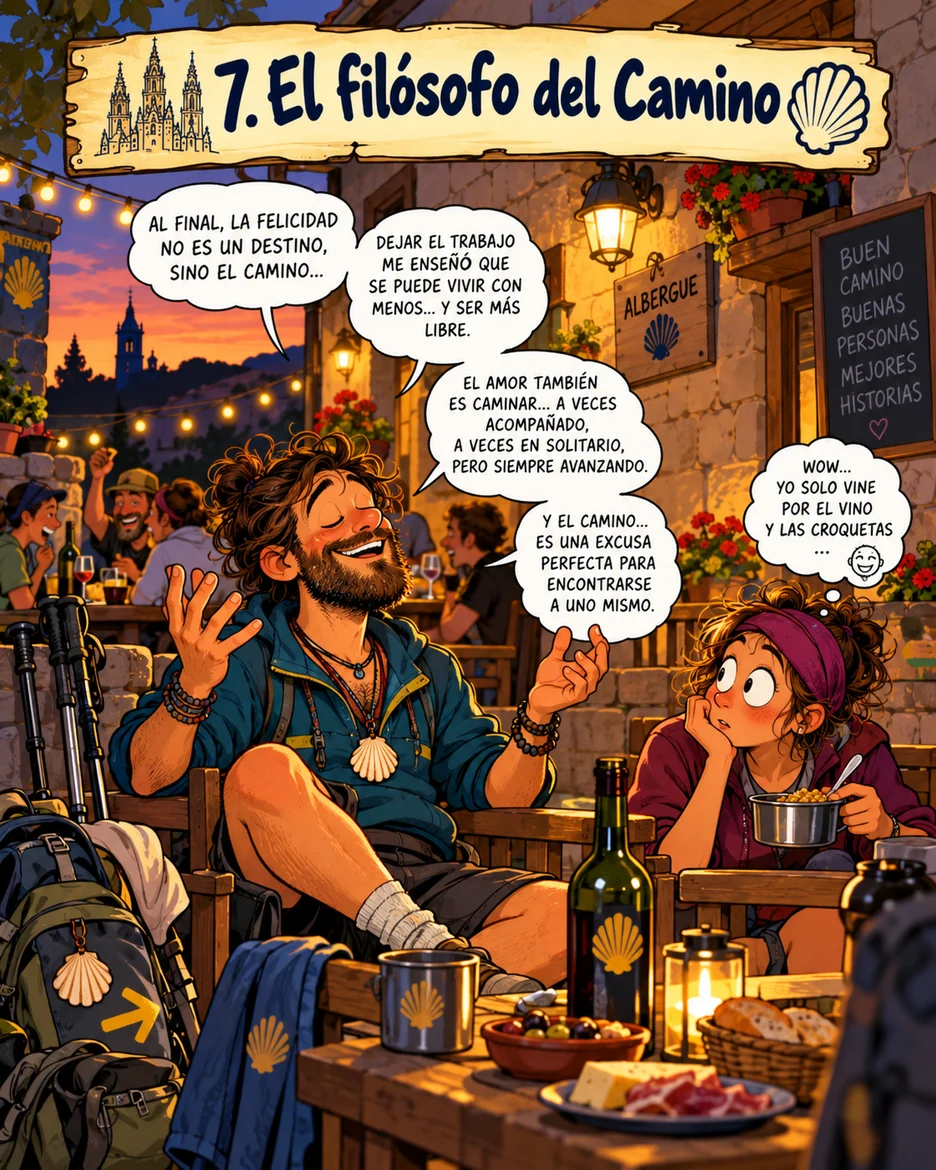
7. The philosopher of the Camino
You met him this afternoon.
You don't know his last name.
You will probably follow different routes tomorrow.
However, before dinner you already know part of his life.
He tells you why he decided to walk, what happened to his job, how a relationship ended, what he thinks about money, happiness, friendship and the meaning of existence.
It all started with a simple question:
—Where do you come from?
Three hours later you're talking about decisions you've never told anyone about.
And perhaps this is one of the most curious things about the Camino de Santiago.
Conversations happen quickly.
People know that they may not meet again and that removes many barriers.
The philosopher can be intense.
But he is also usually the one who remembers that behind every backpack there is a story.
And surely some are missing
We could add many more.
The one who carries a gigantic backpack during the first stage and starts giving things away in the second.
The one who claims that he never uses transportation but knows perfectly well all the bus schedules.
The pilgrim who gets lost following a huge yellow arrow.
The person who arrives saying that he will only do one hundred kilometers and ends up thinking about his next Camino before even reaching Santiago.
Because the Camino is not only made up of routes, monuments and landscapes.
It is also built with characters.
With people who are exhausted, funny, silent, generous, exaggerated, excited or completely clueless.
And perhaps that is why, years later, many pilgrims perfectly remember an impromptu dinner in a hostel even though they have forgotten the name of the town.
In the end, we have all been one of these seven at some point.
And probably more than one.