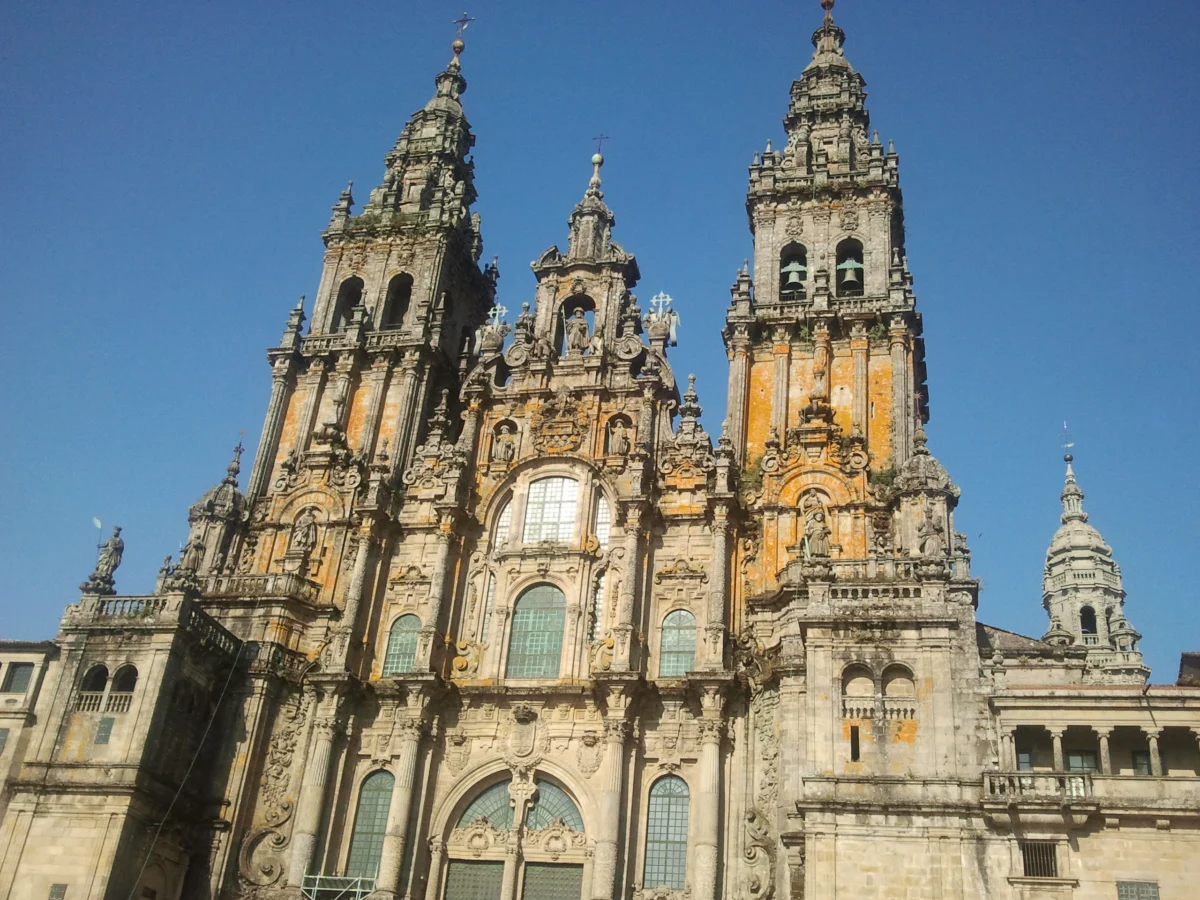
What does the pilgrim find when he arrives in Santiago de Compostela and leaves behind his last stage? In the Plaza del Obradoiro stands a cathedral that is, at the same time, a sanctuary, a monument and the scene of a history that has transformed Europe. Its baroque façade protects a Romanesque heart built since the end of the 11th century, while the Portico of Glory, the altar of the Apostle and the footprints of millions of walkers explain why this temple continues to be one of the great references of the Camino de Santiago.
The Cathedral of Santiago de Compostela cannot be understood only from the outside. To understand it, we must go back to the medieval discovery of a tomb attributed to the apostle Santiago, observe how the church grew in the first centuries and tour a building that changed its appearance as its needs changed. Each era left its mark without completely erasing the previous one.
It is also a very different destination depending on how you get there. Whoever visits Santiago for tourism can approach the monument for its history and works of art. For those who finish the French Way or any of the other Jacobean routes, the same square usually marks the end of a long march and the beginning of another experience: that of getting to know the city and its heritage without the weight of the pending kilometers.
From the medieval tomb to a cathedral that attracted Europe
Christian tradition places the burial of the apostle Santiago the Greater in Compostela. According to the history collected by the Cathedral itself, the site of the tomb was identified around the years 820-830, during the episcopate of Theodomir, in the ancient territory of Iria Flavia. The news had exceptional religious and political significance.
King Alfonso II promoted the construction of a first sanctuary on that site. Later, Alfonso III promoted another larger temple, consecrated in the year 899. Pilgrimages grew during the following centuries, until Compostela became one of the main religious destinations in medieval Europe.
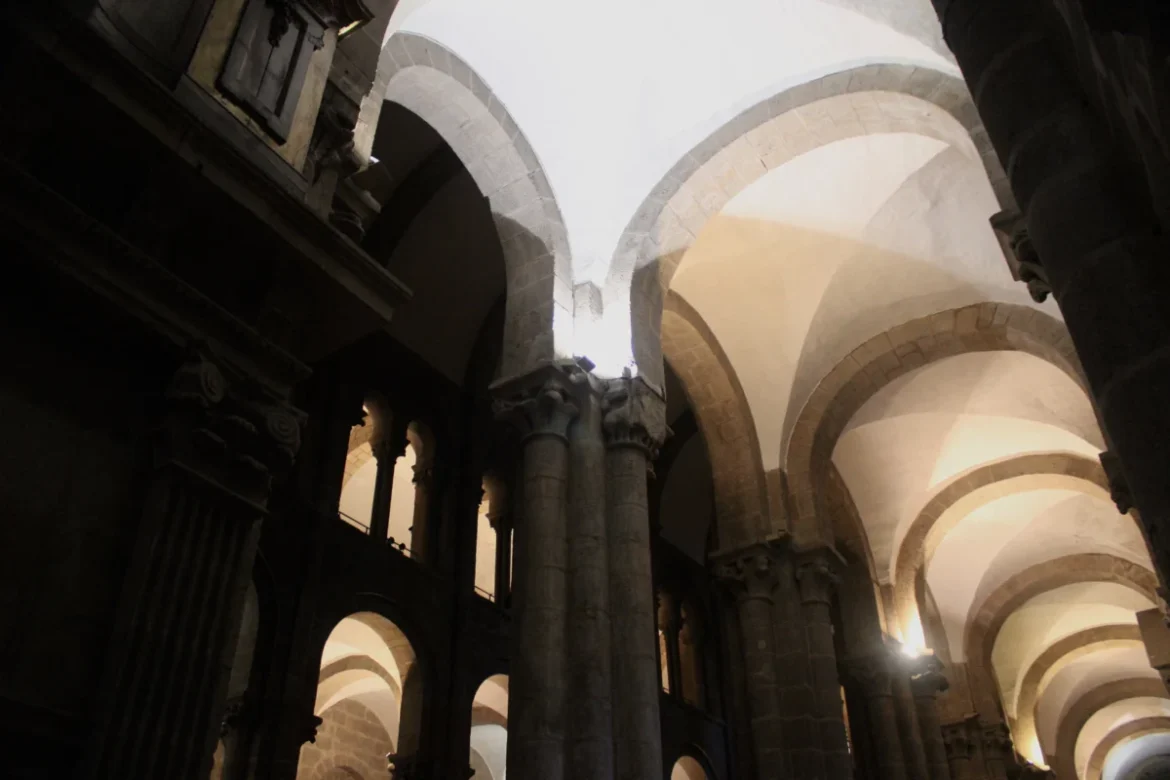
The great Romanesque cathedral began to be built around 1075, under the reign of Alfonso VI and in the times of Bishop Diego Peláez. Its plan responds to the needs of a pilgrimage church: wide naves, transept, ambulatory and spaces that allowed the faithful to circulate around the most sacred area. This arrangement still makes it easier today to understand the welcoming vocation that the building had from its origin.
In the 12th century, Bishop Diego Gelmírez gave Santiago a decisive ecclesiastical, cultural and political dimension. The temple continued to develop with the intervention of different workshops and teachers. His consecration took place in 1211, after a long construction enterprise that left one of the great Romanesque architectures of the Iberian Peninsula.
The historic city of Santiago de Compostela was incorporated into 1985 to the UNESCO World Heritage List. The recognition refers to an exceptional urban complex in which the Cathedral occupies a central place, accompanied by squares, convents, old hospitals and civil buildings that tell the story of the Camino.
The Obradoiro façade: the great baroque face of Compostela
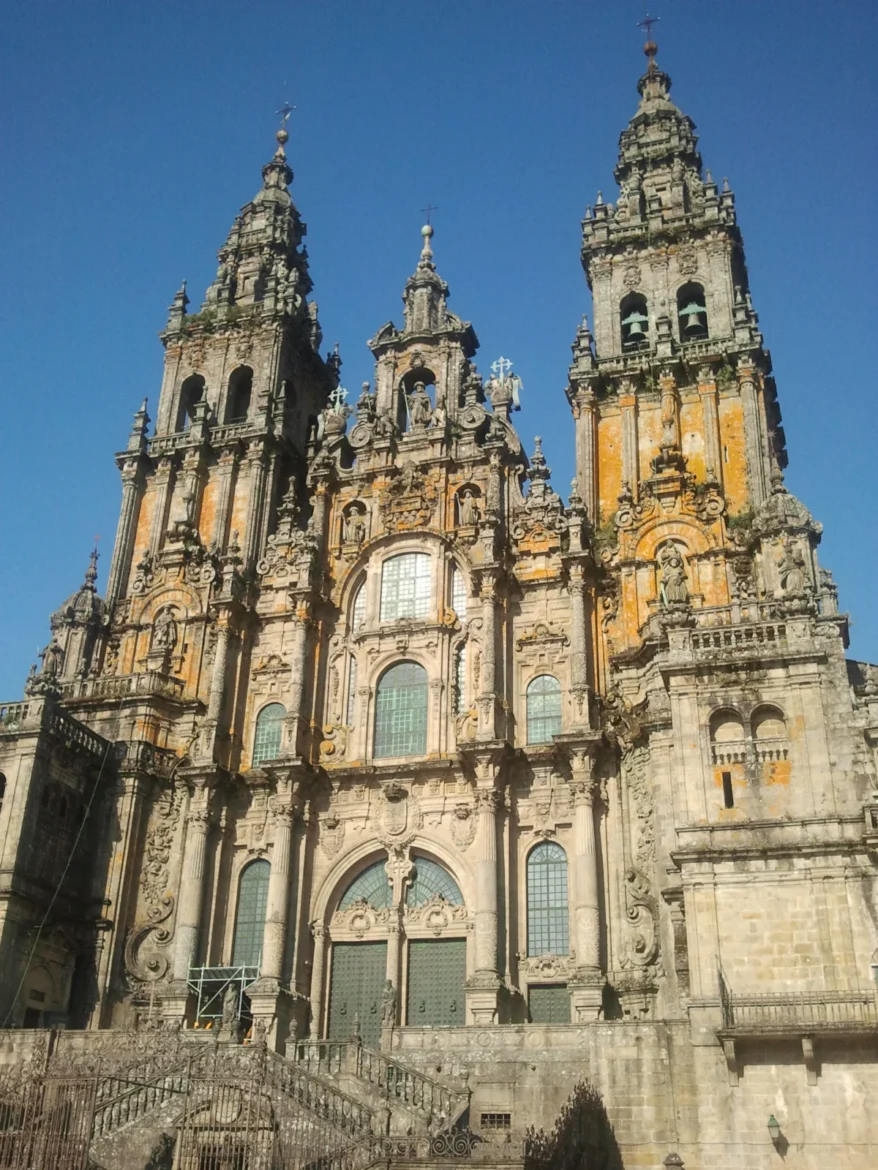
The view that greets the walker from the Plaza del Obradoiro is a monumental baroque façade, built centuries after the Romanesque core. Its two towers, the movement of the stone and the abundant sculptures make up an image that has become a universal symbol of the Camino.
The current façade was built mainly in the 18th century, with a decisive intervention by Fernando de Casas Novoa. One of its functions was to protect and monumentalize the old western entrance, while offering a setting appropriate to the growing importance of the sanctuary.
It is advisable to observe the façade slowly, from different points of the square. At the top the figure of the Apostle stands out. The towers and the grand staircase provide verticality; The windows allow the interior to be illuminated and the baroque composition contrasts with the solidity of the medieval temple that remains behind.
The Obradoiro is also a magnificent starting point to understand the historic center. In front of the Cathedral is the Raxoi palace; On one side, the old Hospital of the Catholic Monarchs, built to serve pilgrims and today converted into a hotel establishment. The facades of the square speak, together, of hospitality, civil power, worship and urban life.
The Portico of Glory, a work that can be contemplated without haste
Behind the baroque façade one of the fundamental creations of European sculpture is preserved: the Porch of Glory. In 1168, Master Mateo received the commission to complete the western works. The year 1188 It appears in the inscription on the lintels, one of the key testimonies to place the complex chronologically.
The portico develops a complex religious program inspired especially by the Apocalypse. His figures show an extraordinary wealth of gestures and expressions; The representation of elderly musicians, apostles and prophets invites us to look at each relief as part of a story. This sensitivity, even based on the Romanesque, announces new forms that would lead to the Gothic.
The work cannot be reduced to a cover. Mateo's project also included a crypt intended to bridge the uneven terrain and an old stone choir, parts of which are preserved. To learn more about this work you can consult our report on the virtual restoration of Master Mateo.
The Portico of Glory has its own visitation and conservation regime. Access may require a reservation, there are paid entry modalities and free appointments with limited places. The Cathedral reminds that it is not allowed to photograph or record it during the visit. It is advisable to consult the official conditions before traveling to the access point in Plaza del Obradoiro.
Inside the Cathedral: the naves, the altar and the embrace of the Apostle
The contrast between exterior and interior is one of the most interesting architectural experiences of the temple. Behind the baroque of the towers appear the large pillars, arches and vaults typical of Romanesque construction. The main nave visually leads towards the transept and the altar, and allows us to appreciate the dimensions of a church designed to welcome pilgrims from very diverse origins.
He high altar concentrates an essential part of the identity of the sanctuary. Above him stands a seated image of Santiago, linked to the traditional gesture of hugging the Apostle. In the crypt, under the altar, is the tomb venerated by the faithful, the ultimate reason for the medieval and contemporary pilgrimage.
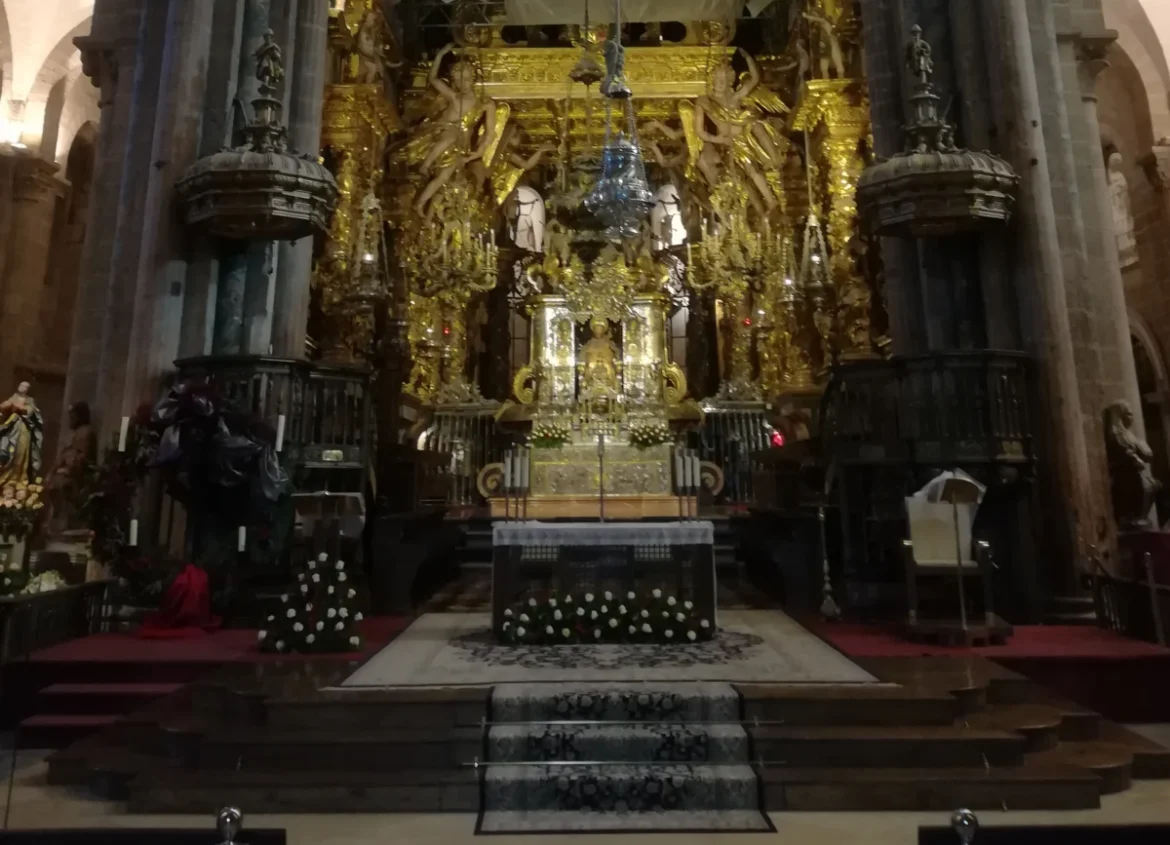
The decoration of the altar was transformed over the centuries and offers another lesson in the overlapping of styles. Wood, silver and gold dialogue here with the Romanesque granite structure. Not everything the visitor sees belongs to the same period: precisely that continuity is part of the artistic value of the building.
The Cathedral maintains intense religious activity. For this reason, tourist visits should not be confused with access to worship, and certain spaces may close during celebrations. In November 2026, the restoration works of the main altar They also affect the usual organization: the Cathedral itself temporarily announces several pilgrim masses in the church of San Agustín, while maintaining another celebration in the Communion chapel.
The Botafumeiro: a symbol that is not always in operation
Few objects in the Cathedral have the popularity of the Botafumeiro, the large incense burner suspended from the transept. Its movement, propelled by the tiraboleiros using a system of ropes, is part of specific liturgical celebrations and has given rise to some of the best-known images of the Compostela interior.
According to official information, the usual censer weighs about 53 kilos, measures approximately 1.50 meters and can reach very high speed when moving from one side of the cruise ship to the other. Beyond the spectacular nature, it has a liturgical meaning associated with the rise of prayers through the smoke of incense.
It is important not to promise the visitor that they will be able to see it work any day. Currently, the Cathedral warns that the Botafumeiro is temporarily out of service for restoration works. RTV has already explained this situation in our information on the Botafumeiro stop. Before organizing your visit, it is worth checking if the official notice has changed.
El Obradoiro, the place where the paths converge
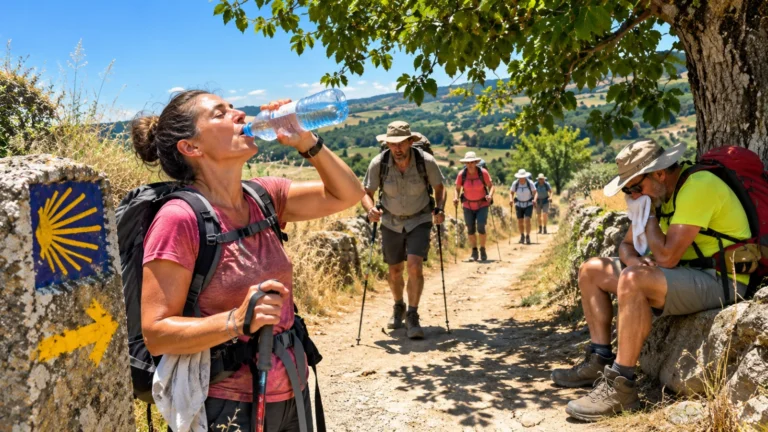
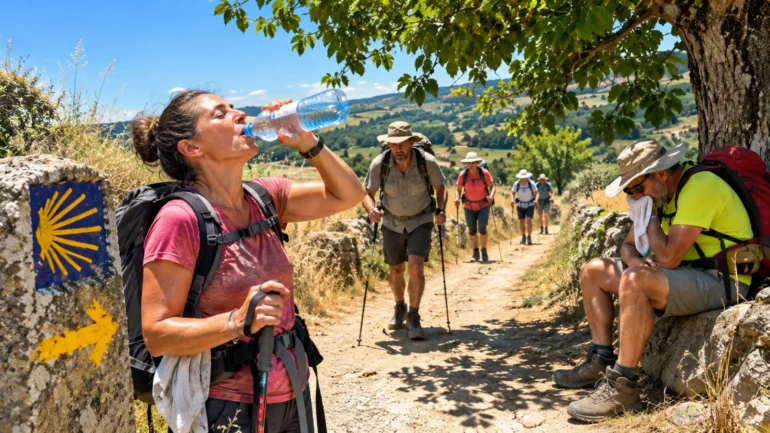
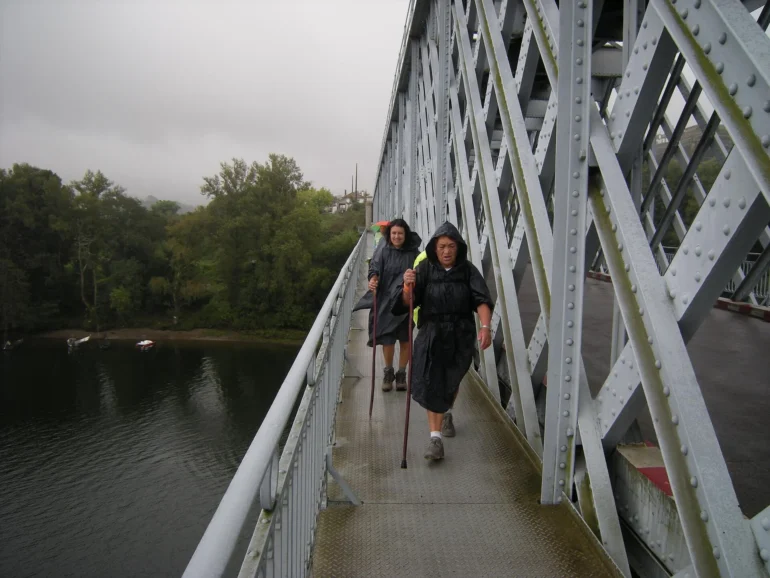
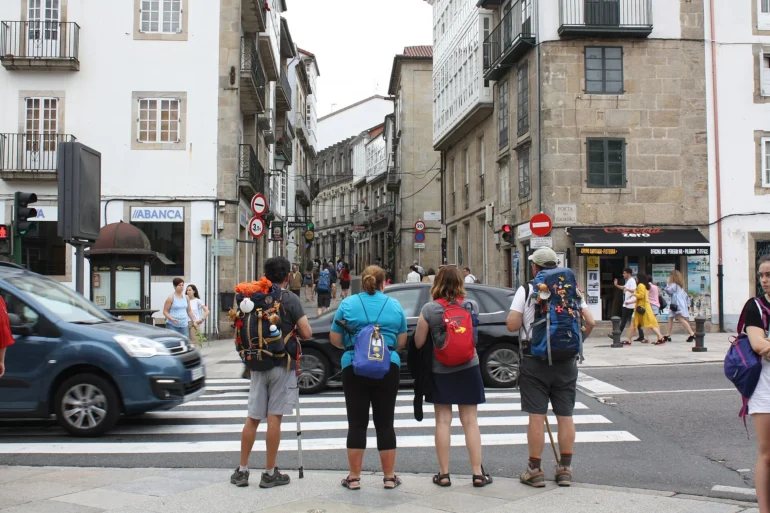
The image of the pilgrim in front of the façade belongs to the current history of Santiago as much as its sculptures or its medieval books. The square brings together daily those who complete the French Way, the Portuguese Way, the Northern Way, the Primitive Way, the English Way and other routes of the great Jacobean network. Their starting points are different, but the arrival at the sanctuary maintains a common reference.
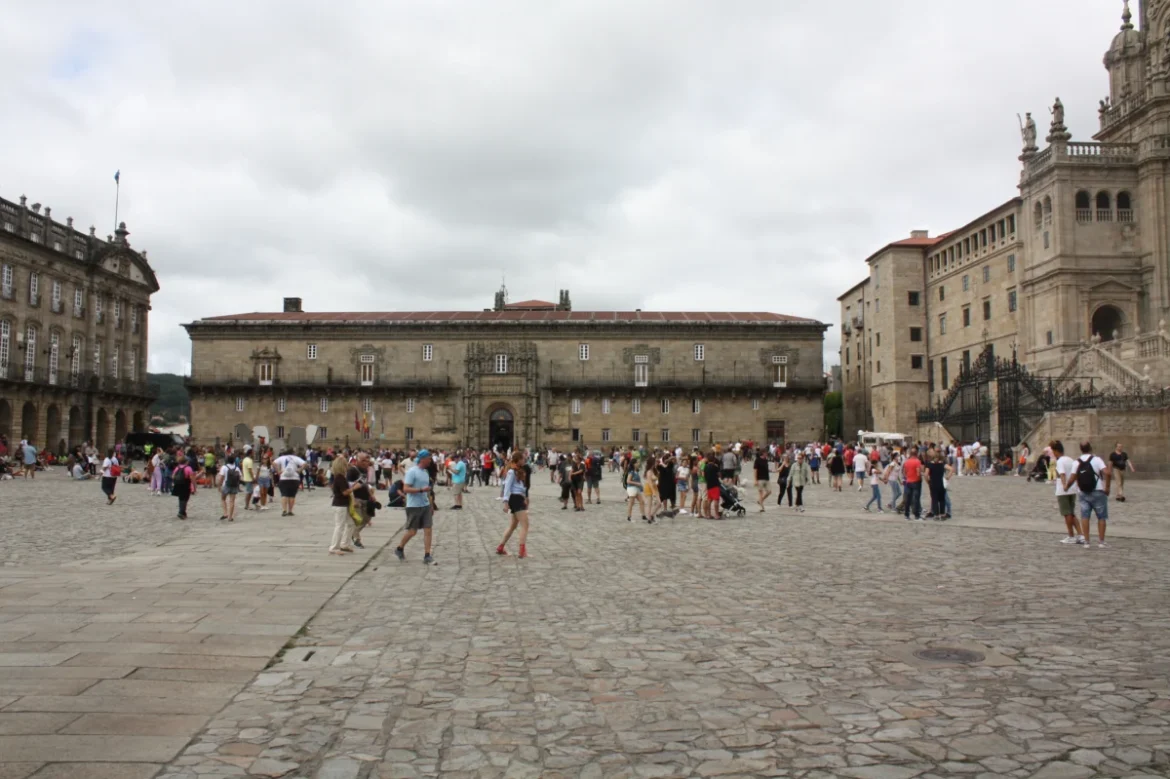
There are those who arrive first thing in the morning, others during the afternoon and some after a particularly long last stage. Many stay for a few minutes in front of the towers, take a photo or rest on the stone floor. It is not necessary to attribute the same emotion to everyone to understand that the Obradoiro is a unique space: there are walkers who perhaps would never have met anywhere else.
After arrival the city remains. It is advisable to walk through the Quintana, the Plaza de Platerías and the Azabachería to discover other facades and perspectives of the complex. The old hospital, arcaded streets and university buildings help explain how the influx of pilgrims transformed Santiago over the centuries.
It is also worth spending time at the Cathedral Museum, where pieces related to Maestro Mateo, the old stone choir and the history of the Compostela headquarters are preserved. The experience is more complete when contemplation of the temple is combined with these artistic and documentary testimonies.
How to visit the Cathedral of Santiago and prepare your arrival
According to the official schedules consulted, November 17, 2026, the ordinary entrance to the Cathedral and the tomb is free, with usual access through the Platerías door and general opening of 7:00 a 21:00. The temple does not accept backpacks for security reasons and may restrict visitors during liturgical celebrations.
The museum, the roofs, certain guided tours and the Portico of Glory have specific access methods and times, sometimes by reservation. For the Porch they also offer limited free shifts, which must be requested through official channels. Availability may change due to building conservation, ceremonies and worship needs.
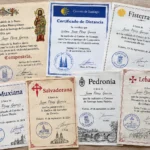
The Pilgrim Reception Office, where the Compostela is processed when its requirements are met, is located on Calle Carretas, 33. It is not the same as the Cathedral or the Museum ticket offices. If your goal is to obtain the certificate, it is advisable to organize this procedure separately and check the published schedules.
The next Compostela Holy Year 2027 will give special relevance to the city. The official liturgical program announces the solemn opening of the Holy Door on December 31, 2026. Anyone traveling on those dates must verify in advance access, masses and any modifications to visits.
For more practical information, consult the official sections of visits and schedules, celebrations and Botafumeiro y free Portico shifts. It is better to check them shortly before traveling than to assume saved schedules from previous seasons are valid.
The Cathedral of Santiago is the visible destination of a pilgrimage, but also a stone book: to understand its history you must read the Romanesque of its naves, the baroque of the Obradoiro and the work of Maestro Mateo with the same attention that is dedicated to the last section of the Camino.
Photo credits and licenses
Featured image and façade detail: Jrodriguezdm, facade y detail, CC BY-SA 3.0 EN.
Interior of the Cathedral: Miguel Hermoso Cuesta, original photograph, CC BY-SA 4.0. Main altar: Charles V of Habsburg, original photograph, CC BY-SA 4.0. Pilgrims in the Obradoiro: Lameiro, original photograph, CC BY-SA 4.0. Photographs resized to web format.
Sources: Santiago Cathedral, history and art; Porch of Glory; visits; liturgy and Botafumeiro; free visits to the Portico.